“But sometimes you just gotta suck it up. Push through, right? Even when you’re super scared.” — John Garrity
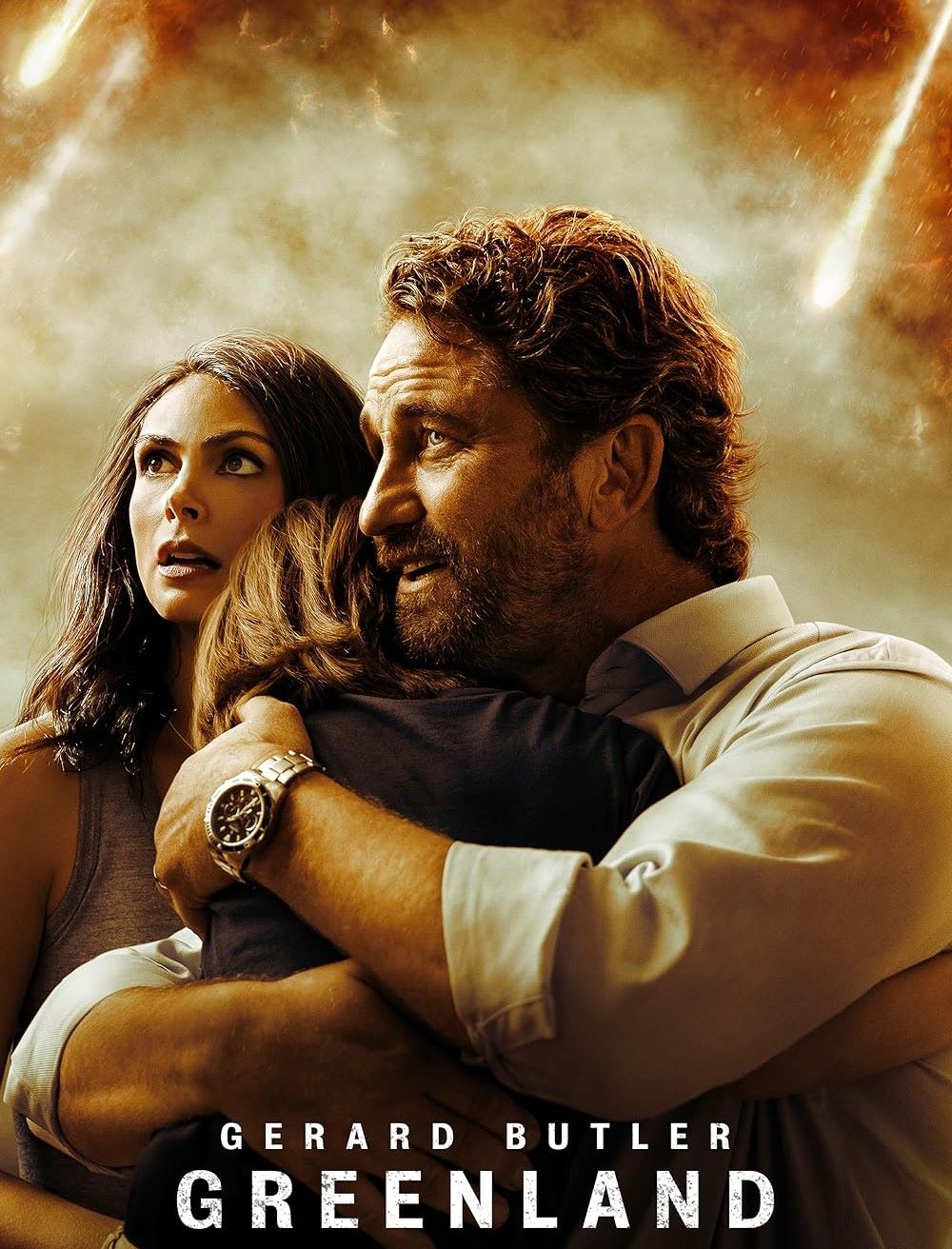
Greenland is one of those disaster movies that sneaks up on you a bit. It sells itself like another “stuff blows up while Gerard Butler scowls” kind of ride, but what’s actually on screen is a more grounded, road-trip survival story about a fractured family trying to stay together as the world quietly ends in the background. Originally slated for a wide theatrical release, the film dropped right as the COVID pandemic shutdown began in early 2020, forcing theaters to close and tanking its box office hopes before it even started. That quick pivot to video-on-demand and streaming services gave it a real second life though, letting it find an audience at home when everyone was hunkered down, doomscrolling real-world chaos that felt eerily similar to the on-screen panic. It’s not a genre reinvention, but it’s a solid entry that balances tense set pieces with surprisingly sincere family drama, even if it leans hard on contrivances and some uneven effects along the way.
The setup is simple: John Garrity (Gerard Butler), his estranged wife Allison (Morena Baccarin), and their young son Nathan are thrown into chaos when a supposedly “spectacle only” comet called Clarke turns out to be a civilization-ending event. The family receives a government alert selecting them for evacuation, which kicks off a desperate scramble through crowded bases, riots, and crumbling infrastructure as they try to get to a classified bunker system in Greenland before impact. The structure is very much “point A to point B with escalating obstacles,” and if you’ve seen any road-movie apocalypse story, you can probably predict the broad strokes: separation, dangerous strangers, moral compromises, last-minute reunions, and a hopeful-but-not-too-happy ending.
What makes Greenland stand out, at least compared to louder fare like Geostorm or the Emmerich filmography, is the way it shrinks the perspective down to the family level. The script keeps the camera glued to people on the ground instead of spending time with scientists in war rooms or presidents giving big speeches, so the apocalypse feels like a series of frightening news alerts and glimpses of distant fire instead of a nonstop CGI showreel. That choice works in the film’s favor; the tension comes less from “how big is the explosion?” and more from whether this specific kid gets his medication in time or whether this specific couple makes it through a checkpoint together.
Gerard Butler reins in his usual action-hero mode and plays John as a somewhat worn-down, very fallible guy who’s been messing up at home long before the comet showed up. He’s not the indestructible savior archetype; he panics, he makes mistakes, and he ends up in violent situations that feel ugly instead of triumphant, especially during a grim sequence on a truck full of evacuees where a man tries to take his wristband and everything spirals. Butler’s limited but believable emotional range works here, and you can see why some viewers singled this out as one of his better recent performances in a genre that usually just uses him as a gruff mascot.
Morena Baccarin gets a bit more to play than disaster-movie wives usually do, which is a pleasant surprise. Allison’s arc runs parallel to John’s for large chunks of the film as she navigates looters, manipulative would-be rescuers, and the absolute nightmare scenario of having her child kidnapped by a couple trying to pass him off as their own to gain access to evacuation flights. Baccarin sells the mix of desperation and competence; she’s constantly stuck in situations where the “right” moral call is murky, but the film never reduces her to someone who just waits around for John to fix things.
The emotional spine of the story rests on the family dynamic and the small, very human interactions they have with strangers along the way. You get scenes with compassionate people—like the FEMA workers who listen to Nathan when he insists he’s been kidnapped—that remind you the apocalypse doesn’t instantly turn everyone into a villain, even as the script also leans into the uglier side of survival instinct. That push and pull between kindness and cruelty keeps Greenland from feeling completely nihilistic, and it lines up with the recurring idea that the real threat is less the comet itself than what people are willing to do to outrun it.
On the disaster side of things, the film works with a mid-sized budget, and you can feel that restraint in both good and bad ways. When the CGI is kept at a distance—comet fragments streaking across the sky, distant impacts lighting the horizon, a sudden shockwave rolling through a neighborhood—it does a solid job of selling scope without drawing too much attention to its limitations. Up close, though, the seams show: some of the destruction shots and digital fireballs look cheap, which undercuts moments that are clearly meant to be awe-inspiring or terrifying, something multiple viewers have criticized as “not consistently convincing CGI effects.”
Pacing-wise, Greenland rarely slows down, which is both a strength and a drawback. The film opens with domestic tension and immediately starts ratcheting things up: news of impacts, sudden evacuation notices, airport chaos, violent confrontations, and constant travel. That forward momentum keeps the film from dragging, but it also leads to what some viewers see as “too many plot twists and always new obstacles to overcome,” a sense that the script keeps piling on one more crisis just to keep the adrenaline high.
Because the film tries to have it both ways—grounded survival and genre thrills—it occasionally betrays its own realism. The amount of coincidence needed to reunite characters after brutal separations, or to get the family to exactly the right airfield and exactly the right plane, feels contrived even by disaster-movie standards. By the time the story reaches its final act in Greenland, complete with last-minute sprinting toward bunkers while the worst of the comet hits, you can feel it edging closer to the “unfortunately genre-typical heroic towards the end” vibe that some reviewers pointed out.
Where Greenland does feel a bit different from many peers is in tone. It’s not quippy, it’s not self-aware, and it does not pause for big “cool” shots of landmarks getting obliterated just for spectacle. The destruction is mostly glimpsed from the vantage point of regular people, via news broadcasts or distant views, which makes the apocalypse feel weirdly more intimate and plausible, like something you’d doomscroll rather than watch unfold from a helicopter. That seriousness is refreshing if you’re tired of disaster movies that treat mass death as a theme park ride, but it also means the film can come off as dour if you were hoping for more escapist fun.
Reception-wise, Greenland landed in that “better than expected, still not amazing” territory with both critics and audiences. Some viewers praised it as “one of the best disaster movies” of recent years specifically because it prioritizes human drama over “weightless CG spectacle,” calling out how tense and emotionally engaging the smaller-scale approach feels. Others shrugged it off as “usual disaster film fare,” pointing to its predictable structure, familiar character beats, and lack of a truly clever story, saying it’s fine for passing time but not particularly memorable. Its streaming surge during lockdowns only amplified word-of-mouth, turning what could’ve been a forgotten theatrical casualty into a go-to comfort scare for pandemic viewers craving controlled chaos.
Ultimately, Greenland sits in a comfortable middle lane. It’s not trying to reinvent the genre, and it doesn’t fully escape its clichés, but it does care more about its characters than its body count, and that goes a long way. If you go in expecting a grounded, on-the-road family survival story with occasional bursts of large-scale chaos, the film mostly delivers, bolstered by committed performances from Butler and Baccarin and a tone that takes the end of the world just seriously enough. If you’re looking for jaw-dropping effects or a genuinely surprising narrative, it will probably feel like a solid, slightly grim, one-and-done watch that does its job and quietly exits before wearing out its welcome—especially resonant for those who caught it streaming while the real world felt a little too apocalyptic itself.



 Through the Shattered Lens