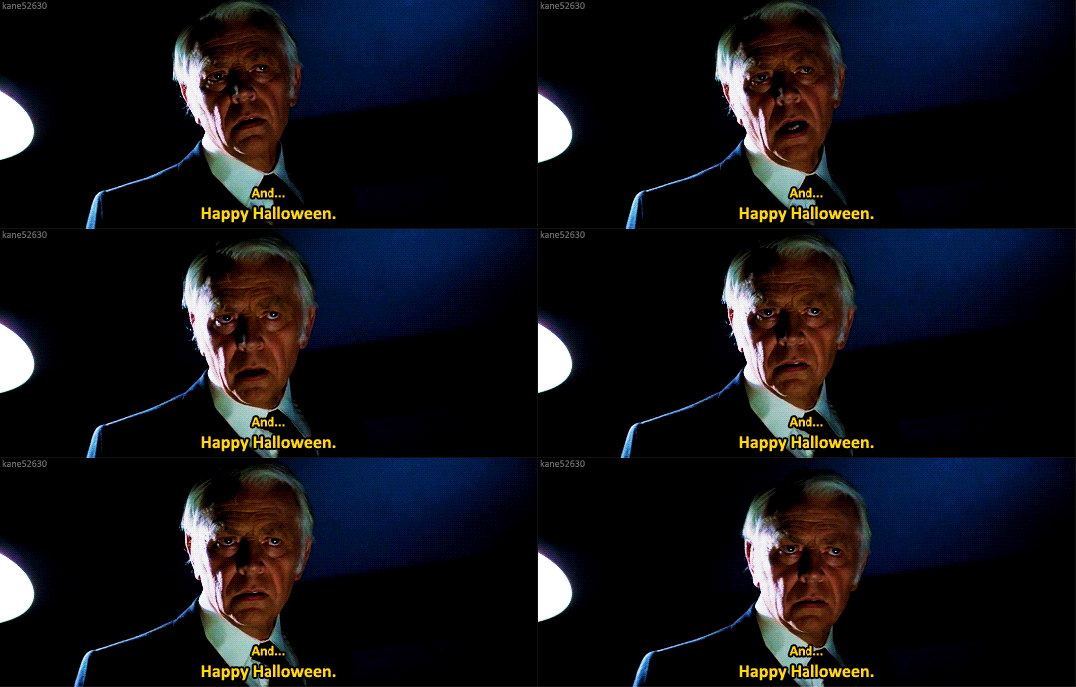
In this scene, Conal Cochran (Dan O’Herlihy) explains not only the origins of Halloween but he also discusses how he’s going to make Halloween great again. This scene is probably the best in the film and it’s almost entirely due to O’Herlihy’s wonderfully menacing performance as Conal Cochran.
The 1977 made-for-TV movie GoodAgainstEvil opens with a woman giving birth in a hospital. Her baby daughter is forcefully taken from her and given to her father, the sinister Mr. Rimmin (Richard Lynch).
Two decades later, Jessica Gordon (Elyssa Davalos) has grown up and is working at a boutique in San Francisco. When her car is rear-ended by a free-spirited, van-driven single guy named Andy Stuart (Dack Rambo), it’s love at first sight. Jessica and Andy are so caught up in their whirlwind romance that they don’t even notice that there’s a schlubby guy following them everywhere that they go and that strangers are giving them dirty looks. Someone does not want Jessica and Andy to end up together.
How could anyone object to two young people falling in love, you may ask. Well, it turns out that Jessica is meant to be a bride of Satan and the plan is for her to eventually give birth to the Antichrist. Everyone in Jessica’s life works for Mr. Rimmin …. or, at least, everyone but Andy. Andy suddenly showing up and falling in love with Jessica throws a big old monkey wrench into Rimmin’s carefully crafted scheme. Mr. Rimmin reacts by sending an army of adorable cats to harass Andy.
This might sound like it has the makings for a good made-for-TV horror film and, in fairness to Good AgainstEvil, the first 50 minutes or so are pretty well-done. The movie does a good job of building up and maintaining an atmosphere of paranoia and I enjoyed watching all of the people attempting to discreetly keep an eye on Andy and Jessica whenever they went out. When Mr. Rimmin finally abducted Jessica and took her back to his mansion, I was prepared to see Andy risk his life to rescue her….
That didn’t happen, though. Instead, Andy got involved with the case of a little girl who was possessed. (Again, in all fairness, he got involved because he read a news story about the girl drawing a pentagram while in a coma and he assumed that meant she was a victim of the same cult that abducted Jessica.) Andy meets the girl’s mother (played by Kim Cattrall) and then helps an exorcist (Dan O’Herlihy) perform an exorcism. The movie ends with Jessica, still in the clutches of Mr. Rimmin.
GoodAgainstEvil was apparently a pilot for a television series that wasn’t picked up. I assume the plan was that Andy would have a weekly supernatural adventure while trying to recuse Jessica from Mr. Rimmin. The idea had some potential. As always, Richard Lynch is a wonderfully sinister villain. But the pilot shoots itself in the foot by getting distracted with the whole exorcism storyline. It’s wonderful to see the great Dan O’Herlihy as a priest but the exorcism storyline really does come out of nowhere and the exorcism scene itself so blatantly copies TheExorcist that they really should have given William Peter Blatty an onscreen credit. Sadly, because this was a pilot, the movie ends with the main storyline unresolved. The joke is on us for caring about two people in love.
GoodAgainstEvil is one of those films that can be found in a dozen Mill Creek box sets. Ultimately, it’s as forgettable as its generic name.
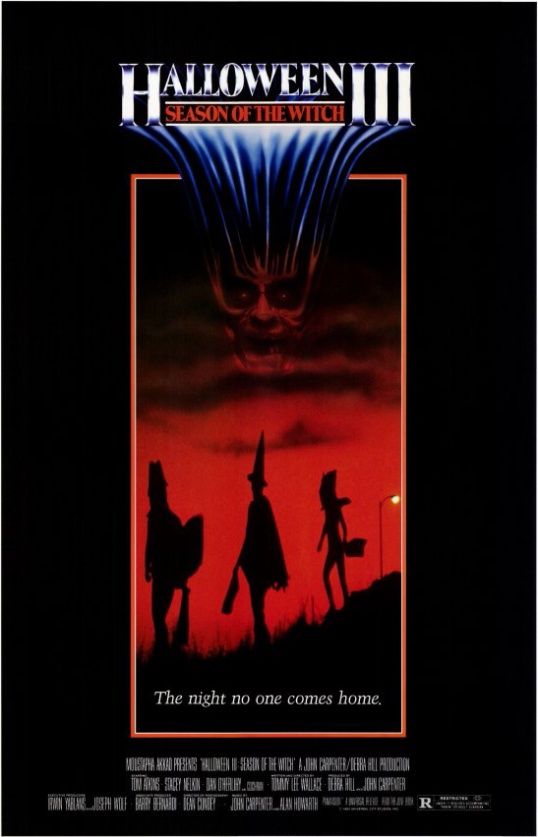
Tonight’s horror scene that I love is from the 1982 film, Halloween III: Season of the Witch, a film that has finally started to be recognized for being the horror classic that it is.
In this scene, Conal Cochran (Dan O’Herlihy) explains not only the origins of Halloween but he also discusses how he’s going to make Halloween great again. This scene is probably the best in the film and it’s almost entirely due to O’Herlihy’s wonderfully menacing performance as Conal Cochran.
105 years ago, on this date, the great character actor Dan O’Herlihy was born in Wexford, Wexford County, Ireland.
O’Herlihy would have a long career as an actor, making his feature debut in 1947’s Odd Man Out and working steadily in film and television for the next 50 years. For modern viewers, he is perhaps best remembered for his role as The Old Man in the first two Robocop films and his performance as the sinister trickster, Conal Cochran, in 1982’s Halloween III: Season of the Witch.
Today’s scene that I love from from the latter film. O’Herlihy explains the mean of Halloween to a trapped Tom Atkins. O’Herlihy truly turned Conal Cochran into one of the great horror villains of the 80s and his performance is one of the main reasons that the rather oddball Halloween III retains a loyal audience to this day.
Robocop 2, the 1990 sequel to Robocop, finds Detroit on the verge of getting nuked.
No, not nuked like that! Instead, there’s a new designer drug called Nuke and it’s tearing the city apart. Of course, Detroit has problems that go beyond just the new drug. The city is almost bankrupt. OCP, under the leadership of The Old Man (Dan O’Herlihy), is still running things behind the scenes. There’s still all sorts of petty crime to deal with. To be honest, it seems like the city has gotten even more out-of-control now that Clarence Boddiker is no longer around to oversee things.
Fortunately, Robocop (Peter Weller) is still patrolling the streets! But, for how long? There are lawyers who claim that Robocop is a huge potential liability and when you consider some of the stuff that went on during the first film, it’s hard not to see their point. His ex-wife is also suing the police department, claiming that Robocop has been harassing her. Despite being a robocop, our hero is still Murphy and he’s still haunted by memories of the family he once had. Or, at least, he is for the first few minutes of the film. That storyline kind of gets abandoned, along with a lot of other storylines.
While OCP is trying to develop a second robocop, one that can be mass produced and used to replace the human police force (the majority of whom have gone out on strike), a cult leader named Cain (Tom Noonan) is attempting to take over the city’s Nuke trade. Working with Cain is the usual gang of flamboyant malcontents. His second-in-command is a sociopathic child named Hob (Gabriel Damon). Hob may be a kid but he’ll kill anyone and he’ll enjoy himself while he’s doing it.
Robocop 2 is a bit of a mess. It apparently was rushed into production after the surprise success of the first film and filming started before there was even a completed script. As a result, there are a lot of storylines and themes that are brought up and then seem to mysteriously disappear. The film duplicates Paul Verhoeven’s satirical approach to the first film’s ultra-violence but, unfortunately, it does so in the most superficial way possible. Once again, we get the cheerful and vapid news reports about impending doom and once again, the violence is completely and totally over-the-top. But none of it carries any of the bite that was present in the first film. The first film worked because director Verhoeven actually was trying to make a larger point with all of the violence and the hints of growing fascism. He was attempting to challenge the audience and to get them wonder why they found all of the terrible thing happening in Robocop to be so entertaining. The sequel was directed by Hollywood veteran Irvin Kershner who was a good, workmanlike director but who also didn’t possess Verhoeven’s subversive sensibility. Far too often, Robocop 2 just feels like it’s going through the motions.
That’s not say that Robocop 2 isn’t occasionally an effective film. Dan O’Herlihy is wonderfully amoral as the Old Man and Tom Noonan is a worthwhile villain. Though Peter Weller has said that he wasn’t happy with how the overall film turned out, he still make for a sympathetic hero and he still manages to capture Robocop’s anguish without letting us forget that the character is still essentially a machine. I’m not really a big fan of films that use evil children for cheap shocks but Gabriel Damon is frequently chilling as Hob. Detroit is such a terrible place in the Robocop films that it’s not really a surprise when an evil child pops up and start shooting people. When compared to the first film, Robocop 2 may be a disappointment but it’s hardly a disaster.
Last week, I watched the original Robocop (along with Robocop 2 and Robocop 3) and I have to say that the first film holds up far better than I was expecting. Made and released way back in 1987, Robocop may be one of the most prophetic films ever made.
Consider the plot:
America is torn apart by crime and a growing gap between the rich and the poor. That was probably true in 1987 and it’s certainly true in 2021.
Throughout the film, we see news reports about what’s happening in the world. The news is always grim but the reporters are always cheerful and the main message is that, no matter what’s happening, the government is not to blame and anyone who questions the wisdom of the establishment is a fool. If that’s not a perfect description of cable news and our current state-run media, I don’t know what is.
The populace is often too busy watching stupid game shows to really pay attention to what’s happening all around them. I’m writing these words on a Wednesday, which means that Game of Talents will be on Fox tonight, immediately after The Masked Singer.
Detroit, a once proud center of industry, has now turned into a dystopian Hellhole where no one feels that they’re safe. Now, I don’t live in Detroit so I don’t know how true that is but I do know that most of the recent news that I’ve heard about the city has not exactly been positive. Also, this seems like a good time to point out that, even though the film is set in Detroit, it was shot in Dallas. Though the Dallas skyline has undoubtedly changed a bit since 1987, I still recognized several buildings while watching Robocop. Seeing Reunion Tower in the background of a movie that’s supposed to be set in Detroit was interesting, though perhaps not as interesting as seeing our City Hall transformed into the headquarters of Detroit’s beleaguered police force.
OCP, a multi-national conglomerate that’s run by the amoral but occasionally charming Old Man (played by the brilliant Dan O’Herlihy), has a contract with city of Detroit to run their police department. This certainly doesn’t seem far-fetched in 2021. Considering that we now have prisons that are run by private companies and that the government has shown a willingness to work with private mercenaries overseas, it’s not a stretch to imagine a city — especially one on the verge of bankruptcy — handing over the police department to a private company.
Two OCP executives — Dick Jones (Ronny Cox) and Bob Morton (Miguel Ferrer) — are competing to see who can be the first to create and develop a peace-keeping robot, a machine that will replace the need to employ (and pay) human police officers. Dick Jones goes with an actual robot, which malfunctions during a boardroom demonstration and guns down another executive. (The scene where the poor exec is targeted is both terrifying and darkly humorous at the same time. Particularly disturbing is how everyone in the boardroom keeps shoving him back towards the robot in order to ensure that they won’t accidentally be in the line of fire.) Bob Morton, however, takes a mortally wounded cop named Murphy (Peter Weller) and turns him into Robocop!
Robocop turns out to be a huge success and is very popular with the media. (Anyone who doubts this would really happen has obviously never watched news coverage of a drone attack.) As you can guess, Dick is not particularly happy about getting shown up by Morton and his robocop. Dick also happens to be secretly in league with Clarence Boddicker (Kurtwood Smith), the crimelord who blew Murphy apart in the first place.
(A gangster and a businessman working together!? I doubt that was shocking even in 1987.)
Robocop claims that he’s just a machine, without a past or emotions, but he’s still haunted by random flashes of his life as Murphy. Working with Lewis (Nancy Allen), Murphy’s former partner, Robocop tracks down Boddicker and his gang. A lot of people die in outrageously violent ways. (The scene where Boddicker and his gang use a shotgun to torture Murphy is still shocking, even after all these years.) The violence is so over-the-top that it soon becomes obvious that director Paul Verhoeven is deliberately trying to get those of us watching to ask ourselves why we find films like this to be so entertaining. On the one hand, Robocop is an exciting action film with a sense of humor. On the other hand, it’s the type of subversive satire of pop and trash culture to which Verhoeven would return with Basic Instinct, Starship Troopers, and Showgirls. This is the type of film that asks the audience, “What are you doing here?”
34 years after it was first made, Robocop remains a triumph. Peter Weller’s performance holds up well, as he does a great job of capturing Robocop’s anguish while, at the same time, never forgetting that the character is ultimately a machine, one that’s trapped in a sort of permanent limbo. I also really liked the performance of Miguel Ferrer, who takes a character who should be unlikable and instead makes him into a surprisingly sympathetic figure.
Of course, a film like this lives and dies on the strength of its villains and both Ronny Cox and Kurtwood Smith are ideally cast as Dick Jones and Clarence Boddicker. Kurtwood Smith especially took me by surprise by how believably evil and frightening he was. As a I watched the film, I realized that it was his glasses that made him so intimidating. Wearing his glasses, he looked like some sort of rogue poet, a sociopathic intellectual who had chosen to use his talents to specifically make the world into a terrible place. Boddicker’s crew was full of familiar actors like Paul McCrane, Ray Wise, and, as the always laughing Joe Cox, Jesse Goins. Interestingly enough, all of the bad guys seemed to genuinely be friends. Even though they were all willing to betray each other (“Can you fly Bobby?”), they also seemed to really enjoy each other’s company. That somehow made them even more disturbing than a group of bad guys who were only in it for the money. The villains in Robocop really do seem to savor the chance to show off just how evil they can be.
(Incidentally, for all of the Twin Peaks fans out there, this film features three members of the show’s ensemble: Miguel Ferrer, Ray Wise, and Dan O’Herlihy.)
Robocop holds up well as entertainment, prophecy, and satire. Though not much was expected from it when it was first released, it became a surprise hit at the box office. Needless to say, this led to a sequel. I’ll deal with that film in about an hour.
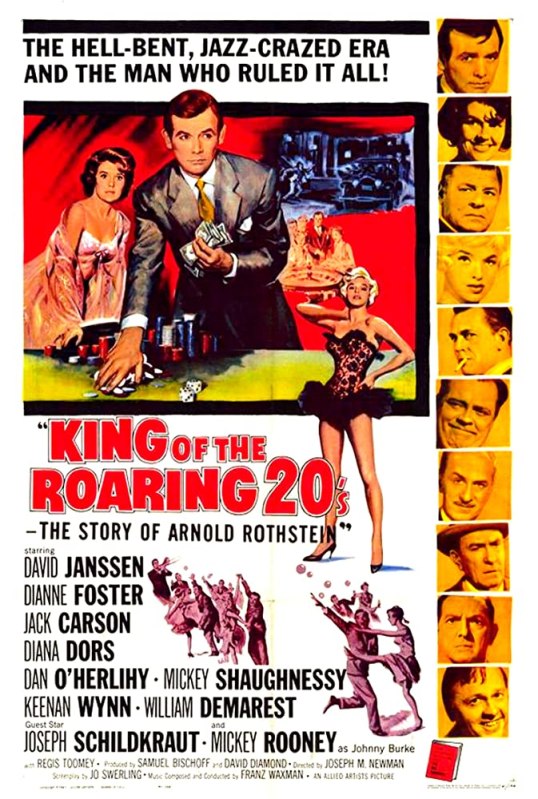
The 1961 gangster biopic, King of the Roaring ’20s: The Story of Arnold Rothstein, tells the story of two men.
David Janssen is Arnold Rothstein, the gambler-turned-millionaire crime lord who, in the early years of the 20th Century, was one of the dominant figures in American organized crime. Though he may be best-remembered for his alleged role in fixing the 1918 World Series, Rothstein also served as a mentor to men like Lucky Luciano, Meyer Lansky, and Bugsy Siegel. Rothstein was perhaps the first gangster to to treat crime like a business.
Mickey Rooney is Johnny Burke, Arnold’s best friend from childhood who grows up to be a low-level hood and notoriously unsuccessful gambler. Whereas Arnold is intelligent, cunning, and always calm, Johnny always seems to be a desperate. Whereas Arnold’s success is due to his ability to keep a secret, Johnny simply can’t stop talking.
Together …. THEY SOLVE CRIMES!
No, actually, they don’t. They both commit crimes, sometimes together and sometimes apart. Perhaps not surprisingly, Arnold turns out to be a better criminal than Johnny. In fact, Johnny is always in over his head. He often has to go to his friend Arnold and beg him for his help. Johnny does this even though Arnold continually tells him, “I only care about myself and money.”
The friendship between Arnold and Johnny is at the heart of King of the Roaring 20s, though it’s not much of a heart since every conversation they have begins with Johnny begging Arnold for help and ends with Arnold declaring that he only cares about money. At a certain point, it’s hard not to feel that Johnny is bringing a lot of this trouble on himself by consistently seeking help from someone who brags about not helping anyone. From the minute that the film begins, Arnold Rothstein’s mantra is that he only cares about money, gambling, and winning a poker game with a royal flush. Everything else — from his friendship to Johnny to his marriage to former showgirl Carolyn Green (Dianne Foster) to even his violent rivalry with crooked cop Phil Butler (Dan O’Herlihy) — comes second to his own greed. The film’s portrayal of Rothstein as being a single-minded and heartless sociopath may be a convincing portrait of the type of mindset necessary to be a successful crime lord but it hardly makes for a compelling protagonist.
Oddly enough, the film leaves out a lot of the things that the real-life Arnold Rothstein was best known for. There’s no real mention of Rothstein fixing the World Series. His mentorship to Luciano, Lansky, and Seigel is not depicted. The fact that Rothstein was reportedly the first gangster to realize how much money could be made off of bootlegging goes unacknowledged. By most reports, Arnold Rothstein was a flamboyant figure. (Meyer Wolfsheim, the uncouth gangster from The Great Gatsby, was reportedly based on him.) There’s nothing flamboyant about David Janssen’s performance in this film. He plays Rothstein as being a tightly-wound and rather unemotional businessman. It’s not a bad performance as much as it just doesn’t feel right for a character who, according to the film’s title, was the King of the Roaring 20s.
That said, there are still enough pleasures to be found in this film to make it worth watching. As if to make up for Janssen’s subdued performance, everyone else in the cast attacks the scenery with gusto. Mickey Rooney does a good job acting desperate and Dan O’Herlihy is effectively villainous as the crooked cop. Jack Carson has a few good scenes as a corrupt political fixer and Dianne Foster does the best that she can with the somewhat thankless role of Rothstein’s wife. The film moves quickly and, even if it’s not as violent as the typical gangster film, it does make a relevant point about how organized crime became a big business.
It’s not a great gangster film by any stretch of the imagination and the lead role is miscast but there’s still enough about this film that works to make it worth a watch for gangster movie fans.
In this scene, Conal Cochran (Dan O’Herlihy) explains not only the origins of Halloween but he also discusses how he’s going to make Halloween great again. This scene is probably the best in the film and it’s almost entirely due to O’Herlihy’s wonderfully menacing performance as Conal Cochran.
A bunch of strangers sit in a bar. On the television, a blandly handsome anchorman delivers the news. He talks about foreign wars. He talks about domestic conflicts. One of the bar patrons asks the bartender to turn off the news. Who cares about all of that stuff? All he wants to do is have a nice drink before heading home to his cattle ranch. Can’t he just do that in peace? The bartender agrees and turns off the news…
That’s a scene that gets played out a lot nowadays. No one wants to watch the news. Certainly not me. I guess we all know that we should because it’s important to know what’s going on in the world and blah blah blah. But seriously, people who spend all of their time watching the news inevitably seem to end up going insane and ruining twitter. I’ve got no interest in doing that.
Here’s the thing, though. Invasion U.S.A. may open with a contemporary scene but it’s hardly a contemporary movie. Instead, it was made in 1952 and it serves as proof that we’re not the first Americans to get sick of watching the news and that our current crop of politically minded filmmakers are not the first to try to change our mind with heavy-handed propaganda.
Everyone at the bar has a complaint. The Arizona rancher resents having to pay high taxes just to support the defense department. The Chicago industrialist is upset that the government wants to use his factories to build weapons. Congressman Haroway (Wade Crosby) is a drunk. Socialite Carla Sanford (Peggie Castle) worked in a factory during World War II but she no longer follows the news. Newscaster Vince Potter (Gerald Mohr) is a cynic. Tim the Bartender (Tom Kennedy) is too busy selling cocktails to worry about the communists.
Only the mysterious Mr. Ohman (Dan O’Herlihy, who would later play Conal Cochran in Halloween III) seems to care. While holding a conspicuously oversized brandy glass, Mr. Ohman explains that he’s a forecaster. What’s a forecaster? A forecaster is … oh wait! There’s no time to explain it because the communists have invaded!
Everyone sits in the bar and watches as the news reports on the invasion of the U.S.A. (Everyone except for Mr. Ohman, who has mysteriously vanished.) In the tradition of all low-budget B-movies, the invasion is represented through stock footage. Lots and lots of stock footage. Planes drop bombs. Soldiers run out of a barracks. Cities burn.
When everyone leaves the bar, they discover that America has been crippled by people like them, people who never thought it would happen. Some of our bar patrons die heroically. (Not Tim the Bartender, though. He’s still making dumb jokes and cleaning beer mugs when the bomb drops.) Some of our patrons regret that they didn’t care enough when it would have actually made a difference. The industrialist discovers that, because he wouldn’t let the government take over his factory, he now has to take orders from sniveling little Marxist. The rancher discovers that taxis get really crowded when everyone’s fleeing the Russians. And others discover that better dead than red isn’t just a catch phrase. It’s a way of life.
Of course, there’s a twist ending. You’ll guess it as soon as you see Mr. Ohman with that brandy glass…
Invasion U.S.A. is often cited as one of the worst films ever made but I have to admit that I absolutely love it. I have a soft spot for heavy-handed, over the top propaganda films and they don’t get more heavy-handed than Invasion, U.S.A. There’s not a subtle moment to be found in the entire film. You have to love any film that features character authoritatively declaring that something will never happen mere moments before it happens. Best of all, you’ve got Dan O’Herlihy, playing Mr. Ohman with just a hint of a knowing smile, as if he’s as amused as we are.
Politically, this film is a mixed bag for me. The film argues that you should trust the government and basically, shut up and follow orders. I’m a libertarian so, as you can imagine, that’s not really my thing. At the same time, the villains were all communists and most of the communists that I’ve met in my life have been pretty obnoxious so I enjoyed the part of the film that advocated blowing them up. The only thing this film hates more than communists is indifference.
In the end, Invasion U.S.A. is a real time capsule of a film, one that shows how different things were in the past while also reminding us that times haven’t changed that much. Though the film’s politics may be pure 1952, its paranoia and its condemnation of apathy feels very contemporary.
(For the record, apathy is underrated.)
Seen today, what makes Invasion U.S.A. memorable is its mix of sincerity, paranoia, and Dan O’Herlihy. Unless the communists at YouTube take down the video, you can watch it below!





 Through the Shattered Lens