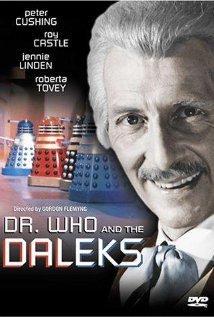
 When the long-running British science fiction show Doctor Who premiered over 50 years ago, it was originally envisioned as being a serialized educational program for children. Each serial would see The Doctor (William Hartnell), his granddaughter Susan (Carole Ann Ford), and teachers Ian (William Russell) and Barbara (Jacqueline Hill) traveling via TARDIS to a different historical period and interacting with real-life figure like Marco Polo and the Emperor Nero. The first serial, An Unearthly Child, featured the Doctor and his companions going back to prehistoric times and teaching cavemen how to make fire.
However, the show’s second serial forever changed the direction of the series. Written by Terry Nation, The Daleks introduced viewers to a race of militaristic aliens who, because they had nearly destroyed their planet in a nuclear war, could only exist inside of a tank-like shell. Devoid of all emotion except for hate, the Daleks were best known for their shrill battle cry of “EXTERMINATE!” Despite being defeated and apparently destroyed at the end of the serial, The Daleks returned to face the Doctor many times and the show itself shifted its focus away from teaching history lessons and instead became the show that we all know and love today.
 At its height, the popularity of the Daleks rivaled that of the Doctor and his companions. In 1965, when Amicus Productions produced the first Doctor Who feature film, it was a no-brainer that it would feature the Daleks. With a few key changes (mostly to the character of the Doctor and his companions), Dr. Who and the Daleks recreates the plot of Terry Nation’s original serial. The Doctor (played by Peter Cushing), his granddaughters, Barbara (Jennie Linden) and Susan (Robert Tovey), and Barbara’s boyfriend Ian (Roy Castle) go to the planet Skaro, where they help the peace-loving Thals battle the war-obsessed Daleks.
Beyond selling the rights to the story, the BBC had nothing to do with the film’s production. Amicus obviously geared the film towards children, perhaps not understanding that, though Doctor Who may have started out as a kid’s show, the program itself had become much more adult as it grew in popularity. Hoping to make a film that could appeal to a wider (read: American) audience than the original TV show, Amicus changed a few key details. As a result, for fans of the original show, Dr. Who and the Daleks is a true oddity. It provides an alternative vision of what Doctor Who could have been.
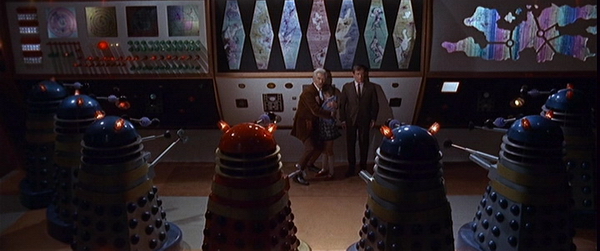
One change that did work is that, at a time when Doctor Who was still being broadcast in black-and-white, Dr. Who and the Daleks was in color. Visually, the film has a pop art feel, full of primary color and featuring locations that feel like low-budget version of the villainous lairs that Ken Adam used to design for the James Bond films. This was the first time that the Daleks had been seen in Technicolor and the show even appropriated the film’s Dalek color-scheme when color episodes started to air in 1970.
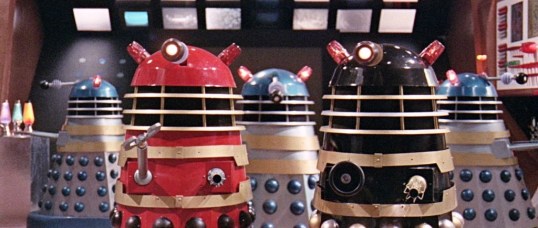
Other changes do not work quite as well. The Daleks’ famous “EXTERMINATE” battle cry is never heard. The show’s beloved theme music has been replaced with an uninspired score from veteran Amicus composer Malcolm Lockyer. While the TARDIS still looks like a blue police box and is bigger on the inside than the outside, the sleek control console and the familiar grinding noise are both gone. Instead, the inside of the TARDIS is a cluttered mess of loose wires and flashing lights. The Doctor now has two granddaughters and, undoubtedly in order to appeal to children, Susan is much younger than she was in the television series. As well, in the television series, Ian was a science teacher who had no fear of standing up to The Doctor. The film’s Ian is clumsy and used mostly for broad comic relief.
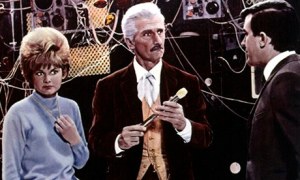 The biggest change is to the character of the Doctor himself. For fans of the series, there is no bigger pet peeve than when unfamiliar critics refer to the main character as being “Dr. Who.” True fans know that the show’s title is a question and not a statement. No one knows the Doctor’s true name or his exact age. What they do know is that Doctor is a Time Lord from Gallifrey and that he stole his TARDIS. Whenever the Doctor’s body suffers too much damage, he regenerates into a new body (and a different actor).
Of course, in 1965, the Time Lords had yet to be officially introduced. The name “Gallifrey” had never been uttered on the television show. The Time Meddler, which was the first serial to introduce another member of the Doctor’s race, only aired a month before the release of Dr. Who and the Daleks. On the TV series, William Hartnell was still playing the First Doctor and it would be another two years before the character would regenerate for the first time. When Dr. Who and the Daleks was released, all that was known of the Doctor was that he was an alien and no one knew his true name.
Even those two facts are ignored in Dr. Who and the Daleks. Instead of being the abrasive alien that Hartnell played on the show, the film’s Doctor is portrayed as being a brilliant but absent-minded inventor who is very much a human being. The film also establishes early that his last name really is Who, with Ian regularly addressing him as “Dr. Who.” We never learn his first name. Maybe it was Larry.
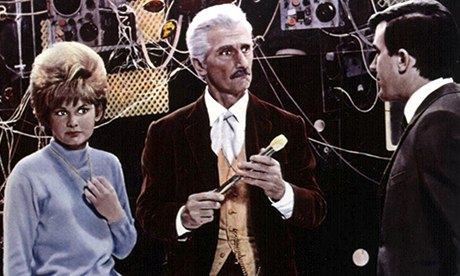
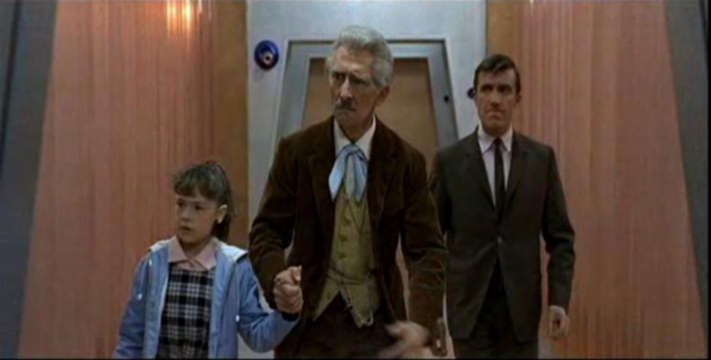
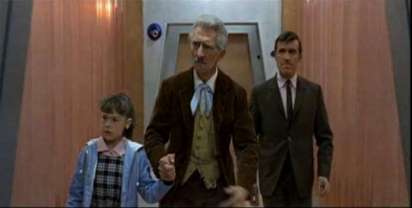 Dr. Who was played by Peter Cushing, who Amicus felt would be a bigger box office draw than William Hartnell. Cushing does a good job playing his version of the character and it’s interesting to compare his kindly performance to both his better known work for Hammer and George Lucas and William Hartnell’s ruthless interpretation of the character. Cushing regularly goes back to save the life of Castle’s cowardly Ian. Hartnell would have just let him die.
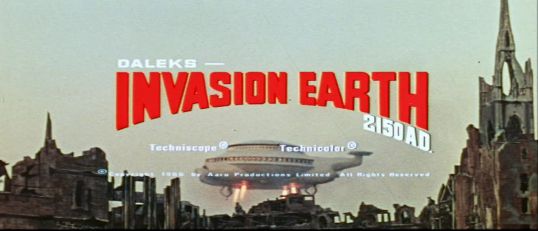
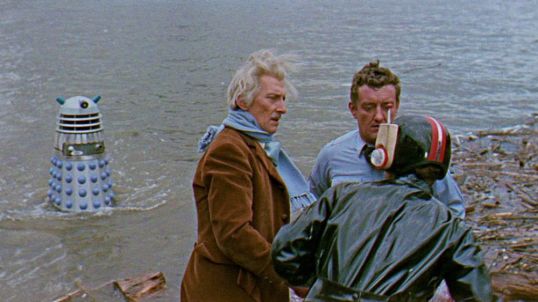
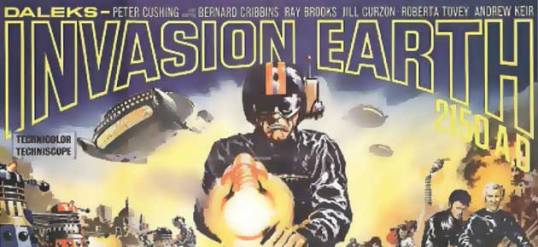
Though the film bombed in North America (where, at the time, Doctor Who was still unknown) it did will enough in the UK to lead to a sequel, Daleks — Invasion Earth: 2150 A.D. When the sequel failed at the box office, plans for future movies starring Peter Cushing as the Doctor were abandoned. That was probably for the best. If the Amicus films had been a success, they could have changed the direction of Doctor Who just as surely as Terry Nation did when he first introduced the Daleks. Doctor Who could have reverted to being a show for children instead of becoming the show that it is today.
Still, it is hard not to wish that Peter Cushing could have gotten to play the Doctor in a “real” Doctor Who film. After all, Christopher Lee would have made a great Master.



 Through the Shattered Lens