Lisa Cleans Out Her DVR: The Girl In the Red Velvet Swing (dir by Richard Fleischer)


(Lisa is currently in the process of cleaning out her DVR!  How long is it going to take?  Forever!  For instance, she recorded 1955’s The Girl In the Red Velvet Swing off of FXM on February 1st and has now gotten around to actually watching and reviewing it.)

The story of Evelyn Nesbit is an interesting one, even if it is now a largely forgotten one.

In 1901, Evelyn Nesbit was a showgirl in New York City.  While she always claimed that she was 16 at the time, there are some historians that think it more likely that she was only 14.  One night, the beautiful Evelyn was introduced to Stanford White.  At the time, White was 47 years old and the most successful and prominent architect in New York City.  White was also a notorious womanizer and Evelyn soon became his latest mistress.  He moved her into one of his many apartments.  Years later, when the details of their relationship became public knowledge, people were shocked to hear that Stanford White kept a red velvet swing in the apartment and that he enjoyed watching Evelyn swing back and forth.  They would be even more scandalized by the news that Stanford also had a “mirror room.”  As Evelyn would later testify, she “entered the room a virgin” but did not come out as one.

Though Evelyn occasionally claimed that she and Stanford were truly in love, she never married him.  (Indeed, Stanford White apparently never married anyone over the course of his life.)  Instead, she ended up meeting and marrying Harry K. Thaw.  Harry was the heir to a 40 million dollar fortune.  He also had a long history of mental illness.  When he learned that, before meeting him, Evelyn had lost her virginity to Stanford White, he was outraged.

(It’s debatable how well Stanford and Harry knew each other.  Some historians claim that they were barely acquainted.  Other accounts claim that Harry and Stanford were business rivals even before Evelyn Nesbit arrived in New York.)

In 1906, Harry and Evelyn ran into Stanford White at Madison Square Garden.  Harry promptly pulled out a pistol and, in front of hundreds of witnesses, shot Stanford dead.

Harry’s subsequent trial was reportedly the first to ever be described as being “the trial of the century.”  Because hundreds of people had seen Harry Thaw shoot Stanford White and the Thaw family was adamant about not publicizing Harry’s history of mental illness, Harry’s defense team attempted to make the trial about Stanford White.  The defense attempted to portray Stanford as being such a depraved predator that Harry really had no other option but to shoot him in cold blood.  Evelyn took the stand and testified to every single detail of her relationship with Stanford White.  The details appeared in every major newspaper in America.

In the end, Harry was found not guilty by reason of insanity and was committed to the  Matteawan State Hospital for the Criminally Insane.  (Reportedly, due to his great wealth, he had the best room in the hospital.)  Meanwhile, Evelyn became one of America’s first reality stars.  Her notoriety led to her appearing in several silent films.  It’s a fascinating story, one that very much feels ahead of his time.  If Evelyn was a star in 1906, just imagine how famous she would be today.

The Girl in the Red Velvet Swing is about Evelyn Nesbit and her relationships with both Stanford White and Harry Thaw.  It’s a shame that the film isn’t as interesting as the real life story.  Ray Milland plays Stanford White.  Farley Granger is Harry Thaw.  Joan Collins is Evelyn Nesbit.  They all give good performances, especially Farley Granger.  But the film itself is just so bland.  Perhaps because it was made in the 1950s, it leaves out the majority of the sordid details that made the story so fascinating to begin with.  For instance, the red velvet swing appears but, in this film, no time is spent in the mirror room.  This true life story is pure tabloid material but The Girl In The Red Velvet Swing is way too respectful for its own good.  By refusing to come down firmly on the side of Harry Thaw or Stanford White, the film feels shallow and a bit empty.  (All good melodramas — even fact-based ones — need a good villain.)  And poor Evelyn Nesbit!  In real life, she was a savvy self-promoter who knew exactly how to manipulate the press.  In this film, she’s just an innocent ingenue.  Considering the facts of the case, the film version is unforgivably dull.

So, I don’t recommend The Girl In The Red Velvet Swing but I do recommend Paula Uruburu’s fascinating 2008 biography, American Eve: Evelyn Nesbit, Stanford White, The Birth of the ‘It’ Girl, and the ‘Crime of the Century.’  It goes into all of the fascinating details that were left out of this film.
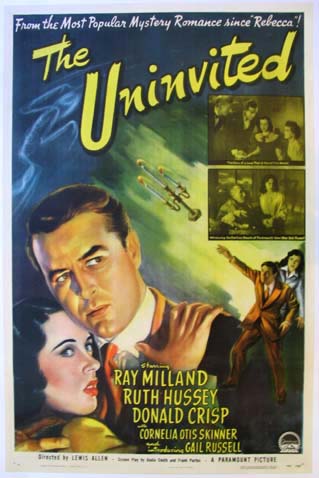
Horror Film Review: The Uninvited (dir by Lewis Allen)


the_uninvited_1944_film

If you want to see a really good haunted house movie, allow me to recommend that you track down the 1944 film, The Uninvited.  The Uninvited may not have been the first movie about a haunted house but it’s definitely one the best and one of the most influential.  None other than Guillermo Del Toro has regularly cited The Uninvited as an inspiration and, as I watched the film last night, I could definitely see where the film had influence Del Toro’s Crimson Peak.

The Uninvited tells the story of Rick Fitzgerland (Ray Milland) and his sister, Pamela (Ruth Hussey).  They’ve just purchased a long-empty seaside house and, incredibly, they were able to get it at an amazingly low cost!  The house’s owner, the frail Commander Beech (Donald Crisp, alternating between being menacing and sympathetic), was apparently desperate to get rid of it.

Far less happy about the selling of the house is Beech’s granddaughter, the mysterious Stella (Gail Russell).  As Stella explains it, she grew up in the house, her mother died in the house, and Stella is still attached to the house.  Beech has ordered Stella to stay away from the house but, with Rick falling in love with her, Stella is soon visiting on a regular basis.

Of course, Stella isn’t the only unexpected visitor that the Fitzgeralds get to know.  It quickly becomes obvious that there’s something strange about the house.  Rick and Pamela discover an artist’s studio that is always cold.  They both hear the sound of a woman crying.  Beech claims that it’s nothing to worry about.  Old house make weird noises, he informs them.  However, Rick and Pamela start to become convinced that the house is haunted.

Stella not only agrees that the house is haunted but she also informs them that she knows the identity of the ghost.  It’s Stella’s mother!  But if that’s true, why does the ghost constantly seem to be encouraging Stella to put her life at risk?  Why does Stella go into a trance and, much as her mother did 16 years earlier, attempt to jump over the side of a cliff?

Is Stella’s mother trying to manipulate her daughter into joining her in death?  Or is there something even more sinister happening?

Well-acted and perfectly paced, The Uninvited is an effectively creepy film, one that remains memorable even 72 years after it was initially released.  Visually, The Uninvited resembles a film noir and, if not for a brief scene towards the end of the film, viewers would be justified in wondering if the house really is haunted or if everyone in the film is just letting the isolation and the shadowy atmosphere get to them.  It’s that hint of ambiguity that elevates The Uninvited and makes it a truly thought-provoking haunted house story.


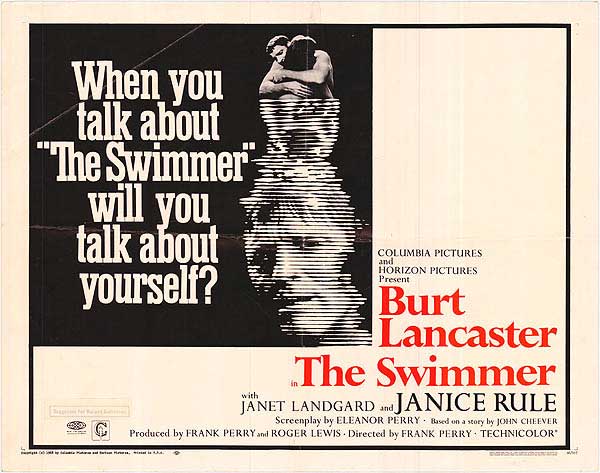
Embracing the Melodrama #23: The Swimmer (dir by Frank Perry)


The Swimmer

The 1968 film The Swimmer opens with Ned Merrill (Burt Lancaster) emerging from the woods that surround an affluent Connecticut suburb.  He’s a tanned, middle-aged man and, because he spends the entire film wearing only a bathing suit, we can tell that he’s still in good shape for a man in his 50s.  When Ned speaks, it’s with the nonstop optimism of a man who has found and claimed his part of the American Dream.  In short, Ned appears to be ideal American male, living in the ideal American community.

However, it gradually starts to become apparent that all is not well with Ned.  When he mysteriously shows up at a pool party being held by a group of his friends, they all seem to be shocked to see him, commenting that it’s been a while since Ned has been around.  Ned, however, acts as if there’s nothing wrong and instead talks about how beautiful the day is and says that he’s heading back to his home.  He’s figured out that all of his neighbor’s swimming pools form a “river” to his house and Ned’s plan is to swim home.

And that’s exactly what Ned proceeds to do, going from neighbor to neighbor and swimming through their pools.  As he does so, he meets and talk to his neighbors and it becomes more and more obvious that there are secrets hidden behind his constant smile and friendly manner.  As Ned gets closer and closer to his actual home, the neighbors are far less happy to see him.

At one house, he runs into Julie (Janet Landgard) who used to babysit for his daughter.  Julie agrees to swim with Ned and eventually confesses that she once had a crush on him.  When Ned reacts by promising to always protect  and love her, Julie gets scared and runs away.

At another house, Ned comes across another pool party.  A woman named Joan (played by a youngish Joan Rivers) talks to him before a friend of her warns her to stay away from Ned.

When Ned reaches the house of actress Shirley (Janice Rule), it becomes obvious that Shirley was once Ned’s mistress.  They discuss their relationship and it quickly becomes apparent that Ned’s memories are totally different from Shirley’s.

And, through it all, Ned keeps swimming.  Even when he’s offered a ride to his house, Ned replies that he has to swim home.

The Swimmer is a film that I had wanted to see ever since I first saw the trailer on the DVD for I Drink Your Blood.  (That’s an interesting combination, no?  I Drink Your Blood and The Swimmer.)  I finally saw the film when it showed up on TCM one night and, when I first watched it, I have to admit that I was a little disappointed.  Stylistically, the film itself is such a product of the 1960s that, even though suburban ennui and financial instability are still very relevant topics, The Swimmer felt rather dated.  I mean, I love a good zoom shot as much as anyone but, often times during the 60s, they seemed to be used more for the sake of technique than the sake of story telling.

However, the second time I sat through The Swimmer, I appreciated the film a bit more.  I was able to look past the stylistic flourishes of the direction and I could focus more on Burt Lancaster’s excellent lead performance.  Lancaster plays Ned as the epitome of the American ideal and, as a result, his eventual collapse also mirror the collapse of that same ideal.  The Swimmer is based on a short story by John Cheever and, quite honestly, the film’s story is a bit too much of a literary conceit to really work on film.  That said, The Swimmer — much like the character of Ned Merrill — is an interesting failure, which is certainly more than can be said of most failures.