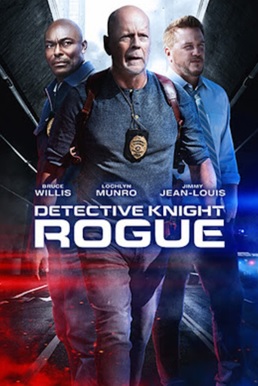
2022’s Detective Knight: Redemption picks up where Detective Knight: Rogue ended.
After having been arrested in front of his wife and daughter, football player-turned-criminal Casey Rhodes (Beau Mirchoff) has been sent to prison. In the same prison is Rhodes’s nemesis, former Detective James Knight (Bruce Willis). Knight has been imprisoned for murdering the two villains from Detective Knight: Rogue, finally answering the age-old question of what happens to an action hero after the end credits roll. In prison, both men meet Ricky Conlan (Paul Johansson), a former convict who is now a chaplain. Conlan is big on encouraging everyone in prison to set aside their differences and come together as one big community of sinners seeking redemption.
Meanwhile, as Christmas approaches, New York City finds itself under siege. Terrorists are dressing up like Santa Claus and robbing banks, chanting “Ho! Ho! Ho!” as they do so. Their leader alternates between handing out candy canes and tossing live grenades at people. He becomes known as The Christmas Bomber and he announces that he’s only robbing the banks to get back at the 1%. He’s a revolutionary, you see.
He’s also a prison chaplain. That’s right, Ricky Conlan is the Christmas Bomber and he’s decided that Casey is going to be newest member of his operation! He even stages a jailbreak, releasing the entire population of Riker’s onto the streets of New York. The only prisoner who voluntarily chooses not to escape is Detective Knight. Impressed by his refusal to escape when he had the chance, NYPD Capt. Anna Shea (Miranda Edwards) arranges for Detective Knight to be released from prison so that he can head up the search for Conlan and the commie Santas.
Meanwhile, Knight’s partner, Eric Fitzgerald (Lochlyn Munro), has traveled to New York to help out with the investigation. In the previous movie, when we last saw Detective Fitzgerald, he was in the hospital after having been shot by Casey Rhodes. Fitzgerald may be in a wheelchair now but he’s still good with a gun and he also mentions that the doctors think that he should be able to walk again by Memorial Day. Fitzgerald doesn’t let being in a wheelchair prevent him from investigating and confronting New York’s power brokers, including the oily mayor (John Cassini).
Detective Knight: Redemption was one of the films that Bruce Willis filmed shortly before the announcement that he would be retiring from acting. Though he’s definitely the main attraction here and he still looks convincing firing a gun during the film’s finale, Willis’s screen time is limited and it’s also obvious that a stand-in was used for a few of the scenes that involved his character. There are a handful of fleeting moments where we get to see some hints of the wiseguy charisma that was Willis’s trademark but, for the most part, Detective Knight is written to be a man of few words. When he made this film, Willis still had his screen presence but it’s still difficult to watch with the knowledge that he was struggling with his health during filming.
With Willis largely sidelined, it falls to Munro, Johansson, and Mirchoff to keep the action moving and all three of them prove themselves to be up to the challenge. Johansson, in particular, is so wonderfully over-the-top in his villainy that it’s impossible not to be entertained whenever he’s onscreen. The film’s plot does have a few interesting twists. Conlan presents himself as being a revolutionary who is dedicated to bringing down the 1% but Casey eventually realizes that, much like Die Hard‘s Hans Gruber, he’s ultimately just a greedy thief. Conlan’s gang is a mix of hardened escaped prisoners who are looking for revenge on the system and confused kids who quickly discover that the revolution is a lot scarier than they thought it would be. The story may sometimes be too quick to ask the viewer to suspend their disbelief but the plot moves quickly and, just as he did with Gasoline Alley, director Edward Drake doesn’t allow the film’s low budget to prevent him from choreographing a few impressive action scenes.
Ultimately, of course, the main reason to see Detective Knight: Redemption is that it features a bunch of Santa Clauses chanting “Ho! Ho! Ho!” while robbing banks. Who can resist that?

 Through the Shattered Lens