SHANE (The TV Series) – Episode 15: “The Great Invasion – Part 1” (originally aired December 17th, 1966)


Episode 15 opens with Shane (David Carradine) at a hotel in Cheyenne, WY. He hears a ruckus in the next room where a guy named Jed (Charles Grodin) is holding court with a group of men and women. Jed, who has clearly been drinking way too much, is going on about the honor of serving with Captain William Quantrill. He asks Shane to have a drink with him and Shane declines. Offended by this, Jed challenges Shane only to get his ass thoroughly kicked in about 10 seconds flat. One of the men in the group recognizes Shane as the great gunfighter. Soon the men force Shane at gunpoint to go see their boss, Major George Hackett (Bradford Dillman). It seems Hackett is putting together a group of men for a project and offers Shane the large sum of $75 per week to join up. Sensing something bad, Shane turns down his offer and leaves. Shane is right to leave as we soon learn that Hackett’s “project” is to eliminate any homesteaders who are not a part of the Cattlemen’s Benevolent Association, a large outfit out of Chicago.

While in Cheyenne, Shane also runs into his old friend Longhorn Jenny (Constance Ford) who is in town selling a herd of cattle. She’s accompanied by her assistant Dan (Archie Moore). The two swap some old stories, with Shane even asking how she came across that herd of cattle. They seem to hint that she didn’t necessarily come across them legally. Shane says goodbye and starts the journey back to the ranch. Before leaving Cheyenne, he reads a story in the paper that specifically mentions Longhorn Jenny, implying that she’s a rustler. The story in the paper, which seems to back the Cattlemen’s Association, plus Major Hackett’s offer convinces Shane that something truly bad is on the way. When he gets back to the ranch, he tells Tom (Tom Tully), Marian (Jill Ireland) and a few other local homesteaders that he’s concerned that they may all be in danger. Unfortunately, everyone he speaks to in the valley about this situation, including cattleman Rufe Ryker (Bert Freed), think he’s overreacting and don’t seem concerned at all. Then Major Hackett and his men ride out to Jenny’s ranch, unveil their Gatling Gun and proceed to kill Jenny and Dan, ultimately hanging her at the gate with a sign that says “Rustler.” Even after Jenny is killed, no one in the valley will listen to Shane and prepare to defend themselves. Marian tells Shane that she’ll prepare to defend their ranch, but she is not leaving. Not knowing what to do to keep those he loves safe, Shane heads back to Cheyenne and accepts Hackett’s offer to work for him. Credits roll for the end of Part 1.  

A lot happens in the “The Great Invasion: Part 1.” All the main people are introduced, with Hackett and his plan coming into light. We also spend an inordinate amount of time with Longhorn Jenny as we meet her, learn about her and ultimately see her die. This being the first part of a two part episode, I’ll withhold my larger analysis for the next review, but I am looking forward to seeing where the story goes. I find the characters quite interesting. Bradford Dillman comes off as very odd and extremely dangerous as Major Hackett, a man who seems to relish the opportunity to use his Gatling Gun. Charles Grodin’s Jed appears to be your typical loudmouth killer at this point, but it will be interesting to see what happens to him. And I’m looking forward to seeing what Shane does to stop the madness before it takes out the people in their valley. There’s no way they can compete with Hackett’s Gatling Gun, so Shane will have to figure out a way to stop things from within. 

There were a few other interesting things I noted while watching this episode. First, when Shane is heading back to the ranch from Cheyenne, we see the Grand Teton Mountain range behind him for the first time in the series. If you remember, the Tetons are prominently featured in the classic 1953 film SHANE, and it was cool seeing them here. Second, Shane goes on a rant to Marian at one point about how newspapers spin the facts in a way that distorts the truth. Just in case anyone thought that a dishonest media was only a current issue, this should lay that theory to rest. And finally, Marian Starett flat out asks Shane why he continues to stay at the ranch. She’s clearly wanting to know if it’s for her. Once again he won’t give her the satisfaction of confirming her thoughts, and it appears that his reluctance to be honest with her is starting to wear thin. Couple that with a crying Joey who doesn’t understand why Shane left and the interpersonal emotions are running high as the episode fades out. I’m all in for seeing how it plays out. 
Horror on TV: Thriller 1.1 “The Twisted Image”


Tonight’s excursion into televised horror is the very first episode of Boris Karloff’s Thriller!

Thriller was an anthology series that lasted from 1960 to 1962.  Each episode presented a new story of horror and/or suspense.  What makes this series especially memorable is that each episode was introduced by none other than Boris Karloff!  I’ve seen a few episodes of Thriller (the entire series is on YouTube) and, to be honest, it’s kind of a hit-or-miss show.  But Karloff and that mischievous twinkle in his eye makes it all worth it!

This episode originally aired on September 13th, 1960.  It’s called The Twisted Image and stars Leslie Neilsen as a man being stalked by two mentally disturbed individuals.  This episode was well-directed by Arthur Hiller and, if it’s more of a suspense story than a horror story, it still has its creepy moments.

Enjoy!

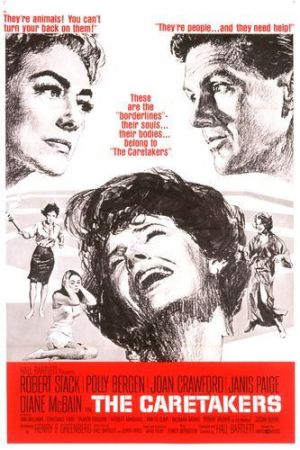
Embracing the Melodrama Part II #27: The Caretakers (dir by Hall Bartlett)


The_Caretakers_(1963_movie_poster)Whenever I go to Half-Price Books, I always seem to end up spending most of my time browsing the “nostalgia” section.  This is where they keep all of the old paperbacks that were published long before I was born.  This is where you can find old romance novels, “for adults only” novels, detective novels, and occasionally you’ll even find mainstream novels that were apparently considered to be quite daring when they were originally released.  These novels usually carry cover blurbs that brag about how controversial they are and how they deal with the “real issues of today.”

Usually, these novels are pretty silly and over-the-top which is why I always seem to end up buying a lot of them.  About a year ago, I bought a novel from 1959.  It was by Dariel Telfer and it was called The Caretakers.  The cover features a naked woman standing in front of several nurses and doctors.  The cover blurb announces that The Caretakers is “A shattering novel about nurses, doctors, and patients in a state hospital where emotions readily explode!”  The back cover features a pull quote from Time: “Will shock as well as arouse compassion.”

Now, I have to admit that I have yet to get around to actually reading The Caretakers.  However, thanks to TCM, I recently saw the 1963 film version and it’s a film that definitely embraces the melodrama.

How melodramatic is The Caretakers?  It’s melodramatic enough that it opens with Lorna Medford (Polly Bergen) stumbling into a movie theater and having a nervous breakdown.  Since this film was made in 1963, her mental breakdown is represented by spinning the camera around and getting hyperactive with the zoom lens, all while Bergen shrieks and tears at her hair.

Lorna is sent to a mental hospital, where she meets several other patients and is treated by Dr. MacLeod (Robert Stack), who is a rebel.  We know that he’s a rebel because everyone else at the hospital keeps telling him that he’s a rebel and complaining about his use of radical use of group therapy.  Under Dr. MacLeod’s guidance, Lorna reveals that she hasn’t gotten over the tragic death of her child.

As the film progresses, Lorna gets to know the rest of the patients.  They’re a mixed bunch, all played by actresses who clearly saw this as their chance to pick up an Oscar for Best Supporting Actress and were determined to make as big an impression as possible.  For instance, Barbara Barrie plays Edna, who never speaks but who does enjoy setting fires and who, whenever she’s feeling persecuted, poses as if she’s hanging from a cross.  And then there’s grandmotherly Irene (Ellen Corby), who is supposed to be the nice one but always looks like she’s on the verge of very sweetly shoving a pair of knitting needles into someone’s eyes.

However, my favorite patient was the cynical Marion (Janis Paige), precisely because she was so cynical and, as a result, she got all the best lines.  Marion is a former prostitute who now hates all men and Paige has a lot of fun playing the role.  Whenever Paige is giving one of her long, angry monologues, she practically grabs the film and refuses to let it go.

And then, of course, there’s Joan Crawford.  Crawford doesn’t play a patient.  Instead, she’s the head nurse and she doesn’t approve of Dr. MacLeod’s methods.  Crawford announces early on that she’s been attacked by a patient in the past and her main concern is protecting her staff.  She teaches a self-defense class.  If you’ve ever wanted to see a middle-aged Joan Crawford flip someone over, The Caretakers is a film to watch.

And that’s The Caretakers for you.  It’s one of those films that takes itself so seriously that it becomes humorous despite itself.  As a result, the film is a lot of unintentional fun.

And who knows?

Maybe someday, I’ll get around to reading the book!


Embracing the Melodrama #16: A Summer Place (dir by Delmer Daves)


A Summer Place

Judging from the films I’ve seen from the decade, the 50s were a time when everyone was obsessed with sex but nobody felt comfortable talking about it.  Boys were, of course, allowed to do whatever they wanted, as long as they kept their hair perfectly straight and went out for a school team or two.  Girls, meanwhile, were divided into “good girls” and “bad girls.”  The most important thing in the world was to remain a good girl and to understand that the bad girls really weren’t having as much fun as they appeared to be having.  As for adults, their lives apparently revolved around sheltering their daughters and encouraging their sons to go get laid.  Now, to be honest, the culture really hasn’t changed that much.  I guess what distinguished 50s hypocrisy from the hypocrisy of today is that people in the 50s were apparently so much more sincere about that hypocrisy.

Case in point: 1959’s A Summer Place.  A Summer Place is one of those films where everyone is obsessed with sex but nobody can ever come right out and admit it.  It’s a film where people seem to exclusively speak in the language of euphemism.  It’s a film, about sex, in which you never see anyone actually having sex though, of course, there is an unplanned pregnancy towards the end of it.  That was the 50s for you.  Have sex outside of marriage once and you’re pretty much guaranteed to get knocked up.  You just better hope that the father is played by Troy Donahue.

(Has ever an actor has a more appropriate name than Troy Donahue?  The name itself just resonates a certain handsome blandness.)

In A Summer Place, Troy Donahue plays all-American boy Johnny Hunter.  Johnny’s father (played by Arthur Kennedy) is an alcoholic.  Johnny’s mother, Sylvia (Dorothy McGuire), is frustrated with her perpetually drunk husband and spends her days dreaming of a lifeguard that she once knew.  The Hunters own an inn, located on beautiful Pine Island off the coast of Maine.

One summer, Ken (Richard Egan) and his cold wife Helen (Constance Ford) come to stay at the inn.  Accompanying them is their teenage daughter, Molly (Sandra Dee).  Helen insists on trying to control every aspect of Molly’s life.  Ken, on the other hand, takes a much more relaxed attitude towards his daughter.  When Molly complains that Helen forces her to wear a bra and a girdle, Ken grabs his daughter’s underwear and tosses it all into the ocean.

(Uhmmm …. yeah, that’s more than a little creepy…)

Molly meets Johnny and, despite the fact that the stiff Troy Donahue generates absolutely zero romantic  sparks, the two of them soon fall in love. (It probably has something to do with the Theme From A Summer Place, a hypnotic piece of music that plays on the soundtrack whenever the two of them so much as even glance in each other’s direction.)  Helen, however, doesn’t want Molly to have anything to do with Johnny.  When Molly and Johnny spend a day stranded on an island together, Helen forcefully checks to make sure that Molly’s virginity is still intact while Molly repeatedly shouts, “I WANT MY FADDAH!  I WANT MY  FADDAH!”

However, her father is not there because he’s too busy having an affair of his own.  It turns out that Ken is the former lifeguard who Sylvia Hunter once loved…

And through all of the complications and the melodrama (and believe me, there’s a lot), the Theme From A Summer Place keeps on playing in the background.

Apparently, A Summer Place was considered to be incredibly risqué back in 1959.  Watched today, it all seems to be rather quaint and, in its way, oddly likable.  It’s not necessarily a good film but it’s an agreeable enough offering if you’re looking to waste two hours with whatever happens to be on TCM.  As opposed to some of the other regular directors of 50s melodrama —  like Douglas Sirk and Nicholas Ray — director Delmer Daves made films where the only subtext was unintentional.   As a result of Daves’s direction and Donahue’s “nice young man” blandness, A Summer Place is a pleasant film that never quite becomes a memorable one.

Still, just try to get that music out of your head…

a summer place, sandra dee, troy donahue