
TV Review: The Girl From Plainville 1.5 “Mirrorball” (dir by Pippa Bianco)


Well, I tried.

I really did.  Coming off of the high that I got off reviewing each episode of The Dropout, I thought it would be pretty easy to review all 8 episodes of The Girl From Plainville but, having watched the fifth episode last night, I think I’m done.

Don’t get me wrong.  I will continue to watch the series.  (There’s only three weeks left.)  And I’ll certainly include any thoughts that I have about the show in my “Week in Television” post.  But I think I’m done with trying to come up with 500-1000 words to use to review each episode because, quite frankly, there’s just not much to say about The Girl From Plainville.  The story of how Michelle Carter encouraged Conrad Roy to commit suicide is well-known.  The fact that Michelle Carter was put on trial and convicted is also well-known.  This show is trying to build-up suspense about a story that most viewers will already know.

It perhaps wouldn’t matter if The Girl From Plainville had something new or unexpectedly insightful to say about the case.  But the fact of the matter is that Michelle Carter is not that interesting of a human being.  Everything that I’ve read and seen about the case seems to suggest that she really didn’t have much going on inside of her brain.  Because she lacked an actual personality, Michelle learned how to behave and how to interact through social media and television.  Conrad’s death allowed her to live her life as if it was an episode of Glee, or at least that’s what Michelle was hoping.  And now, years after Conrad’s suicide, Michelle is out of prison and being played in a miniseries by Elle Fanning.  It doesn’t seem to be quite fair, does it?

As for last night’s episode, it felt pretty much like a filler episode.  The prosecution team continued to build a case against Michelle while Michelle had to deal with going from briefly being the most popular girl in school to being an absolute pariah.  We also got a few clumsily handled flashbacks to Michelle texting Conrad.  Last weekend, I watched Dopesick, which also aired on Hulu and also used a jumbled timeline.  The timeline in Dopesick did occasionally get confusing but, at the same time, it worked because it took place over several years and the actors could be made to look older or younger, depending on the timeline.  If Michael Keaton had a hint of hair, you know the show was taking place in the 90s.  If he was bald, you know it was 2004.  The Girl From Plainville, on the other hand, is only dealing with a two-year period and, as such, it’s hard to keep track of what’s happening when.  The characters played by Elle Fanning and Chloe Sevigny pretty much look and act the same in 2012 as they do in 2014.  It’s a very clumsily constructed story structure, one that does the miniseries little good.

That said, Elle Fanning continues to give a convincingly unhinged performance as Michelle and Colton Ryan is appropriately vulnerable as Conrad.  (Sorry,  I’m not going to call him Coco.)  I think if the miniseries had done away with all of the flashback nonsense and just told their story in chronological order, Fanning and Ryan’s strong performances would have been better served.  For now, I’m done with doing full reviews of this show but, if next week’s episode is a surprisingly good one, that could change.
TV Review: The Girl From Plainville 1.4 “Can’t Fight This Feeling Anymore” (dir by Pippa Bianco)


Last week, when the first three episodes of The Girl From Plainville dropped on Hulu, my main concern was that, regardless of how well-acted the show may be or how tragic the true life story might be, there really wasn’t much left to be said about Michelle Carter and Conrad “Coco” Roy.   

Having watch the fourth and latest episode last night, I have to say that I think my concerns were justified.  I mean, don’t get me wrong.  The fourth episode was fairly well-directed.  It was definitely well-acted.  There was a scene where Elle Fanning and Colton Ryan start singing Can’t Stop This Feeling that I’m sure will be a favorite amongst many viewers.  But, in the end, it’s hard to see why eight hours are going to be required to tell this story.  There was really nothing in the fourth episode that couldn’t have been communicated in a two-minute montage.

The fourth episode continued the show’s distracting habit of jumping back and forth in time.  The main problem with this is that, unless Colton Ryan is in the scene, it’s often difficult to keep track of whether we’re seeing the past or the show’s “present.”  There’s not much different between past Michelle and present Michelle.  For that matter, Coco’s parents appear to have been just as miserable in the past as they were in the present.  There was a scene where Coco’s father and his grandfather got into an argument about whether or not they should sell Coco’s truck and it took me a few minutes to understand that the scene was supposed to be taking place in 2014 and not 2012.  To be honest, there’s really no reason for the show’s jumbled timeline, other than the fact that it’s currently what all the Emmy-winning miniseries are doing.  But since we all already know how the story began and how the story is going to end, we don’t really get much out of the show’s mix of flashbacks and flashforwards.

The show seem to be trying to generate some suspense over whether Michelle will actually go on trial over her part in Coco’s death but again, what’s the point?  We all know that she went on trial.  The publicity of the trial is the whole reason why most people are going to be watching this show in the first place.  In fact, all of the legal maneuvering is probably the least interesting part of the story.  So far, both the prosecutor and Michelle’s attorney are coming across as being one-note characters.  That may be a reflection of reality because real-life lawyers are rarely as interesting as their television counterparts but that still doesn’t make for compelling viewing.

What does make for compelling viewing is the show’s suggestion that this was all because of Glee.  Michelle’s obsession with Finn and Rachel, in particular, seems to have been her main motivation for pursuing a relationship with Coco in the first place.  And, of course, Finn died when his actor died so perhaps Coco had to die as well.  (On the bright side, at least Michelle wasn’t obsessed with Puck and Quinn.)  While the rest of the world is trying to understand why Coco killed himself and why Michelle apparently ordered him to get back in the truck, Michelle is imagining herself in an episode of Glee.  As I mentioned earlier, the Can’t Fight This Feeling scene was probably the episode’s highlight, if just because it revealed how fragile Michelle’s concept of reality truly was.

If the fourth episode of The Dropout was where that show justified its existence, the fourth episode of The Girl From Plainville feels like it has more in common with the fourth episode of Pam & Tommy.  The Girl From Plainville works as a showcase for Elle Fanning and, occasionally, Colton Ryan but the show itself still hasn’t quite convinced me that it needs to exist.

TV Review: The Girl From Plainville Episodes 1-3 (dir by Lisa Cholodenko and Zetna Fuentes)


With The Dropout scheduled to air its final episode next week, Hulu is moving on to another 8-hour miniseries about another young blonde woman who was at the center of a media firestorm.  The Girl From Plainville stars Elle Fannie as Michelle Carter, a teenager who was convicted of more or less goading her “boyfriend,” Conrad Roy (played by Colton Ryan, who was one of the few good things about Dear Evan Hansen) into killing himself.

It was a case that got a lot of attention and Michelle was, for a few months, everyone’s favorite heartless villain.  She was eventually convicted of manslaughter and, after several appeals, was eventually sentenced to 15 months in prison.  She served 11 and is currently free.  She’s 25 years old and has already experienced not only prison but also being briefly the most hated person in the country.  And yet, for all the attention that she received, no one has ever been able to determine just why exactly she told Conrad Roy that he should kill himself or why she went as far as to order him to do so, even after he said he had changed his mind.  There was a lot of speculation that Conrad perhaps thought that he and Michelle had a suicide pact, one that Michelle didn’t follow through on.  It’s also undeniable that, after Conrad’s suicide, Michelle made herself the center of attention.  Before her final text messages to Conrad were discovered, Michelle organized a charity softball game in his memory.  Of course, she held the game in her hometown instead of Conrad’s and apparently, she went out of her way not to involve any of Conrad’s friends or family in her efforts.  Could Michelle have pressured Conrad to kill himself just so she could use his death to be the center of everyone’s attention?

The first three episodes of The Girl From Plainville dropped on Hulu earlier this week and they certainly suggest that Michelle could be capable of doing it all for the attention.  At the same time, they also suggest that Michelle herself probably didn’t truly understand what she did or why she did it.  As played by Elle Fanning and Colton Ryan, both Michelle Carter and Conrad Roy come across as two people who didn’t have much of a connection with reality.  Conrad, or Coco as his friends and family call him, wants to escape a home life that is dominated by the constant bickering between his divorced parents.  He’s at his happiest when he gets a summer job working on a fishing boat and he’s miserable when he has to return to the “real” world, where he’s anxious around people his own age and he’s constantly being used as a pawn in his mother and father’s never ending battles.  Meanwhile, Michelle is so detached that she has to watch an episode of Glee in order to come up with something to say after Conrad’s suicide.  Conrad’s family is earthy, loud, and working class while Michelle’s family is reserved and wealthy but both families have raised children who feel like permanent outsiders.  Indeed, it seems almost preordained that they would eventually find each other and both Colton Ryan and Elle Fanning do a good job of bringing Conrad and Michelle to life.

That said, as I watched the first three episodes of The Girl from Plainville, I did find myself wondering if there was anything more to say about this case.  After the endless news coverage, one Lifetime movie, one HBO special, and countless “ripped from the headlines” episodes of Law & Order: SVU, are there any new insights left to be gleaned from the story of Michelle and Conrad?  With a story this terrible, one’s natural tendency is to search for a deeper meaning but is there really one there?  What if, for all the speculation, Michelle really was just a heartless monster who manipulated Conrad into suicide because she knew she could?  In short, is there enough here to really justify spending 8 hours with someone like Michelle Carter?

I guess we’ll find out over the upcoming few weeks.

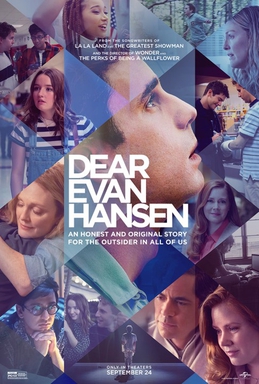
The Films of 2021: Dear Evan Hansen (dir by Stephen Chbosky)


Last night, I finally watched Dear Evan Hansen.

Dear Evan Hansen is the film adaptation of the Tony-award winning Broadway musical of the same name.  Recreating his stage role, Ben Platt plays Evan Hansen, a teenager who suffers from social anxiety and who is mistaken for having been the best friend of Connor Murphy (Colton Ryan), a troubled classmate who committed suicide after stealing a letter that Evan had written to himself.  (Somewhat awkwardly, it was also a letter in which Evan somewhat obliquely wrote about the crush that he had on a member of Connor’s family.)  When the letter is subsequently found on Connor’s body, it’s assumed that it’s a suicide note that Connor meant for Evan.  Evan, who is in love with Connor’s sister, Zoe (Kaitlyn Dever), allows everyone to believe that he and Connor were friends.  Connor’s mother, Cynthia, (Amy Adams) and his stepfather (Danny Pino) adopt Evan as a sort of replacement for their dead son.  Cynthia views Evan as being the only way that she’ll ever understand what Connor was going through and Evan continually reassures that Murphys that Connor really did love all of them and that he was trying to change his life for the better.  With the Murphys now treating Evan as a member of their own family, Evan’s mother (Julianne Moore) feels that her son is now ashamed of her.  And Evan’s classmate, Alana (Amandla Stenberg), launches a movement to raise money to preserve the apple orchard where Evan claims that he and Connor spent all of their time together.

As a musical, Dear Evan Hansen was very popular.  As a film, it doesn’t work and it doesn’t work for all the reasons that everyone assumed that it wouldn’t work.  Believe me, I wanted it work.  From the minute that the trailer first dropped, the reaction to the film has been so overwhelmingly negative that I was really hoping that the film itself would turn out to be an overlooked gem.  I was really hoping that this would be one of those underappreciated films that just needed a few brave champions.  Instead, it turned out to be not terrible in the way that Cats was terrible but still too flawed to be considered a success.

First off, the plot itself doesn’t transition well from the stage to film.  There’s too many holes and there’s too many places in the story where you find yourself wondering why you should care about Evan and his problems.  Those plot holes may not have been as big of a problem when the story was presented on the stage because watching any story play out against an artificial backdrop requires a certain suspension of disbelief.  But, on film, seeing Evan attending an actual school and walking down an actual street and visiting an actual house, you’re much more aware of how inauthentic the story feels.  Evan’s actions rarely make sense and it’s difficult to accept that anyone, even Connor’s emotionally desperate parents, would believe the stories that Evan concocts about his friendship with Connor.  On stage, you could perhaps accept that Zoe would buy that Evan and Connor were friends who confided in each other despite the fact that Evan doesn’t seem to know anything about Connor’s family or home life.  On screen, especially when one considers the fierce intelligence that Kaitlyn Dever brings to the role of Zoe, it’s a bit more difficult to believe.

The other big problem with the film is Ben Platt is too old for the role of Evan.  Platt first played the role in 2015, when he was 23.  He won a Tony and certainly, he deserves a lot of credit for creating the role from the workshop phase all the way to Broadway.  Now, however, he’s 28 and he looks considerably older.  So much of what Evan does is acceptable only if you believe that he’s an immature 17 year-old who is desperately looking for a place and a family where he belongs.  The same actions go from being poignant to being creepy when they’re done by someone who appears to be in his mid-30s.  While Platt has a great singing voice and shines in the musical numbers, he’s a bit too mannered when he just has to recite dialogue.  He’s still giving a stage performance, even though he’s now playing the role on film and everyone around him is giving a film performance.  Platt’s talent is undeniable but he’s miscast here and casting him opposite performers who can actually still pass for teenagers doesn’t help the situation at all.

(When I watched the film, I thought that obvious age difference between Ben Platt and Kaitlyn Dever occasionally made the scenes between Evan and Zoe uncomfortable to watch.  Then I did some research and discovered that Dever is only three years younger than Platt.  It’s just that Dever still looks like a teen while Platt looks very much like an adult.  And there’s no shame in looking your age.  Someone just needs to cast Platt in an adult role.)

In Platt’s defense, the film doesn’t really make perfect use of any of the members of its talented cast.  Amy Adams is such a good actress but the film casts her as a stereotypically flakey rich suburbanite who flitters from one trend to another.  Julianne Moore and Amandla Stenberg are similarly wasted, playing characters who have potential but who are never quite given as much to do as they deserve.  Of the cast, Kaitlyn Dever is the stand-out, even though Zoe is a bit of an inconsistent character.  Initially, she seems like the one person willing to call out everyone on their BS and then, just as suddenly, she’s oddly forgiving of someone who essentially manipulated her emotions for his own benefit.

Not surprisingly, Dear Evan Hansen works best when people are singing.  Ben Platt and Colton Ryan bring so much energy to Sincerely, Me that I briefly had hope that the film was turning itself around.  Unfortunately, that wasn’t the case but still, it’s a good production number.  Unfortunately, the rest of the movie doesn’t really live up to it.