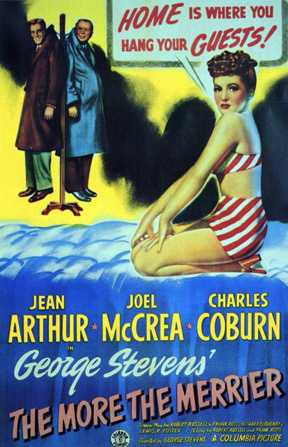
After I finished with Watch On The Rhine, I decided to watch another film from 1943. Like Watch On The Rhine, The More The Merrier is a film about life during wartime and it takes place in Washington, D.C. However, that’s all that they have in common. Whereas Watch On The Rhine was a serious and somber affair, The More The Merrier is thoroughly delightful little comedy.
The More The Merrier opens with a retired millionaire named Benjamin Dingle (Charles Coburn) arriving in Washington D.C. He’s been asked to serve as an adviser for a commission that has been tasked with solving America’s housing shortage. (This was apparently a very real concern during World War II.) However, as soon as Dingle arrives, he finds directly effected by the problem that he’s supposed to be solving. His hotel room won’t be available for two days and he has no where to stay. After a quick look through the newspaper, Ben finds an ad for a roommate.
When he arrives at the apartment, he discovers a long line of men waiting outside. They’re all in the same situation as him and are hoping that Connie Milligan (Jean Arthur) will select him for her roommate. However, Connie picks Ben, largely because he’s old and rich and she won’t have to worry about him hitting on her on like most guys nor does she have to worry about him borrowing her clothes or getting jealous of her, like she would have to with a female roommate. Connie is engaged to a boring but well-paid bureaucrat named Charles Pendergrast (Richard Gaines). She doesn’t really love Pendergrast (and he has an annoying habit of shushing her) but, after growing up poor because her mother married for love, Connie is determined to not to make the same mistake.
Ben and Connie struggle, at first, to adjust to each other’s habits. Connie keeps to an exact schedule and claims to not have any use for frivolity. Ben is the exact opposite. The early scenes of them trying (and, of course, failing) to stay out of each other’s way are hilarious, with both Coburn and Arthur giving brilliant comedic performances. (I’m jealous of how wonderfully Jean Arthur could express exasperation.) Connie’s apartment is already small and it gets even smaller once she sublets half of it to Benjamin Dingle.
However, things are about to get even more crowded. One day, while out exploring Washington, Ben runs into Joe Carter (Joel McCrea), a sergeant who has a few days before he’s scheduled to be shipped overseas and who has no place to stay. Generously, Ben agrees to sublet half of his half of the apartment to Joe. Of course, Ben does this without telling Connie.
When, after another hilarious and artfully done sequence of the three new roommates wandering around the apartment and just barely missing each other, Connie discovers what Ben has done, she orders both Ben and Joe to leave the apartment. Ben agrees to do so, if she gives him back his security deposit. Unfortunately, Connie already spent that money on a hat…
So, they’re stuck together. Connie is attracted to Joe and Joe to Connie but Connie is also determined to marry Pendergrast. (When Joe scornfully says that he bets Pendergrast combs his hair “every hour on the hour,” Connie snaps back, “Mr. Pendergrast has no hair!”) Fortunately, Ben — being older and wiser — can see that Joe and Connie are perfect for each other and he starts doing everything he can to bring the two together.
As Ben says more than once, “Damn the torpedoes! Full speed ahead!”
Jean Arthur is one of my favorite actresses of Hollywood’s Golden Age. She had this perfect “no bullshit” attitude, mixed with an unexpected vulnerability. In The More The Merrier, she’s just as credible when she’s ordering Ben and Joe to leave as when she’s breaking into tears after she catches Ben reading her diary. In the role of Ben, Charles Coburn is warm, kind, and wonderfully eccentric. (When Joe asks him what does for a living, Ben cheerfully replies, “I’m a well-to-do retired millionaire. How ’bout you?”) And then you have Joel McCrea, in the role of the “cute but dumb” Joe Carter. He’s not really that dumb but he certainly is cute. Wisely, McCrea never tries to be funny. Instead, he gets most of his laughs just by reacting to all of the craziness going on around him.
Briskly directed by George Stevens, The More The Merrier features a snappy script from Frank Ross, who was married to Jean Arthur. It’s full of hilarious lines but, at the same time, there’s an undercurrent of melancholy to it as well. Hanging, like a shadow over all of the comedy and the romance, is the fact that Joe is soon going to be shipped overseas. Even while you laugh, you’re very aware that there’s a chance he might not be coming back. That reality brings an unexpected depth to the film’s otherwise cheerful love story.
The More The Merrier was nominated for best picture but it lost to Casablanca. However, Charles Coburn did win the Oscar for best supporting actor.
 Through the Shattered Lens