Cleaning Out The DVR #38: It Happened One Night (dir by Frank Capra)


For those following at home, Lisa is attempting to clean out her DVR by watching and reviewing 38 films by the end of today!!!!!  Will she make it?  Well, it depends on whether or not she can finish the review below!)
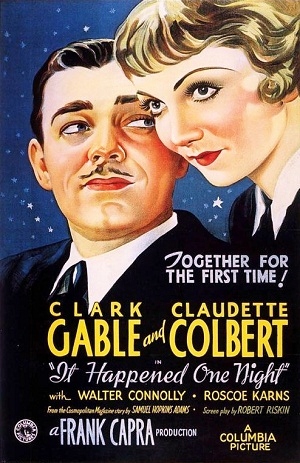
Gable_ithapponepm_poster

Before I talk too much about the 1934 film It Happened One Night, I want to tell a story about legs.

I’ve always been insecure about having a slightly large nose and once, when I was 17 years old, I was giving my mom a hard time about the fact that I had basically inherited it from her.  I was going on and on and being fairly obnoxious about it.  (Yes, believe it or not, I can occasionally be obnoxious…)

Finally, my mom held up her hand and said, “Yes, you got your nose from me but you also got my legs so stop crying!”

And you know what?  I glanced down at my legs and I realized that she was right and that made me feel a lot better.  Ever since then, I’ve taken a lot of pride in having a good pair of legs.

Now, you may be asking yourself what that has to do with It Happened One Night.  Well, It Happened One Night is one of the ultimate “good legs” movies.  That’s because It Happened One Night features the famous scene in which Claudette Colbert teaches Clark Gable the proper way to hitchhike.  (If I ever take up hitchhiking, I’m planning on using the same technique.)

That’s the scene that It Happened One Night is justifiably famous for.  However, It Happened One Night is more than just a film about hitchhiking.

It’s also a romance, one that features Claudette Colbert at her wackiest and Clark Gable at his sexiest.  Reportedly, the sell of undershirts plummeted after Clark Gable took off his shirt and revealed that he wasn’t wearing one.

It was one of the first road movies and it was such a success that it remains influential to this very day.  Any time you watch a movie that features two seemingly different characters getting to know each other on a road trip, you’re watching a movie that exists because of It Happened One Night.  (And yes, that includes Tom Hardy and Charlize Theron in Mad Max: Fury Road.)  

Frank Capra won his first Oscar for directing this film and It Happened One Night remains one of his most likable and least preachy films.  Just compare the unpretentious, down-to-Earth style of It Happened One Night to Meet John Doe.

Perhaps most importantly, It Happened One Night was the first comedy to win the Oscar for best picture.  It Happened One Night is a film that announces that a film doesn’t have to be a self-serious, pretentious epic to be great. Before the victory of It Happened One Night, the top prize was exclusively reserved for films like Cimarron and Calvalcade.  (Seriously, just try watching some of those early winners today.)  It Happened One Night‘s Oscar victory was a victory for the future of entertainment.

(By the way, as I sit here typing up this review, I keep accidentally typing It’s A Wonderful Life instead of It Happened One Night.  That’s the power of Frank Capra.)

It Happened One Night tells the story of  Pete Warne (Clark Gable).  Pete is an out-of-work reporter.  Though he may be down on his luck, he’s still confident and lovably cocky in that way that only Clark Gable could be.  While riding on a bus from Florida to New York, Pete recognizes one of his fellow passengers as Ellie Andrews (Claudette Colbert), an heiress who has recently eloped with a buffoonish big game hunter named King Westley (Jameson Thomas).  Ellie’s father wants to get the marriage annulled and has people all over the country searching for his daughter.  Pete agrees not to call Ellie’s father if Ellie will agree to give him an exclusive story when she meets up with Westley in New York.

For the rest of the film, we follow Pete and Ellie as they cross the United States, spending awkward nights in motel rooms, getting kicked off of buses, and hitchhiking.  Ellie gives lessons on how to get a car to stop.  Pete delivers a long monologue on the proper way to undress before going to bed.  Along the way, Pete and Ellie fall in love.  It also becomes obvious that Ellie’s father is right about Westley only marrying her for her money.

They also meet a large cast of increasingly eccentric characters.  Whether they’re dealing with the passengers on the bus or the cranky people staying at a rest stop or a motorist who won’t stop singing, Pete and Ellie do noy meet anyone who doesn’t have at least one odd quirk.  Like many classic screwball comedies, It Happened One Night takes place in a world where everyone — from a bus driver to a desk clerk to a group of women waiting to use a shower at a rest stop — has something to say about everything.  Some of the film’s funniest moments come from watching the normally smooth Pete have to deal with the increasingly crazy world in which he’s found himself.

(For her part, Ellie is at her happiest when things are at their strangest.  Ellie’s the best.)

The other great moments come from simply watching Gable and Colbert interact.  They have an amazing chemistry and it comes through in their performances.  It’d odd to read that apparently neither Gable nor Colbert were happy to be cast in It Happened One Night because their performances are so much fun to watch.  A love story only works if you love the characters and the love story in It Happened One Night definitely works.

As I stated above, It Happened One Night was the first comedy to win Best Picture.  Beyond that, it was also the first movie to win all of the top 5 Oscars: Picture, Director, Actor, Actress, and Adapted Screenplay.  (Those were also the only 5 nominations that It Happened One Night received.)  For once, the Academy got it right.  It Happened One Night remains a delightful film.

(Oh my God, y’all, I did it!  That’s 38 films reviewed in 10 days and my DVR now has space to record all sorts of things!  And making it all the better is that I finished this project by reviewing a truly wonderful comedy like It Happened One Night!)
Lisa Watches An Oscar Nominee: San Francisco (dir by W.S. Van Dyke)


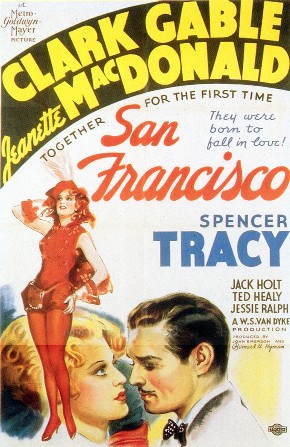
San_Francisco_(film)_poster

As I sit here writing this, I’m snowed in, my asthma’s acting up, and our cat is quickly losing patience with me.  On the plus side, however, this weather has given me an opportunity to watch some more of the old best picture nominees that I had saved up on my DVR.

For instance, I just finished watching the 1936 best picture nominee, San Francisco.

San Francisco was one of the first disaster films, a film that follows a group of characters as they attempt to survive the 1906 earthquake that destroyed the town of San Francisco.  And it has to be said that, nearly 80 years after the film was first released, the climatic earthquake remains effective and scary.  San Francisco, of course, was made long before there was any such thing as CGI.  Many of the film’s sets were built on special platforms that were designed to shake back and forth, just like in an actual earthquake.  When you see walls and buildings collapsing in San Francisco, you know that those walls are breaking apart and collapsing for real and the extras running for their life are literally doing just that.  After the earthquake, Clark Gable, as the film’s hero, walks through the ruins of San Francisco with the haunted look of a true survivor.  Gable was such a confident actor that it’s still jarring to see him looking overwhelmed.

Unfortunately, before you get to that spectacular earthquake, you have to sit through the rest of the film.  It’s a massive understatement to say that the pre-earthquake portion of San Francisco drags.  Clark Gable is Blackie Norton, a notorious gambler and saloon keeper.  Blackie may be a rogue but he’s a rogue with a heart of gold.  His childhood friend, Father Tim (Spencer Tracy), wants Blackie to run for the board of supervisors.  Blackie, however, is more interested in Mary Blake (Jeanette MacDonald), the newest singer at his club.

From the minute she first appears to the very end of the film, Jeanette MacDonald is singing.  Even when she’s not at the center of the scene, you can often hear her singing in the background.  And, after a little while, you just want her to stop singing.  But, whenever that happens, she tries to act and you realize that the only thing more boring than Jeanette MacDonald singing is Jeanette MacDonald acting.

Anyway, the film goes through all of the expected melodrama.  Blackie wants to reform.  Blackie decides not to reform.  Father Tim believes that there’s good in Blackie.  Father Tim gives up on Blackie.  Father Tim decides to give Blackie another chance.  Mary loves Blackie.  Mary fears Blackie.  Mary leaves Blackie.  Mary comes back to Blackie.  Mary leaves Blackie again.  Mary sings.  And sings and sings and sings…

But then, just when you’re about to fall asleep, the city starts to shake and all is forgotten in the wake of a natural disaster.  Even earthquakes serve a purpose…

San Francisco was a huge box office success.  It was nominated for best picture.  Somehow, Spencer Tracy received a nomination for best actor, despite the fact that he’s really not that impressive in the film. (His role is primarily a supporting one and he’s consistently overshadowed by Gable.)  The only Oscar that San Francisco won was for best sound recording and it must be said that, after all these years, the earthquake still sounds terrifying.

As for the film itself, I’d suggest skipping ahead to the earthquake.  That, after all, is the main reason anyone would be watching the film and, by skipping ahead, you’re spared having to sit through an hour and a half of Jeanette MacDonald singing.

Lisa Marie Reviews The Oscar Winners: Mutiny on the Bounty (dir by Frank Lloyd)


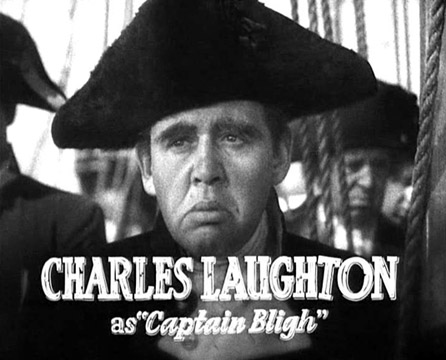
Charles Laughton

It’s been a strange Oscar season and it could get even stranger.  Several critics and industry insiders are speculating that, on February 24th, Argo might win the Oscar for best picture without winning in any other category.  As strange as that may sound, Argo would not be alone in achieving this distinction.  In the past, 3 films have won best picture without winning anything else.

Mutiny on the Bounty, the best picture of 1935, is one of those films.

Based (rather loosely, according to many historians) on a true story, Mutiny on the Bounty tells the story of one of the most controversial events in maritime history.  The HMS Bounty leaves England in 1787 on a two-year voyage to Tahiti.  The Bounty is manned by a disgruntled crew (many of whom have been forced into Naval service) and is captained by a tyrant named William Bligh (Charles Laughton).  Bligh has little use for the majority of his crew and thinks nothing of having a man whipped until he is dead for even the pettiest of infractions.

Blight’s lieutenant is Fletcher Christian (Clark Gable), a compassionate man who disapproves of Bligh’s methods.  As the voyage continues, Christian grows more and more vocal with his disgust towards Bligh.  When the ship finally reaches Tahiti, Christian falls in love with a local Tahitian girl and defies Bligh’s direct orders so that he can spend time with her.

It’s only after the ship leaves Tahiti and Bligh’s tyranny leads to the death of an alcoholic crew member that Christian finally leads the mutiny of the film’s title. The rest of the film is divided between Bligh’s surprisingly heroic efforts to survive after being set adrift in a lifeboat and Christian’s attempts to avoid being captured by British authorities.  Caught up in the middle of all of this is Christian’s friend (and audience surrogate), Roger Byam (Franchot Tone).

Mutiny on the Bounty was one of the biggest box office hits of 1935 and it received 8 Academy Award nominations, including Best Picture, Best Director, and a record-setting 3 nods for Best Actor with Clark Gable, Charles Laughton, and Franchot Tone all receiving nominations.  However, out of those 8 nominations, Mutiny only won the award for Best Picture while John Ford’s The Informer took home the Oscars for Best Director and Actor.  Mutiny on the Bounty was the third (and, as of this writing, the last) best picture winner to fail to win any other categories.

For a film that lost dramatically more awards than it won, Mutiny on the Bounty still holds up pretty well.  Director Frank Lloyd keeps the film moving at a quick pace and perfectly captures not only the misery of the Bounty but the joyful paradise of Tahiti as well.  Lloyd is at his best during the short sequence of scenes that depict Bligh’s efforts to reach safety after being forced off of the Bounty.  During this sequence, the audience is forced to reconsider both Captain Bligh and everything that we’ve seen before.  It introduces an intriguing hint of ambiguity that is not often associated with films released in either the 1930s or today.

Of the three nominated actors, Clark Gable and Charles Laughton both give  performances that remain impressive today.  In the role of Fletcher Christian, Gable is the literal personification of masculinity and virility.  Meanwhile, in the role of Bligh, Laughton is hardly subtle but he is perfectly cast.  If Gable’s performance is epitomized by his charming smile than Laughton’s is epitomized by his constant glower.  Wisely, neither the film nor Laughton ever make Bligh out to be an incompetent captain.  As is shown after the mutiny, the film’s Bligh truly is as capable a navigator and leader as everyone initially believes him to be.  Unlike many cinematic tyrants, Blight’s tyranny is not the result of insecurity.  Instead, Bligh is simply a tyrant because he can be.  Laughton and Gable are both so charismatic and memorable that Franchot Tone suffers by comparison.  However, even Tone’s bland performance works to the film’s advantage.  By being so normal and boring, Roger Byam is established as truly being the sensible middle between Gable’s revolutionary and Laughton’s tyrant.

Mutiny on the Bounty remains an exciting adventure film and it certainly holds up better than some of the other films that were named best picture during the Academy’s early years.  If Argo only wins one Academy Award next Sunday, it’ll be in good company.