VGM Entry 33: Amiga 500


VGM Entry 33: Amiga 500
(Thanks to Tish at FFShrine for the banner)

It was around 1988 that European computer gaming really started to make the transition over to the Amiga 500 from the Commodore 64. While the Amiga line had been around since 1985, the Amiga 500 launched in 1987 and was designed to be a much more cost effective, mass consumer-friendly product.

With a change in platform came a change in composers, oddly enough. Rob Hubbard is mentioned in a measly nine game credits on Lemon Amiga, and Martin Galway not at all. Suddenly David Whittaker, a Commodore 64 composer with an expansive library but little fame, ruled the roost. If we consider again a simple Lemon Amiga search result, his name pops up in 86 different Amiga titles. Platoon (Ocean Software, 1988) was not actually originally his, but as a faithful port of Jonathan Dunn’s 1987 C64 original (unless of course the music appeared in the movie itself; I’ve never seen it) it makes apparent the audio improvements the Amiga could offer. Whittaker’s Platoon was not necessarily better than the Jonathan Dunn original if we consider what the two artists had to work with, but he certainly did not squander or misuse the expansive new options that the Amiga 500 brought.

Whittaker’s most famous work would arrive the following year. Shadow of the Beast (Psygnosis, 1989) was a 12 song collection which really helped to solidify what we might think of as the Amiga 500 sound. The old Commodore 64 crew typically failed to carry on their legacies in the Amiga era, true, but most of the composers who replaced them did get their start programming for the C64 and enjoying the works of Hubbard and co. Artists had to be very selective about the styles of music they pursued in the C64, given its limited capacity, and what I think you hear on soundtracks like Shadow of the Beast is a continuation of those styles set to pretty decent instrument samples. This song could easily be translated into a SID piece and retain its original character. The actual C64 conversion sounded bad, as it turned out, but only because Fredrik Segerfalk did a shoddy job of it, not because the music was incompatible.

My favorite Amiga 500 tune by far though is Crystal Hammer (reLINE Software, 1988) by Karsten Obarski. The game itself is a mere Breakout copycat, but Obarski really made it shine. From what I can tell it was one of his only game compositions–Sarcophaser (Rainbow Arts, 1988) is another good one–and the brevity of his works is quite a shame. He made his name known more as a software developer, creating the highly criticized but frequently employed Ultima Soundtracker for the Amiga. Despite having almost no involvement in Commodore 64 composition whatsoever, Obarski’s music sounds just as indebted to Rob Hubbard as the rest of them. This is especially apparent on Sarcophaser, where you can get a feel for how the standard SID sounds and the more original style of Crystal Hammer existed side by side.

Chris Hülsbeck was a bit of an exception to the rule of new names on the new platform. One of his most shining moments was the Amiga 500 port of R-Type (Electric Dreams, 1989). Though Hülsbeck did, to the best of my knowledge, create the loadscreen music to the Commodore 64 version of R-Type as well, he chose two completely different songs. Never fully conforming to the ‘standard’ sound of any system, Hülsbeck was going to forge ahead with his own unique sound, and the product might not be backwards compatible.

That being said, while I have no doubt that Hülsbeck composed the Amiga title screen–it is unmistakably his style–I can’t say with certainty that he actually wrote the C64 one. Ramiro Vaca is additionally credited as a musician on the C64, as is Darius Zendeh on the Amiga, and I am not sure what role either played.
VGM Entry 25: Meanwhile in Europe…


VGM Entry 25: Meanwhile in Europe…
(Thanks to Tish at FFShrine for the banner)

It can be pretty easy to get boxed into a NES perspective and forget that, while Nintendo may have controlled the majority of the gaming market, they weren’t a total monopoly. The Commodore 64 in particular was still a close rival in the area of gaming music.

The same small handful of names seem to pop up everywhere I turn for C64 music. I don’t know if there were in fact fewer musicians, if their works drastically outshines the competition, or if most C64 composers have been unfairly forgotten, but I can tell you this much. Between 1985 and 1987 Rob Hubbard composed the music for over 60 video games. That is completely unheard of for any other time and any other system. Monty on the Run, the first Hubbard work to catch my attention, also happened to be one of his earliest. He would carry on the innovative tradition for many years to come, with such original (to the best of my knowledge) compositions as Nemesis the Warlock (Martech, 1987) rivaling his more famous 1985 works.

The tendency towards covers continued as well. Rob Hubbard visited Larry Fast and his Synergy project again on Zoids (Martech, 1986), this time arranging “Ancestors” from Audion, the same album that featured “Shibolet”. This time around, a version of the original music is conveniently available.

Which Hubbard music I post from here is really quite arbitrary, because the quality of his works is consistently high. Delta (Thalamus, 1987) is among my favorites. Delta is an interesting example of just how low-key video game development used to be. The sequel to Sanxion (Thalamus, 1986), both Delta and its predecessor were programmed by Stavros Fasoulas and composed by Rob Hubbard. To the best of my knowledge, that’s it. Perhaps this is why Hubbard was not composing ending credits themes.

I’ve read that the music to Delta was inspired by Koyaanisqatsi by Phillip Glass, but I have no reliable source to confirm this, and I have not heard the song myself.

Ben Daglish is another prolific C64 composer with dozens upon dozens of titles to his name. It’s pretty easy to miss soundtracks like Mountie Mick’s Death Ride (Ariolasoft, 1987) in the sea of material out there, especially with Daglish not getting quite the excessive attention of Hubbard and Galway. A great stand-alone song, Mountie Mick’s Death Ride also achieves a much higher level of game relativity than the average C64 composition. Unless this video is misleading, the game doesn’t seem to have had a seperate sound effects track at all; Daglish’s composition incorporated the chug of the train into the basic beat of the music.

http://www.youtube.com/watch?v=n8jI_BUvUGI

(This video must have been removed in the past day or two, and I could not find a replacement nor did I have time to overhaul my article to adjust for it. I do hope this was deleted by the poster’s choice and not another victim to the most recent string of copyright threats by these media conglomerates who seem to be buying up massive quantities of obscure, out of print material and erasing all record of their existence. A whole ton of similarly innocent videos from different users seem to have vanished in the past few days.)

A Commodore 64 composer I drew attention to in an early post was Martin Galway, for his work in Yie Ar Kung-Fu and Roland’s Rat Race. I didn’t quite realize how significant the guy was at the time, but the more C64 soundtracks I look at (at least up through 1987), the more he comes across as the guy who scored every soundtrack that Hubbard didn’t. The two both put out ridiculous numbers. To Hubbard’s 60+, Galway can add another 30. Just how many games were released in this three year span?

By 1987, Galway seems to have gotten pretty experimental. A lot of his works don’t feel quite as “safe” as Hubbard’s. Game Over (Imagine, 1987) is a case in point. Weird as it may be, the first 1:50 still constitute a functional game soundtrack. But as the melody all drops out and nothing but Galway’s bizarre experimental drumming is left behind, well… whatever your take on the composition, I think you’ll be hard pressed to conceive of a relevant gaming context.

http://www.youtube.com/watch?v=jZcB_WOuPhQ

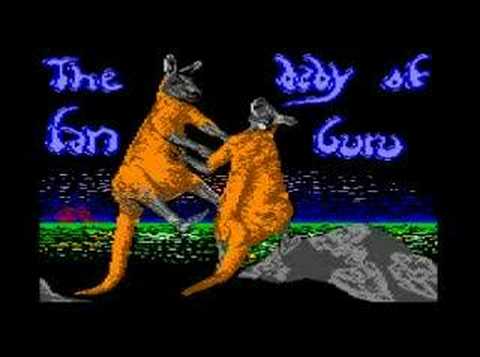
Maybe it’s just Game Over‘s cool box art that makes me think a relevant gaming context matters in the first place. I mean, if you tried to musically capture the title screen of The Baby of Can Guru (Rainbow Arts, 1987) you would probably be fired. So just as he did with The Great Giana Sisters that same year, Chris Hülsbeck said “to hell with this” and wrote whatever pleased him.

I mean, if the significance of what you’re now hearing hasn’t sunk in yet, let me try to clarify:

THIS GAME has a wicked soundtrack.

Anyway, this about wraps up my thoughts on SID music up through 1987. I will leave you with another Martin Galway piece: the Commodore 64 port of Arkanoid (Imagine, 1987), which is really just as absurd as Hülsbeck’s music for The Baby of Can Guru when you consider that the game is nothing more than a Breakout copycat.

http://www.youtube.com/watch?v=1stW0J7Myew

Rob Hubbard and Martin Galway were not the only two people writing music for the Commodore 64–I still know next to nothing about David Whittaker, for instance–but it is consistently their works which strike me as noteworthy in the mid-1980s. Chris Hülsbeck, or Huelsbeck if you prefer, seems to really start to make his presence known in 1987, and the works of Jeroen Tel would soon follow. Tim Follin, the mastermind behind the Bionic Commando port arrangement, would also start to really expand his impact beyond the ZX Spectrum in the late ’80s. ’85-’87 might for many people constitute the real glory days of Commodore 64 music, but there was much greatness still to come.

———————-

Notice: Square Enix have apparently deemed one of my soundtrack reviews a copyright infringement and demanded I remove the offending content (brief audio samples from an out of print ost). I have complied, and I kindly encourage you to boycott all Square Enix products in the future. Since their games are terrible these days anyway I am probably doing you a favor.

VGM Entry 20: The Great Giana Sisters


VGM Entry 20: The Great Giana Sisters
(Thanks to Tish at FFShrine for the banner)

A number of video games released in 1987 would go on to become major generation-spanning series. The Great Giana Sisters was not one of them. In fact, if was probably one of the worst ideas in gaming history. It was apparently developed for release on the Amiga, Amstrad CPC, Atari ST, Commodore 64, and MSX2 all at the same time, with a ZX Spectrum version to shortly follow. It was intended to be Rainbow Arts’ major commercial rival to the smash hit Super Mario Bros. But what was it exactly?

Well, one version of the box art depicts an attractive, perky-breasted woman in a miniskirt flying through a bizarre montage of giant lobsters, magical mushrooms, UFOs, and deadly dragons guarding foreboding castles on grim, icy mountain peaks.

Another depicts two trailer trash meth addicts sporting peace signs and an “I’m Cool” nametag, along with the suggestive comment that “The brothers are history!” A bit contradictory? Well, look right here! Zzap!64 says it’s “the greatest platform game of all time”, so it must be true!

The music, too, might lead you to believe this. It was also one of the first soundtracks composed by the now legendary Chris Huelsbeck (more often spelled Hülsbeck, though the artist himself uses Anglicized adaptation. For the sake of consistency I’ll stick to the latter in the future). The game’s title screen theme is pretty intriguing, bearing a sense of foreboding that aptly reflects the degree of strife and diversity which at least some versions of the cover art promise to bring.

Are you excited? Or at least curious? Good or bad, all signs point to a game that will in the very least be extraordinarily unique. Well, let’s take a look at the gameplay. Brace yourselves.

Needless to say, they got their pants sued off and pulled every version of the game from the shelves within weeks of its release, never again to see the light of day until Nintendo, perhaps for pure comedy value, allowed publisher Destineer to release it on the DS last year.

Rainbow Arts was a German publisher, and perhaps copyright laws are different there, but one has to imagine that a good many staff members were flipping burgers after this brilliant idea. Chris Hülsbeck would not be among them. He would go on to compose for many Rainbow Arts games to come, including the highly acclaimed Turrican series for which he is best known.

But before we brush The Great Giana Sisters off, really, what is going on with the music here? The main gameplay song is quite catchy and appropriate, but the title screen and underground theme (see Stage 4 in the video, 3:24) have about as much in common with the game as the box art. It would be interesting to find out why he chose these songs in particular. Perhaps they were some unaffiliated demos he had lying around in a dusty desk drawer, or perhaps he took advantage of a terrible game to write what he wanted to with no concern for relativity.

Whatever the case, the staff at Rainbow Arts heard his work even if no consumers did, and his future game assignments seem to reflect his personal style, not the reverse. The title theme and Stage 4 of The Great Giana Sisters examplify precisely the sound he would become famous for.