Lisa Reviews An Oscar Winner: The Life of Emile Zola (dir by William Dieterle)


The Life of Emile Zola, the winner of the 1936 Oscar for Best Picture of the Year, opens with two French artists living in a drafty apartment.

Emile Zola (Paul Muni) is destined to become one of France’s most popular and important writers.  Paul Cezanne (Vladimir Sokoloff) will eventually become one of the most important artists of the post-impressionist movement.  But for now, they’re just two struggling artists who have sworn that they will never sell out their principles.  They are poor but they’re happy.  That changes for Zola after he meets a prostitute named Nana (Erin O’Brien-Moore) and he uses her life story as the inspiration for a novel.  The book is controversial and its frank content scandalizes France.  The public censor comes close to banning it.  But it also becomes a best seller.  It’s the book everyone secretly owns but claims to have never read.

Zola writes several more books, all about the conditions of the working class in France.  Eventually, he becomes what he claimed he would never be, a wealthy man living in a mansion and having little contact with the poor and oppressed.  Cezanne sees Zola one last time, calling him out for having sold his talent for money.  Cezanne explains that, on general principle, he can no longer be Zola’s friend.

Meanwhile, a quiet and rather meek family man named Captain Alfred Dreyfus (Joseph Schildkraut) has been arrested and accused of being a spy for Germany.  There’s little evidence that Dreyfus is a spy.  Indeed, most of the evidence seems to point to a Major Walsin-Esterhazy (Robert Barrat).  But, because Dreyfus is considered to be an outsider, he is convicted in a show trial and exiled to Devil’s Island.

(In real life, it’s generally agreed that Dreyfus was a victim of anti-Semitism.  As the only Jewish member of the army’s General Staff, Dreyfus was viewed with suspicion by his colleagues even before anyone knew that there was a German spy.  The Life of Emile Zola doesn’t specifically state that Dreyfus was a victim of anti-Semitism, with the exception of a brief moment when one of his accusers looks at his personnel file and says, “He’s not one of us,” while pointing at the word “Jew.”  Otherwise, the fact that Dreyfuss was Jewish is never mentioned in the film.  It’s as if the film is going out of its way to avoid offending the very people that the movie is criticizing.)

After speaking to Dreyfus’s wife (played by Gale Sondergaard, who would later become the victim of a show trial herself when she was blacklisted as a suspected communist), Zola decides to take up Dreyfus’s case.  He publishes an open letter — J’Accuse — in which he states that Dreyfus was not given a fair trial and that Dreyfus is innocent of the charges against him.  Zola finds himself in court, accused of libel.  Zola uses his trial to give Dreyfus the hearing that he never received.  While the army boos his every utterance, the people of France rally to his side.

The Life of Emile Zola is an early example of the type of prestige production that today is often referred to as being an “Oscar picture.”  It tells a true story.  As a film that condemns the treatment of Alfred Dreyfus but avoids stating the obvious reason why Dreyfus was targeted in the first place, it’s political without being radical.  And it features a performance from the most acclaimed actor of the era, Paul Muni.  Muni gives a powerful performance as Zola, holding the viewer’s attention even during the lengthy trial scenes that take up most the second half of the film.  That said, the true star of the film is Joseph Schildkraut, who plays Dreyfus as being a kind and trusting soul who finds himself caught up in a Kafkaesque nightmare.  At one point, Dreyfus is given a gun and told that there’s one way that he can avoid being put on trial for treason.  Schildkraut played the scene so well that I wanted to cheer when he refused to surrender.

The Life of Emile Zola is a big and, at times, self-consciously important production.  It was clearly designed to win a bunch of Oscars and it certainly managed to do that.  Compared to some of the other films nominated that year — The Awful Truth, Dead End, A Star is Born, Lost Horizon, Stage Door, In Old Chicago — The Life of Emile Zola can seem a bit stodgy.  However,  the performances of Muni and Schildkraut continue to make the film worth watching.
Mardi Gras Film Review: Lady Behave! (dir by Lloyd Corrigan)


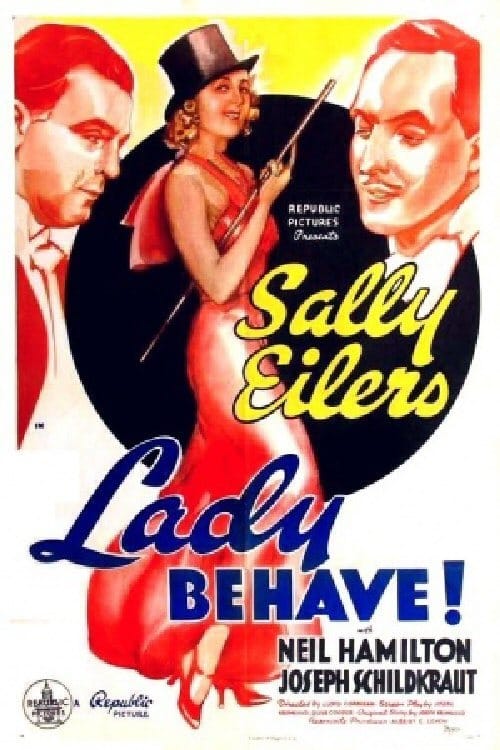
The 1938 film, Lady Behave!, begins with a woman named Clarice (Patricia Farr) getting ready to go out and celebrate Mardi Gras.  Even though Clarice invites her older sister, Paula (Sally Eilers), to come with her, Paula refuses.  Paula has work to do at home.  It’s pretty obvious that this is the way that it’s always been between the two sisters.  Clarice has fun while Paula stays home and waits for her to return.

Fortunately, Clarice does return in the morning.  As she tells Paula, she had a great time during Mardi Gras.  In fact, she had such a great time that she ended up getting married!  She married a wealthy northerner named Stephen Cormack (Neil Hamilton).  The only problem is that Clarice is already married!  She’s totally forgotten that she only recently became the wife of a dissolute playboy named Michael Andrews (Joseph Schildkraut).  By getting married a second time, Clarice has committed bigamy!  She could go to prison for 10 years!

Whatever is Paula to do?

Well, what if she arranges for Clarice to leave the country?

What if she tries to bribe Michael into accepting an annulment?

What if Paula goes up to New York and pretends to be Clarice (because, after all, Stephen was pretty drunk when he married her)?

What is she does all three!?

Of course, when Paula goes up to New York, she discovers that Stephen is out of the country.  She moves into his mansion, where she discovers that his two children — Patricia (Marcia Mae Jones) and Hank (George Ernest) — are convinced that she’s just a gold digger who only wants to steal their father’s money (and, it should be noted, also their inheritance).  When Michael shows up at Stephen’s mansion, he explains to Paula that he needs $10,000 for a horse and he’ll only agree to an annulment if he gets the money.  However, when he meets Patricia and Hank, he tells them that if they pay him $30,000, he’ll help to break up the marriage between Stephen and Paula (who, of course, everyone but Michael thinks is actually Clarice).

Eventually, Stephen shows up and he assumes that Paula actually is Clarice.  Paula and Stephen quickly fall in love and it turns out that Stephen is very serious about his new marriage.  He even wants to take Paula on a honeymoon.  Of course, he thinks Paula is Clarice and Paula is freaking out because they’re not actually married but she wishes that they were.  But, if they did actually get married, Stephen would be guilty of bigamy and then he’d have to leave the country like Clarice and….

Yes, this is one of those somewhat busy screwball comedies where almost every action is motivated by a misunderstanding and where all of the dialogue is extremely snappy.  To be honest, it’s all a bit too hyper.  Though the film originally had a running time of 70 minutes, most of the existing prints are only 57 minutes long.  This film has a lot of plot for only 57 minutes and it’s often difficult to keep track of what’s happening from one scene to the next.  That wouldn’t be a problem if this film starred someone like William Powell and Carole Lombard (or, for that matter, Cary Grant and Myrna Loy) but instead, this film features Sally Eilers and Neil Hamilton, who are likable performers but not quite likable enough to carry the film over it’s rough edges.

On the plus side, Joseph Schildkraut has some very funny scenes as the flamboyant Michael.  And Marcia Mae Jones and George Ernest both do a great work as Stephen’s paranoid children.  They consistently made me laugh.  Otherwise, Lady Behave! is a bit too frantic for its own good.

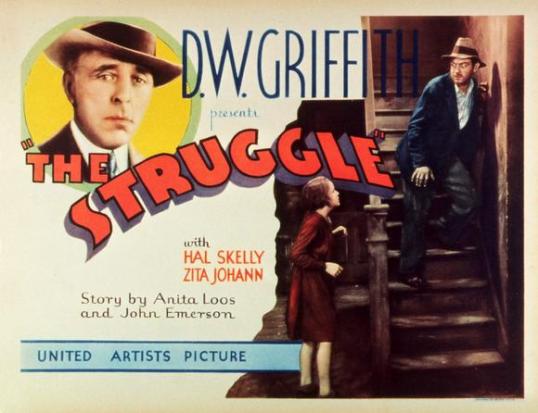
Embracing the Melodrama Part II #4: The Struggle (dir by D.W. Griffith)


The Struggle

Like a lot of the films directed by cinematic pioneer D.W. Griffith, the 1931 film The Struggle is currently available on Netflix.  As a result of his direction of the film Birth of the A Nation, Griffith is a controversial historical figure but it cannot be denied that he was one of the most ambitious, talented, and innovative of the silent filmmakers.  Unfortunately, like a lot of the great figures of silent film, he did not survive the transition to sound.  Griffith directed two sound films.  Abraham Lincoln is overly theatrical while The Struggle … well, bleh.

The Struggle tells the story of a married couple whose marriage is threatened by the husband’s alcoholism.  Florrie (Zita Johann) only agrees to marry Jimmie (Hal Skelly) on the condition that he stop drinking.  And, for several years, Jimmie doesn’t touch a drop of liquor.  But, under pressure at work and struggling to support his family, Jimmie finally breaks down, steps into a speakeasy (this film was made during prohibition), and has a drink.  Soon, Jimmie is a full-blown alcoholic, wandering the streets of New York while little school children shout, “He’s a beggin’ bum!” at him.  Will Jimmie’s life be turned around as the result of hearing a sermon the radio?  Or will he just keep drinking himself to death?

This was the last film on which Griffith was credited as being director.  (Reportedly, he was an uncredited co-director on San Francisco.)  It’s obviously a heart-felt work but, outside of the harrowing shot-on-location scenes of the unshaven Jimmie stumbling down the streets of the Bronx, the film is too overly theatrical and the performances are too stiff and unconvincing to really work.  Griffith was still a visual stylist but, watching The Struggle, it’s obvious that he never learned how to work with speaking actors.  As well, dialogue that would have worked on a title card came across as being over-the-top and preachy when actually uttered aloud.

That said, The Struggle has some interesting historic value, especially for those of us who tend to take the Libertarian point of view when it comes to the war on drugs.  The Struggle opens with a scene that is set at a garden party in 1911.  We listen to various conversations being held at each table.  Two people debate whether the Biograph Girl is named Mary Pickford or Mary Packard.  A man declares that Woodrow Wilson will never be President because he’s a college professor.  (This is all the 1931 equivalent of that scene in Titanic where Billy Zane says that a painting was done by “Somebody Picasso.  I’m sure nothing will ever become of him….”)  Suddenly, scandal hits the garden party as it’s discovered that a woman has had too much to drink and is now drunk.  Everyone at the party, on their own, shuns the woman and she is properly shamed.

The film jumps forward to 1923.  Prohibition is now the law of the land and we find ourselves in a speakeasy.  The thing that we immediately notice is that there are a lot more people in the speakeasy than were at that garden party and every single one of them is drunk.  And, since liquor in now illegal, it’s no longer being bought from safe and trustworthy sources.  Instead, it’s now being brewed in a back room.  One bootlegger holds up a bottle of prohibition liquor and announces it to be poison before then sending it out to be drunk by the Jimmies of the world.

The film’s point, of course, is that community is a lot better when it comes to policing itself than the government is.  The Struggle may not be a great film but it certainly has the right message.