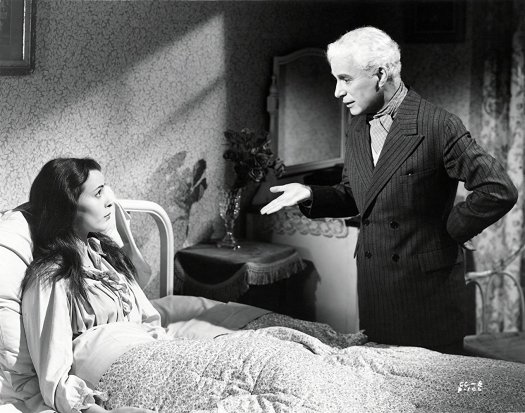
Charlie Chaplin was unquestionably one of the true geniuses of cinema. His iconic character ‘The Little Tramp’ has been entertaining audiences for over 100 years, enchanting both children and adults alike with his winning blend of humor and pathos. But by 1952, the 63-year-old Chaplin had been buffeted about by charges of immoral behavior and the taint of Communism during the HUAC years, and filmgoers were turning against him. It is at this juncture in his life and career he choose to make LIMELIGHT, a personal, reflective piece on the fickleness of fame, mortality, despair, and most prominently, hope. It could be considered Chaplin’s valedictory message to the medium he helped establish, even though there would be two more films yet to come.
“The story of a ballerina and a clown…” It’s 1914 London, and the once-great Music Hall clown Calvero arrives home from a drunken bender. Fumbling with the…
Over on Through the Shattered Lens Presidents the Oscars, Jedadiah Leland and I have been reimagining Oscar history, one year at a time! Today, we take a look at 1916, the year of Thomas H. Ince, Civilization, and Intolerance!
In the long history of the Academy of Motion Picture Arts and Sciences, 1916 was dominated by one man: Thomas H. Ince.
Today, Ince is a largely forgotten figure and his many accomplishments have been overshadowed by the mysterious and potentially sordid circumstances of his death in 1924. However, in 1916, Ince was one of the most popular figures working in the film industry. He was the first producer to build his own studio in California and, with D.W. Griffith and Academy President Mack Sennett, founded the Triangle Motion Picture Company. When, following the 2nd Academy Awards ceremony, Sennett announced the he would not be running for a second term as president of the AMPAS, Ince was the obvious choice to replace him.
As President, Ince immediately launched a recruiting drive to bring more industry professionals into the organization…
I recently discovered that Uverse has select films from the Criterion Collection available OnDemand. Last night, I took advantage of this service and watched 1940’s The Great Dictator. Along with being Charlie Chaplin’s first all-sound film, the Great Dictator was also a best picture nominee. (It lost to Alfred Hitchcock’s Rebecca.)
The Great Dictator is a broad comedy that, ultimately, has a very serious message. Made at a time when the second world war was looking more and more inevitable, The Great Dictator features Charlie Chaplin in two roles. As the film opens at end of World War I, Chaplin plays a meek but well-meaning Jewish barber who has found himself serving in the army of Tomania. Though the barber manages to survive the war, he also loses his memory and ends up spending the next 20 years in a mental hospital. When his memory finally does return, the barber returns to his barber shop and quickly discovers that things have changed. His shop has been boarded up and the word “JEW” has been painted over the windows. Thugs wearing military uniforms now patrol the streets and continually threaten to send people to concentration camps. Tomania is now ruled by a dictator named Adenoid Hynkel.
Hynkel, who happens to look just like the barber (and who is, of course, also played by Chaplin) is quickly established as being a crazy and rather simple-minded buffoon. As played by Chaplin, Hynkel gives long speeches in a harsh gibberish language that is designed to sound German without actually being German (fortunately, Hynkel has a translator on hand to tell us, after he has just spent two minutes harshly ranting, “Hynkel just explained his position on the Jews.”) and he continually runs throughout his palace in an attempt to prove that he’s capable of doing a hundred more things than the average person. In his private time, he does a child-like dance with a big inflatable globe, speculates on how glorious it will be to be the “brunette dictator of the Aryan people,” and tries to maintain a shaky alliance with his fellow dictator Benzino Napaloni (Jack Oakie). Playing a character that was the polar opposite of his usual persona, Chaplin’s performance manages to be both comedic and disturbing. You laugh at Hynkel’s buffoonish behavior but you never forget that he’s a very dangerous man. (Admittedly, I say that with a hindsight that was not possessed by either Chaplin or the audiences of 1940.)
The film proceeds to follow these two characters in two separate storylines that finally come together at the end of the movie with (SPOILER) Chaplin giving a nearly 5-minute plea for world peace. While Hynkel schemes to conquer the world one country at a time, the barber attempts to adjust to his new life while sweetly romancing the outspoken Hanna (Paulette Goddard), While the film is probably best known for Chaplin’s performance as Hynkel, I found the barber and Hannah’s relationship to be sweetly poignant. Their relationship gives this film a heart to go along with its biting satire.
For me (and admittedly, I’m a secret history nerd), it’s interesting to watch The Great Dictator today and try to imagine how audiences first reacted to it in 1940. According to Wikipedia, the Great Dictator was Chaplin’s most financially succesful film and Chaplin was even invited to the White House to recite the film’s climatic speech for President Roosevelt. And, of course, The Great Dictator also scored Oscar nominations for best picture, actor (Chaplin), supporting actor (Jack Oakie), screenplay, and original score. Chaplin also said, in his later years, that if he had known what was truly being done by Hitler and the Nazis, he would never have made a comedy like The Great Dictator.
I think that would have been a mistake on his part because if The Great Dictator proves anything, it proves that satire and humor is often the most powerful weapon against the forces of evil. Though Chaplin makes no secret of the fact that Hynkel is meant to be Hitler and Oakie is meant to be playing Mussolini, they could also serve as stand-ins for just about any dictator who has seized power through exploiting prejudice and hatred. The sight of Hynkel dancing with that globe is actually a far more effective anti-totalitarian statement than the heartfelt and undeniably sincere speech that ends the film.




 Through the Shattered Lens