Why does one join a cult?
That’s a question that’s been raised by a lot of different people over the past few years. Some people claim that MAGA is a cult. Others claim that Wokeism is a cult. One need only go on twitter to discover cults devoted to celebrities. There was a crazy woman named Emma who literally spent 8 years searching twitter for any critical reference to Garrett Hedlund so that she could personally attack whoever made the comment. I once made a rather mild joke about Jennifer Lawrence’s habit of falling at award shows and, almost immediately, I started getting angry replies from people who had J Law as their profile pick. Once upon a time, the Beliebers ruled the twitter wastelands. Then it was the One Direction stans. Now, people have to be very careful about what they say about Taylor Swift and Timothee Chalamet. What makes people devote their lives to blindly defending celebrities and politicians who don’t even know (or care) that they’re alive?
In the HBO docuseries, The Vow, Mark Vicente (a former leader of the NXIVM cult) declared that “Nobody joins a cult!” His point was that no one willingly joins a cult. Instead, they get involved because they’re looking for something that is missing in their lives and, sometimes, this leaves them vulnerable to being manipulated by whoever is in charge of the cult. Vicente’s argument was that it could happen to anyone. The subtext, of course, was that Vicente was saying, “It even happened to me and look how smart I am!”
(It’s the same thing that one tends to hear from former members of Scientology. “Sure, all of the stuff about Xenu didn’t make any sense and the average child would have seen through it but I fell for it so that means anyone could have fallen for it!”)
My own personal opinion is that most people join cults because they’re incredibly dumb and don’t have the confidence necessary to think for themselves. That may sound harsh but I really do think that this is a case where it’s helpful to remember the law of parsimony. It’s tempting to come up with all sorts of complex theories to try to explain why people join cults but the simplest answer is that people joins cult because they’re dumb. I think sometimes we spend so much time exploring the lives of those who join cults that we tend to forget that the majority of people are smart enough not to.
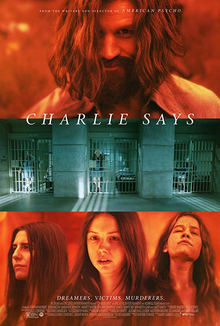
This was something that I found myself thinking about as I watched the 2018 film, Charlie Says. Charlie Says is one of the many recent films to explore how a grubby ex-con named Charles Manson (Matt Smith) was able to brainwash a group of hippies and turn them into his own personal army of murderers. Charlie Says opens with Leslie Van Houten (Hannah Murray), Patricia Krenwinkel (Sosie Bacon), and Susan Atkins (Marianne Rendon) already in prison for the Tate-LaBianca murders. A social worker named Karlene Faith (Merritt Weavers) is assigned to teach them college classes but Karlene is more concerned with trying to break the mental-hold that Manson continues to have over the three women.
The film is full of flashbacks to life at the Spahn Ranch with Charles Manson. All of the expected details are included. Charles Manson plays his guitar and talks about letting go of one’s ego. A dazed Tex Watson (Chace Crawford) wanders around in the background, eager to prove that he truly is a member of the Family. Blind George Spahn gets a handjob from Squeaky Fromme. The women search through dumpsters for food. The orgies give way to violence as Manson realizes that he’s never going to be a rock star. Everyone at Spahn Ranch is happy until they aren’t.
Both the film and Karlene speculate as to how Charles Manson managed to brainwash the women who lived at the Ranch. The film suggests that it was a combination of drugs, Manson’s own skills as a con man, and the fact that most of Manson’s followers were so eager to escape the patriarchal system under which they grew up that they didn’t realize that they had wandered right into another. Of course, it could also be that Manson’s followers were just extremely stupid. One thing that I have discovered from reading about Manson is that, while there was many people who decided to follow him, there were even more who took one look at him and Spahn ranch and who, much like Brad Pitt in Once Upon A Time In Hollywood, left as quickly as they could.
(One of the more interesting things about the online reaction to Once Upon A Time In Hollywood were the complaints that the film’s finale was misogynistic due to the violent deaths of the Manson followers. Personally, I’m against the death penalty. I view it as a classic example of putting too much trust in the government. However, knowing what was done to Sharon Tate, I had no problem with Leonardo DiCaprio setting Susan Atkins on fire with his flame thrower.)
Mary Harron has directed many good films, including I Shot Andy Warhol, American Psycho, The Notorious Bettie Page, and The Anna Nicole Story. Unfortunately, Charlie Says often feels like it’s meant to be a parody of all the other films about Charles Manson. Some of that may have been unavoidable. The horrific nature of their crimes has often overshadowed the fact that Manson and the Family were a ludicrous group of people. Take out the crimes and they were essentially the real-life version of those dumbass commune dwellers in Easy Rider, the one who were trying to grow food in the desert. Indeed, one of the smartest thing that Tarantino did with Once Upon A Time In Hollywood was that he used Manson and the Family sparingly. As Charlie Says shows, the more time that a film spends with Manson, the more difficult it is to feel that the members of the Family are worth much consideration. For the most part, the film follows Leslie Van Houten as she goes from being an insecure teenager to being a brainwashed murderer but, despite a strong performance from Hannah Murray, it doesn’t offer up much insight (beyond her own stupidity) as to how and why Leslie was so easily seduced into life at the ranch.
On the plus side, Matt Smith does a good job as Charles Manson, playing him as being a natural born con man. As played by Smith, Manson is someone who knows how to use his hippie image to his advantage and who also knows how to read people. The question about Manson has always been whether he believed all of his Helter Skelter nonsense or if he was just a criminal mercenary. (The author Ed Sanders, who wrote The Family and spent years researching Manson, was of the opinion that Manson was far more well-connected with the leaders of Los Angeles’s organized crime scene that his hippie image might have suggested.) Charlie Says suggests that Manson was a con man who ultimately made the mistake of believing his own con.
As far as Manson films go, Charlie Says doesn’t add much that hasn’t already been said. Personally, I could do without anymore Manson films. There’s nothing left to be learned from his horrific crimes. Allow Once Upon A Time In Hollywood to be the last word on what the Family was and how they deserved to go out.


 Through the Shattered Lens