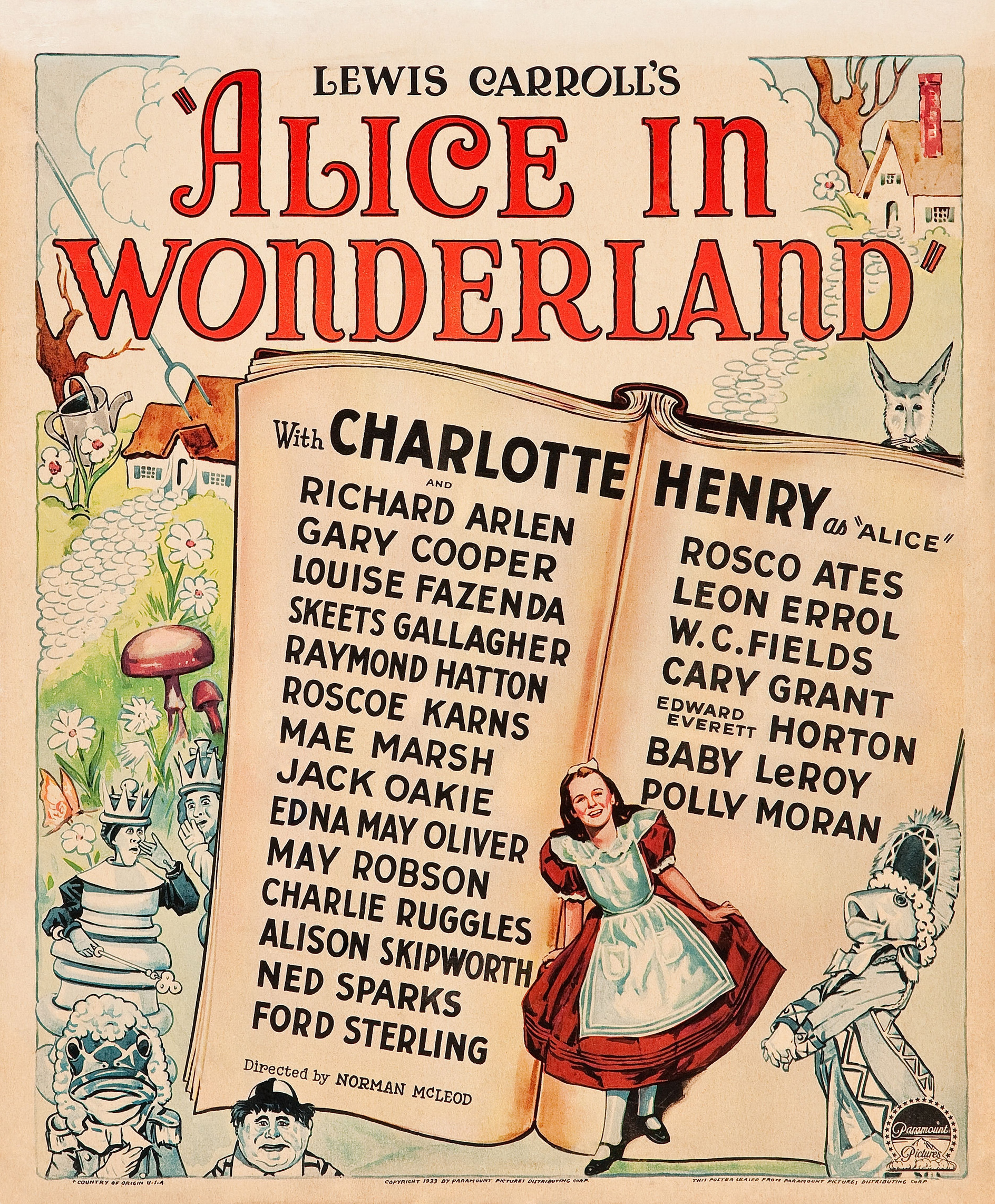
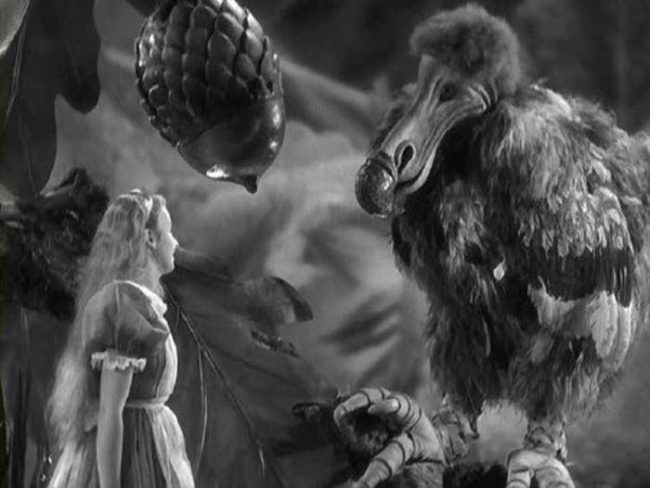
Lewis Carroll’s 1865 children’s classic ALICE IN WONDERLAND was turned into an all-star spectacular by Paramount in 1933. But the stars were mostly unrecognizable under heavy makeup and costumes, turning audiences off and causing the film to bomb at the box office. Seen today, the 1933 ALICE is a trippy visual delight for early movie buffs, thanks in large part to the art direction of William Cameron Menzies.
Menzies’ designs are truly out there, giving ALICE the surrealistic quality of the books themselves. He actually storyboarded his ideas right into the physical script, earning a co-writer credit along with Joseph L. Mankiewicz . Menzies was the cinematic wizard whose art direction brought the magical 1924 THE THIEF OF BAGDAD to life. He was co-director and special effects designer for 1932’s CHANDU THE MAGICIAN, and the title of Production Designer was invented for him on the classic GONE WITH THE WIND. Menzies also directed a few films; especially of…
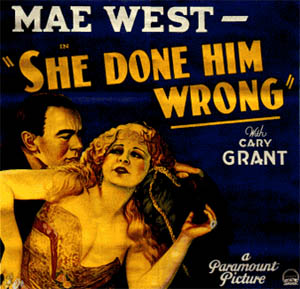
When watching the 1933 film She Done Him Wrong, it helps to know a little something about American history.
It helps to know that the film was made at the tail end of the failed progressive experiment known as prohibition, an attempt to ban liquor in the U.S. which only served to make people idolize criminals and feel nostalgic for the time when you could just safely hang out in a saloon and get drunk with bunch of shady characters.
It helps to know that this film was made at a time when America was struggling through the Great Depression and, more than ever, movies were seen as an escape from reality. The Depression also created a situation where, much like today, most Americans felt as if they were on the outside of the good life and, as a result, the most successful films of the time deal with outsiders getting something over on the smug and judgmental insiders.
It also helps to know that She Done Him Wrong was one of the last of the pre-Code films. Though, by modern standards, the film may seem outwardly tame, the innuendo and subtext is anything but. In fact, She Done Him Wrong was considered to be so racy that some people were actually scandalized when it became the biggest box office success of 1933. (These were largely the same people who, 13 years before, celebrated the passage of prohibition.) The infamous production code was largely instituted to make sure that a film like She Done Him Wrong could never be given another chance to corrupt filmgoers.
What exactly made She Done Him Wrong so controversial?
Well, it took place in a saloon in 1890s. The saloon is owned by Gus (Noah Beery), who uses it as a front for prostitution and counterfeiting. This is a film that features a lot of people drinking a lot of alcohol and it’s also a film that goes so far as to suggest that having a drink or two is not necessarily the worst thing in the world. Captain Cummings (Cary Grant) runs a city mission that has opened up next to the bar and the film devotes a lot of time to poking fun at Cummings’s upright morality. (Of course, Cummings has a secret of his own, one which suggests that his crusading attitude is just a convenient disguise.) Though it would be repealed by the end of the year, Prohibition was still the law of the land when She Done Him Wrong was released and it’s fun to see how much the film has at the law’s expense. That’s the type of fun that would basically be banned by the Production Code.
The Production Code would also require that all criminals be punished for their crimes by the end of a film. In She Done Him Wrong, singer Lady Lou (Mae West) stabs to death the viscous Russian Rita (Rafaela Ottiano) and basically gets away with it. It’s true that Lou was acting in self-defense but what makes She Done Him Wrong unique (for its time) is that Lou shows no remorse and that the killing is handled rather flippantly. When the police, who have been searching the saloon for another criminal, burst into the room after Rita has been stabbed, Lou fools them by placing Rita’s corpse in a chair and combing her hair. (“Haven’t you ever seen anyone comb someone’s hair before?”) After the police leave, Lou has her bodyguard dispose of the body and Rita is never mentioned again. Again, this is something that would never be allowed happen under the Production Code.
And then there’s the naked painting of Lou that hangs in the saloon. Whenever it’s shown a screen, a man in a hat happens to be standing in just the right position to block the viewer from seeing the entire portrait. Again, this would never have been allowed to happen under the Production Code.
And perhaps the biggest indication that this is a Pre-Code film is Mae West herself. Reportedly, She Done Him Wrong was an extremely toned down version of West’s stage act but what was heard on-screen would certainly be enough to throw the guardians of decent society into a panic. Nearly every line that she utters in this film is a double entendre but it’s not only what Mae West says. It’s the way that she says it. West may not have been a great actress but she had enough attitude that she didn’t need to be. With every line, with every glance, with every movement, Mae West announces that she not only has sex but she enjoys it too. In the Pre-Code days, that was unusual. Once the Production Code went into effect, such a portrayal would be impossible.
As for the film itself — well, it’s pretty much just an excuse for Mae to be Mae. There’s a plot, of course. Lady Lou has many suitors and they all converge on the saloon at the same time. However, Lou’s got her eye on the upstanding Captain Cummings. (He’s a man in uniform, after all.) It’s not a great film by any stretch of the imagination but, if you’re into film history or if you’re curious to see how American social mores have changed (and occasionally, not changed) over the years, She Done Him Wrong is a must see.
She Done Him Wrong is only 66 minutes long and it’s the shortest film to ever receive an Oscar nomination for best picture. It received no other nominations and lost to Cavalcade.
First off, a warning. The following review of the 1941 best picture nominee Suspicion will include spoilers. So, if you haven’t seen the film and you’re obsessive about avoiding major spoilers, then don’t read the review. Simple, no?
Two years ago, I was having lunch with some of my fellow administrative assistants. One of them was talking about how she had watched an “old movie” the previous night. From listening to the vague details that she offered up, I was able to figure out that she had apparently stumbled across TCM for the first time in her life. From listening to her talk, I would not be surprised if she was literally describing the first time she had ever actually seen a black-and-white movie. Needless to say, my first instinct was to correct everything she was saying but I resisted. (For some reason, at that time, I was feeling self-conscious about being perceived as being a know-it-all.) But, as she kept talking, I found it harder and harder to keep quiet. Listening to her talk about old movies was like attending an art history lecture given by someone who had flunked out of a finger painting class. Finally, when the conversation had moved on to someone who we all knew was sleeping with her much older boss, our self-proclaimed old film expert announced that age didn’t matter. “I’d go out with Cary Grant,” she said, “and he’s old.”
Before I could stop myself, I added, “He’s also dead.”
Oh my God, the look of shock on her face! I actually felt really guilty because I could tell that she had apparently taken a lot of happiness from the idea that suave, witty, and handsome Cary Grant was still out there. And can you blame her? In a career that spanned three decades and included several classic dramas and comedies, Cary Grant epitomized charm. Some of his movies may seem dated now but Grant was such a charismatic and natural actor that it’s impossible not to get swept up in his performances.
(Who would be the contemporary Cary Grant? I’ve heard some people compare George Clooney to Grant. And it’s true that Clooney has Grant’s charm but, whereas Grant always came across as very natural, you’re always very aware that George Clooney is giving a performance.)
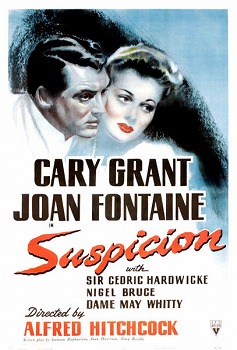
It was Grant’s charm that made him the perfect choice for the male lead in Suspicion but it was that same charm that made the film so controversial. In Suspicion, Grant plays Johnnie. Johnnie meets, charms, and — after the proverbial whirlwind courtship — marries Lina (Joan Fontaine), a sheltered heiress. It’s only after Lina marries Johnnie that she discovers that he’s broke, unemployed, and addicted to gambling. With everyone from her family to her friends telling her that Johnnie is only interested in her money, Lina starts to worry that Johnnie is plotting to kill her. Lina starts to view all of Johnnie’s actions with suspicion, wondering if there’s an innocent explanation for his occasionally odd behavior or if it’s all more evidence that he’s planning to kill her. When he brings her a glass of milk, Lina has to decide whether or not to risk drinking it…
Suspicion was based on a novel in which Johnnie was a murderer and which ended with Lina voluntarily drinking that poisoned milk. In the film, however, Johnnie is not a murderer. Apparently, it was felt that Grant was so charming and so likable that audiences would never accept him as a murderer. Instead, he’s an embezzler and all of his strange behavior is due to him being ashamed of his past and feeling that he’s not worthy of Lina. Once Lina realizes that Johnnie isn’t trying to kill her, she promises him that she’ll stay with him.
And a lot of people (including director Alfred Hitchcock, who claimed it was forced on him by the film’s producers) have criticized that ending but you know what?
It works. If I had to choose between Joan Fontaine essentially committing suicide or Joan Fontaine promising to love Cary Grant even if Grant goes to prison, I’m going to go with the second choice. Ultimately, Suspicion works because you can imagine being swept off your feet by Grant’s character. But what makes Suspicion enjoyable, to me, is that Johnnie ultimately turns out to be exactly who we were hoping he would be.
Needless to say, Suspicion works as a great double feature with Rebecca. Watch one after the other and have a great night of menace and romance.
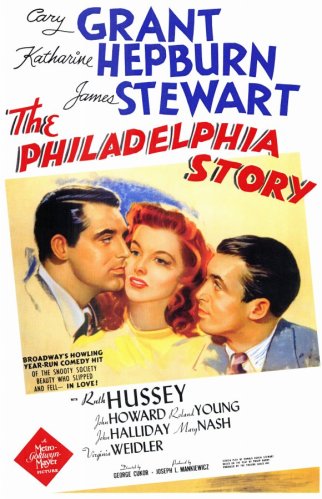
There are a few reasons why The Philadelphia Story was one of those films that I had been meaning to watch for a while. For one thing, The Philadelphia Story was nominated for best picture of 1940 (it lost to Alfred Hitchcock’s Rebecca) and my ultimate goal is to see and review every single film ever nominated for best picture. The other reason is that Jimmy Stewart won an Oscar for his performance in The Philadelphia Story and anyone who doesn’t love Jimmy Stewart has obviously never seen Anatomy of a Murder (not to mention It’s a Wonderful Life!).
Well, The Philadelphia Story was on TCM last night and I finally got to see it and what can I say? I absolutely loved it. For a 74 year-old, black-and-white comedy, The Philadelphia Story is still a lot of fun.
The Philadelphia Story tells the story of Tracy Lord (Katharine Hepburn), a wealthy socialite who is engaged to marry George Kitteridge (John Howard), a self-described “man of the people,” who is widely respect for both his strong moral character and the fact that — unlike most of Tracy’s friends — he made his fortune as opposed to inheriting it.
It would be tempting to reach into the bag of simplistic blogging clichés and call the Lords a 1940s version of Khardashians but I’m not going to do that because the Lords have a lot more wit and class. My favorite member of Tracy’s family was Dinah (Virginia Wiedler), her teenage sister who is sarcastic, cheerfully cynical, and has no problem demanding to be the center of attention. My sister Erin claims that the reason I liked Dinah is because I saw a lot of myself in the character and that’s probably true. However, I have to say that the great thing about both Tracy and Dinah is that they were both wittier, classier, and better dressers than all of the Khardashians and Jenners combined.
Anyway, the evil editor of Spy Magazine, Sidney Kidd (Henry Daniell), wants to get pictures of Tracy’s very exclusive and very private wedding so he sends two of his reporters in under cover. Mike Connor (James Stewart) is a frustrated writer who hates having to lower himself to writing for a tabloid. Photographer Liz (Ruth Hussey) is secretly in love with Mike. Helping Mike and Liz pass themselves off as friends of the family is Tracy’s ex-husband, C.K. Dexter Haven (Cary Grant).
As quickly becomes obvious, Dexter is still in love with Tracy. However, Tracy divorced Dexter because Dexter was an irresponsible alcoholic and, even though Dexter has changed his ways and she is still obviously attracted to him, Tracy is now engaged to the morally upright but boring and judgmental George.
However, Tracy is not just torn between George and Dexter. She is attracted to Mike as well, to the extent that Tracy even takes the trouble to read some of Mike’s short stories. For only the second time in her life, Tracy gets drunk and goes for a midnight swim with Mike. This, of course, leads to the best scene in The Philadelphia Story: Jimmy Stewart singing Somewhere Over The Rainbow.
Seriously, the scene made my entire night.
The Philadelphia Story is based on a play and the film itself is rather stagey in that way that films from the 40s often appear to be to modern viewers. But, once you get used to the fact that the movie was made in 1940 and not 2014, it’s a real delight. The dialogue is funny and it’s delivered by one of the best casts ever. Playing a role that was specifically written for her, Katherine Hepburn is brilliant as the strong-willed but unapologetically romantic Tracy and Cary Grant is just as charming as you would expect Cary Grant to be. Best of all, you’ve got Jimmy Stewart singing Somewhere Over the Rainbow and seriously, how can you not love that?
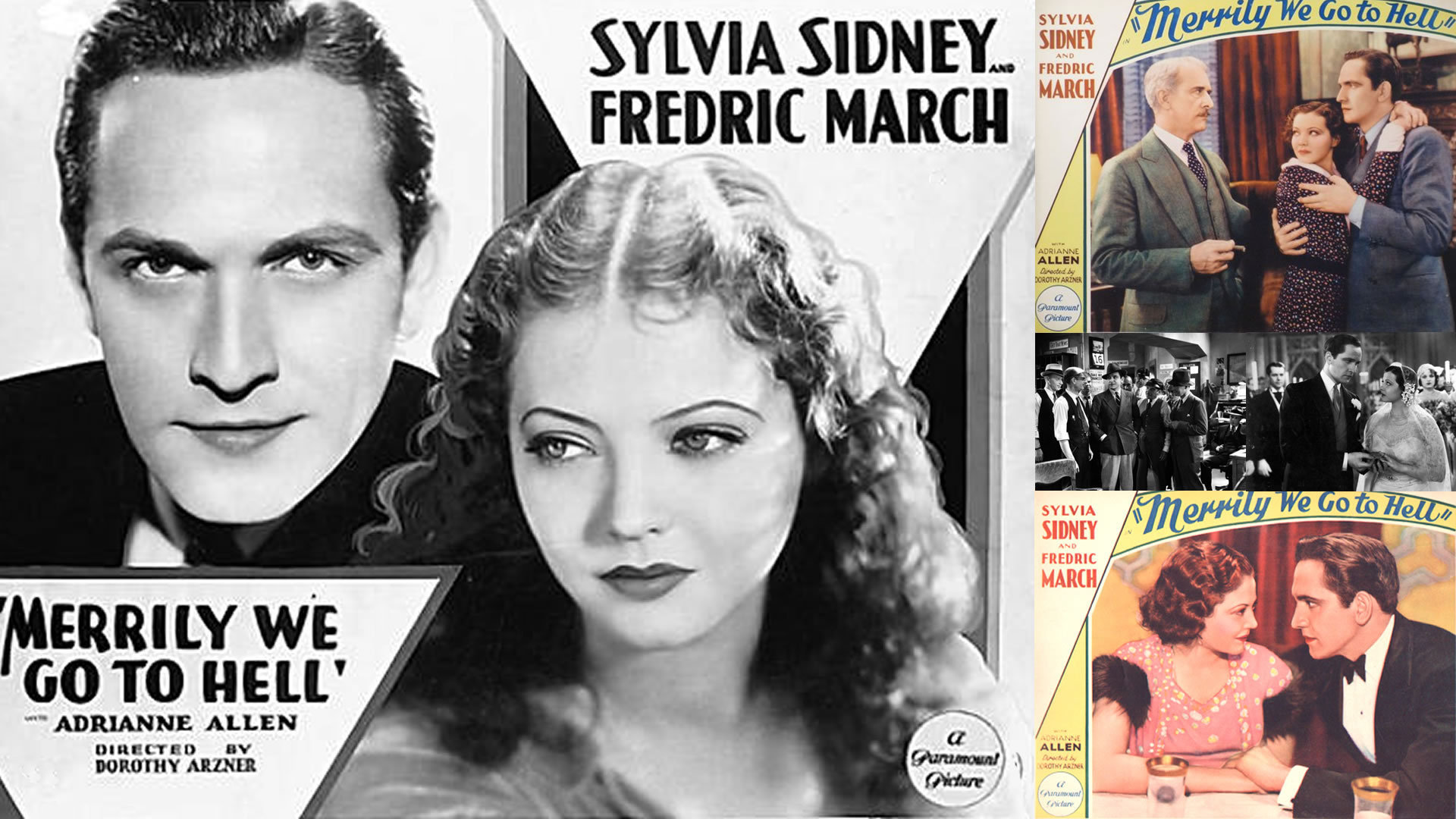
We conclude today’s melodramatic embrace by taking a look at another Pre-Code film. Released in 1932, Merrily We Go To Hell takes a look at one of the institutions that the Production Code was meant to save: marriage. It also takes a look at alcoholism, overprotective fathers, and what goes on backstage during a Broadway production. In many ways, this movie is a comedy but, at heart, it’s a melodrama through and through.
Everyone should have a catchphrase. Myself, for example, I tend to say “Stay Supple” a lot. It drives some people crazy but I like the way it sounds and I also happen to think that it’s a pretty good expression of how I view life. Alcoholic newspaper reporter Jerry Corbett (Fredric March) has a catch phrase of his own. Every time he takes a drink, he toasts with, “Merrily, we go to Hell.” Jerry has been haunted ever since he was dumped by his beautiful girlfriend, actress Claire Hempstead (Adrienne Ames), and he now spends all of his time drinking and dreaming of being a playwright.
However, things start to look up for Jerry when, at one of those decadent rooftop parties that always seem to show up in pre-Code films, he meets an innocent young heiress named Joan (Sylvia Sidney). Jerry and Joan fall in love and, despite the reservations of Joan’s disapproving father (George Irving), they marry. With Joan’s help, Jerry stops drinking and writes his play. It’s called “When Women Say No” and despite the creepy and misogynistic title, it becomes a huge success. Oh, did I say despite? I meant to say because of.
(For those you sitting at home, I am currently dramatically rolling my eyes and shaking my head.)
However, there’s a problem. Guess who is cast as the play’s leading lady? That’s right — Claire! Jerry may love Joan but he’s obsessed with Claire. Having again fallen under her spell, Jerry is soon drinking again and neglecting his wife. However — and this is what distinguishes Merrily We Go To Hell from even most films made today — Joan doesn’t just silently accept Jerry’s infidelity or sit around obsessing on how she can get her husband back. Instead, she decides that if he can do it, she can do it. And who can blame her when Charlie Baxter is around? Not only is Charlie suave and handsome but he’s played by none other than Cary Grant!
Merrily we go to Hell indeed!
Merrily We Go To Hell is available as a part of the Pre-Code Hollywood Collection and I think it makes for a good double feature with The Cheat. (The people who put together the Pre-Code Hollywood Collection obviously agreed with me because they put both films on the same disc.) While Merrily We Go To Hell is, at heart, a very serious movie, it begins with a deceptively light touch. Fredric March was such a charming actor and seems to be having so much fun playing Jerry as a charming and well-meaning fuckup, that you actually are surprised when the film reveals just how desperate a character he really is. This is the epitome of the type of film that makes you laugh at the start just so it can make you cry at the end.
Incidentally, Merrily We Go To Hell was directed by Dorothy Arzner, one of the only female directors to work in Hollywood during the studio era. As a director, she understands that, at heart, Merrily We Go To Hell is Joan’s story. Whereas a male director would probably have focused almost exclusively on Jerry and used Joan as a mere plot device, Arzner is more interested in exploring why Joan marries Jerry in the first place and how she deals with the inevitable discovery that there’s actually less to Jerry than first met the eye. It’s that perspective that ultimately elevates Merrily We Go To Hell above the level of being a mere domestic dramedy and makes it worth watching 82 years after it was first released.

 Through the Shattered Lens