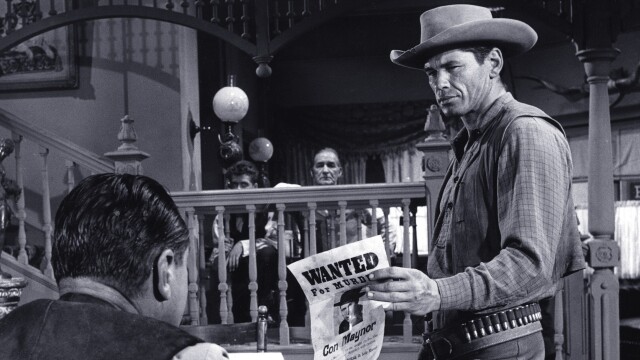
1958 was an interesting year for 36-year-old Charles Bronson. After mostly playing character parts on movies and TV for the first part of the decade, Bronson would star in four movies in 1958 and also headline his own TV show. On first glance, the western SHOWDOWN AT BOOT HILL would appear to fit nicely into the image that Bronson would project during the heights of his popularity in the 70’s and 80’s. But upon further inspection, this little gem shows us a side of Bronson we rarely would get to see in his heyday.
The story opens with Luke Welsh, played by Bronson, riding into a dusty western town. After dropping his horse off at the livery stable, Welsh strolls into the local restaurant and immediately confronts town citizen Con Maynor. It’s here that we learn that Welsh is a bounty hunter and Maynor is a wanted man. A gunfight ensues and Maynor is gunned down. All Welsh needs is the local authorities to confirm the identity of Maynor so Welsh can collect his bounty. Unfortunately for Welsh, it seems the townsfolk like Con Maynor so they refuse to confirm his identity. This leads to Welsh having to stay in town until he can get someone, anyone, to agree to the name of the dead man.
All of this sounds pretty normal for a western headlined by Charles Bronson. He is a tough guy of action for sure, but there are several things in the film that are quite unique in the Bronson filmography. Let me explain. First, Bronson’s character, Luke Welsh, is extremely insecure about his height, and this turns out to be an ongoing plot device in the film. In the gunfight with Maynor that opens the film, the wanted man refers to Welsh as “pint-sized,” and after gunning him down, Welsh responds with “how tall are you now, big man?” Later in the film, the local storekeeper, Mrs. Bonaventura, notices Welsh looking up at a mannequin in the store that he is standing by. Being a wise lady, she immediately recognizes his insecurity and offers him kind words and encouragement multiple times throughout the film. Many people who have followed Bronson’s career know that the actor was, in fact, insecure about his height and would often insist that his co-stars be no taller than him. I think Bronson’s ability to sympathize with this element of the character would result in a very strong performance. When you think of the characters he played after he hit it big, this type of insecurity would not be featured again in his work.
Another thing that makes SHOWDOWN AT BOOT HILL unique is the fact that Charles Bronson’s character Luke Welsh shows more vulnerability in his relationships than what we would see later in his career. I’ll use his relationship with the lonely young woman, Sally Crane, to illustrate this point. After recognizing how rough her hands are from her work at the restaurant, Welsh goes out of his way to purchase her some hand cream at Mrs. Bonaventura’s shop. When he’s giving her the hand cream in her room, he notices just how plain the room is and begins to see that Sally is doing everything in her power to not be noticed and has shut herself off from the world. He recognizes that they’re both just a couple of misfits, with him hiding behind a gun and her hiding behind her apron. Welsh speaks so softly and sweetly to her at different times in the film. I think Bronson does a fine job with this side of his character and shows he could have played more roles with romantic overtones. Even in his films with his wife Jill Ireland, Bronson would rarely show such vulnerability with his female co-stars in future films.
Finally, the actual showdown at Boot Hill that takes place at the end of the film plays out nothing like you would expect in later films like THE MECHANIC, MR. MAJESTYK or DEATH WISH 3. After getting to know many of the local people like Sally & Mrs. Bonaventura, and after having grown tired of never having a place to call home, Welsh makes the only decision that will allow him to stay. I won’t spoil it for you, but in my opinion, it’s an unexpected and wonderful ending for these characters who I had really grown to like throughout the course of this compact, 71 minute film. I highly recommend SHOWDOWN AT BOOT HILL!
We dedicated an episode of the THIS WEEK IN CHARLES BRONSON podcast to this solid western. I’ve attached the link below if you want to know even more about SHOWDOWN AT BOOT HILL.

 Through the Shattered Lens