The setting is the Korean War. After getting information that American POWs are being tortured and brainwashed in North Korean prisoner-of-war camps, Major Hale (Harry Morgan) assigns Webb Sloane (Ronald Reagan) to go undercover. After parachuting behind enemy lines, Webb spots a group of POWs being marched through the snow and joins the group. From the minute that Webb joins the march, he begins to observe war crimes. The death march itself, with the POWs being forced to move in freezing weather, is itself a war crime. At the POW camp, Webb discovers the presence of an arrogant Soviet interrogator (Oscar Homolka) and a routine designed to break the POWs down until their ready to betray their native country. Some POWS, like Captain Stanton (Steve Forrest), refuse to break. Others, like cowardly Jesse Treadman (Dewey Martin), break all too quickly. Webb sends the information back to Hale and eventually tries to make his escape.
It’s not terrible. That the North Koreans and, later, the North Vietnamese tortured their POWs and forced some of them to denounce America is a matter of the historical record and, for a 1954 film, PrisonerofWar doesn’t shy away from the brutality of the torture that POWs were often subjected too. Of all of Reagan’s film, PrisonerofWar had the strongest anti-communist message, though Reagan himself feels miscast as a hard-boiled secret agent. (Reagan’s affability comes through even in a film set in a POW camp.) Sending someone undercover into a prisoner of war camp and then hoping that they’ll find a way to escape doesn’t sound like the most efficient way to determine if the Geneva Convention is being violated.
The film features a dog who is found by one of the POWs. Don’t get attached.
“No, you must not miss the newsreels. They make a point this week no man can miss: The war has strewn the world with corpses, none of them very nice to look at. The thought of death is never pretty but the newsreels testify to the fact of quite another sort of death, quite another level of decay. This is a putrefaction of the soul, a perfect spiritual garbage. For some years now we have been calling it Fascism. The stench is unendurable.”
Those words were written in 1945 by director Orson Welles. He was writing about the footage that had been filmed at the Nazi concentration camps during the final days of World War II. These films not only revealed the crimes of the Third Reich but they also proved the existence of evil. With World War II finally ended and Hitler dead, many people were eager to move on and forget about the conflict. Many even claimed (and some continue to do to this very day) that the reports of the Nazi death camps were exaggerated. Writing in his syndicated column for the New York Post, Welles told those doubters that the reports of the Nazi death camps were not exaggerated and that, unless people confronted the horrors of the Nazi regime by watching the newsreels and seeing for themselves, history would repeat itself.
A year later, Welles would use that documentary footage in a key scene of his 1946 film, The Stranger. A government agent named Mr. Wilson (Edward G. Robinson) shows the footage to Mary Longstreet Rankin (Loretta Young), the daughter of a Supreme Court justice. Wilson is hoping that, by showing her the footage, he’ll be able to convince her to help him bring a Nazi war criminal to justice. Complicating things is that Wilson believe that the Nazi war criminal is Mary’s new husband, Professor Charles Rankin (played by Orson Welles, himself).
In this shot, the horrors of the Holocaust are literally projected onto Edward G. Robinson’s face, a reminder that is on us to prevent it from ever happening again.
Rankin’s real name is Franz Kindler. One of the architects of the Holocaust, he escaped from Germany at the end of World War II and, after making his way through Latin America, he ended up in a small town in Connecticut. He got a job at the local prep school, where he instructs impressionable young minds. He also found the time to work on the town’s 300 year-old clock.
When we first see Kindler/Rankin, he’s walking out of the school and it’s obvious that all of his students love him. Rankin has a quick smile, which he uses whenever he has to talk to Mary or any of the other townspeople. However, that smile disappears as soon as he’s approached by another Nazi fugitive, Konrad Meinike (Konstantin Shayne). Rankin assures Meinike that he’s merely biding his time until he can establish a Fourth Reich. Meinike, meanwhile, announces that he’s found God and he suggests that Rankin should turn himself in. Correctly deducing the Meinike is being followed by Wilson, Rankin promptly strangles his former collaborator and spends the rest of the movie trying to cover up his crimes.
Welles was best known for playing characters who had the potential for greatness in them but who were ultimately brought down by their own flaws. Think about Charles Foster Kane or Harry Lime or the detective in Touch of Evil or even Falstaff in Chimes at Midnight. The Stranger is unique as one of the few instances in which Welles played an outright villain. Unlike Kane or Falstaff, there’s no greatness to be found in Rankin/Kindler. He’s fooled the town into thinking that he’s a good man but, instead, he’s a soulless sociopath who is even willing to murder his wife if that’s what he has to do to protect his secret. Franz Kindler is the Third Reich and, by having him thrive under a new name in America, Welles argues that the Nazi threat didn’t end just because Hitler killed himself in Berlin.
The Stranger was Welles’s third completed film as a director. It was a film that he reportedly agreed to direct in order to prove that he was capable of bring in a film on budget and ahead-of-schedule. Because Welles was largely acting as a director-for-hire on this film, there’s a tendency to overlook The Stranger when discussing Welles’s films. While that’s understandable, The Stranger is clearly a Welles film. From the use of shadow to the skewed camera angles, the film has all of Welles’s visual trademarks. Thematically, this is another one of Welles’s films about a man who is hiding a secret underneath his ordinary facade.
It’s a good film, with Welles giving an appropriately evil performance as Kindler and Loretta Young providing strong support as Mary. That said, the film’s soul is to be found in Edward G. Robinson’s performance. Robinson was born Emmanuel Goldenberg in Romania. In 1904, his family fled to America after one of his brothers was attacked by an anti-Semitic mob. As someone who had experienced anti-Semitism firsthand, Robinson brought a righteous fury to the role of Mr. Wilson. Wilson isn’t just pursuing a fugitive in The Stranger. Instead, he’s seeking justice for the six million Jews who were murdered by men like Franz Kindler.
The Stranger is an important film and it seems like the right film with which to end my 30 Days of Noir. Noirvember is ending and so ends our 30-day walk through the shadowy streets of noir cinema.
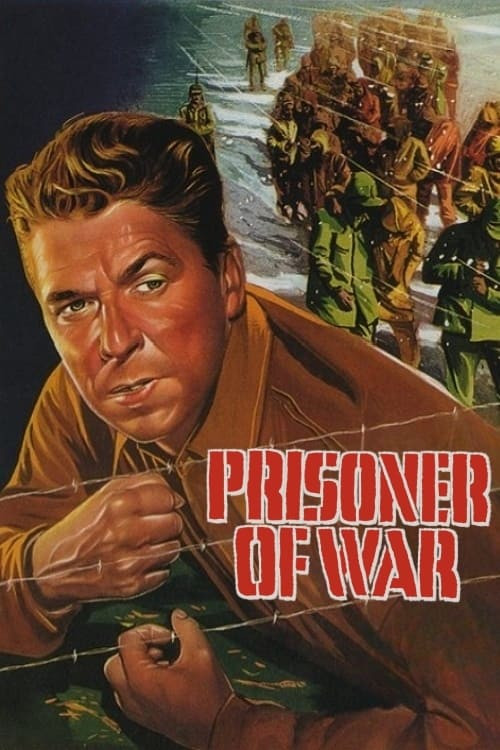 The setting is the Korean War. After getting information that American POWs are being tortured and brainwashed in North Korean prisoner-of-war camps, Major Hale (Harry Morgan) assigns Webb Sloane (Ronald Reagan) to go undercover. After parachuting behind enemy lines, Webb spots a group of POWs being marched through the snow and joins the group. From the minute that Webb joins the march, he begins to observe war crimes. The death march itself, with the POWs being forced to move in freezing weather, is itself a war crime. At the POW camp, Webb discovers the presence of an arrogant Soviet interrogator (Oscar Homolka) and a routine designed to break the POWs down until their ready to betray their native country. Some POWS, like Captain Stanton (Steve Forrest), refuse to break. Others, like cowardly Jesse Treadman (Dewey Martin), break all too quickly. Webb sends the information back to Hale and eventually tries to make his escape.

 Through the Shattered Lens