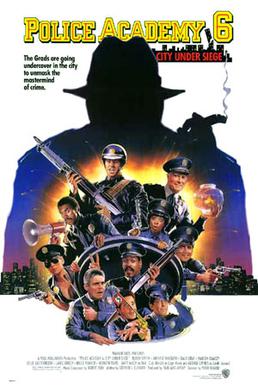
Police Academy 6: City Under Siege (1989, directed by Peter Bonerz)


The sixth Police Academy film opens with another crime wave.  Considering that the Police Academy Class of 1984 was supposedly the best to ever graduate, they don’t seem to have done much to clean up the city.  This time, a series of robberies are being committed in the Wilson Heights neighborhood.  Since Captain Harris (G.W. Bailey) and Lt. Proctor (Lance Kinsey) don’t seem to be capable of upholding the law in their precinct, the Mayor (Kenneth Mars) orders Harris to work with Commandant Lassard (George Gaynes) and the usual gang of Police Academy graduates.

Carey Mahoney is still missing in action but Nick Lassard (Matt McCoy) has transferred up from Miami and has taken Mahoney’s place as the resident smartass.  Also returning are Sound Effects Man (Michael Winslow), Hightower (Bubba Smith), Hooks (Marion Ramsey), Callahan (Leslie Easterbrook), Tackleberry (David Graf), and, after having been absent for the previous two films, Sgt. Fackler (Bruce Mahler)!

I cannot believe I’m saying this but Police Academy 6 turned out to be better than I remembered.  It’s just as stupid as all of the other Police Academy films but everyone seems to be having a good time and Matt McCoy no longer feels out of place as Mahoney’s replacement.  Bruce Mahler’s return as Fackler also means a return to the physical comedy that he excelled at in the first two films and the total incompetence of Harris and Proctor is handled better here than it was in the previous few films.  A welcome addition to the cast is Gerrit Graham, as the childish head of the robbers.  (Whereas the previous few films at least tried to pretend like the criminals were a potentially serious threat, City Under Siege presents them as being as clownish as everyone else in the film.  It’s a better approach because it’s not as if anyone watches a Police Academy film expecting to see something like The French Connection or Fort Apache, The Bronx.Police Academy 6 is a stupid, stupid movie and the jokes are as juvenile as ever but, along with Part 3, it’s still one of the better sequels.

Police Academy 6 was the first Police Academy film to not be a box office hit.  It would be followed by one final sequel, Mission to Moscow, which I’ll take a look at on Saturday.

Police Academy 3: Back in Training (1986, directed by Jerry Paris)


Police Academy 3 opens with a state in the middle of a fiscal crisis.  Money has to be saved somewhere and the governor (Ed Nelson) has decided that it’s not necessary for the state to have two police academies.  I am not sure why the governor would be the one to make that determination since the previous two Police Academy films established that the academies are run by the city but I guess I should remember that I’m watching a Police Academy film and not ask too many questions.

Which academy is going to be closed down?  Will it be the academy run by Commandant Lassard (George Gaynes) or the one run by Commandant Mauser (Art Metrano, returning from the second film)?  Mauser is willing to use any dirty, under-handed trick to keep his academy open.  Meanwhile, Lassard has his most recent graduating class returning to instruct his latest batch of recruits.  Can Mahoney (Steve Guttenberg) and Michael Winslow’s human sound effects machine save the academy?

When I watched Police Academy 3 this weekend, I was surprised to discover that it wasn’t as bad as I remembered.  Maybe it’s because I watched it immediately after the first two films and my senses were dulled but Police Academy 3 turned out to be an amiable and enjoyably stupid comedy. It helped that two of the new recruits were played by Tim Kazurinsky and Bobcat Goldthwait.  Returning to the roles that they first played in the second movie, Kazurinsky and Goldthwait make for a good comedic team.  As for the rest of the Police Academy regulars, they all do their usual comedy bits like pros and without any fuss.  It’s predictable and sometimes, funny.

Police Academy 3 was the first Police Academy film to have a PG-rating and, as a result, the jokes were still as juvenile and crude as the first two movies but, at the same time, Police Academy 3 seems to have made peace with the fact that it’s target audience was a bunch of adolescent boys dropped off at the theater by their mothers.  Mauser is still regularly humiliated but no one gets a blow job while standing in front of a podium.  This is a Police Academy for the entire family, assuming that your family is easily amused and not too demanding.

Police Academy 3 is a dumb movie and the recurring joke about policemen accidentally entering the Blue Oyster Bar is even less funny the third time that it’s used.  There’s also a Japanese recruit who only seems to be included because, back in the 80s, American films were obsessed with making fun of Japan.  Despite all that, Police Academy 3 is still not as bad as the usual Police Academy sequel.

But what about Police Academy 4?  Check in tomorrow to find out if it’s also better than I initially remembered.

(It’s not.)

Police Academy 2: Their First Assignment (1985, directed by Jerry Paris)


In an unnamed city that is probably meant to be Los Angeles but which looks like Toronto, a criminal gang known as the Scullions have taken over the 16th precinct.  Led by the loud, marble-mouthed Zed (Bobcat Goldthwait), the Scullions are terrorizing the citizens and harassing one shop owner, Carl Sweetchuck (Tim Kazurinsky), in particular.  The captain of the 16th precinct, Pete Lassard (Howard Hesseman), calls his brother, Eric Lassard (George Gaynes), and asks for the best cadets to have recently graduated from the police academy.

Carey Mahoney (Steve Guttenberg) and a few other of the cadets from the first Police Academy movie end up in the 16th.  Tackleberry (David Graf) is there and so is accident-prone Douglas Fackler (Bruce Mahler).  Bubba Smith is back as Hightower and so is Michael Winslow, the human sound effects machine.  They’re determined to help Lassard’s brother but it’s not going to be easy because they have to work with Lt. Mauser (Art Metrano) who is basically a dick who wants to be captain.  Mauser is exactly like Harris from the first film, except his name is Mauser and, instead of getting his head stuck up a horse’s ass, he gets his hands super-glued to his head.

Police Academy 2 is less raunchy than the first film but still not quite as family friendly as the films that would follow.  There’s still one f-bomb dropped and a few adult jokes, as if the film wasn’t fully ready to admit that it was destined to become associated with juvenile viewers who would laugh at almost anything involving a bodily function.  There is one funny moment where Steve Guttenberg goes undercover to join Zed’s gang, mostly because he’s Steve Guttenberg and he’s even less believable as a gang member than he was as a cop.  The closest thing that movie has to a highlight is Bobcat Goldthwait’s manic turn as Zed and Tim Kazurinsky’s desperation as he watches his store get repeatedly destroyed.  Tackleberry also gets an amusing romantic subplot, where he meets a police woman (Colleen Camp) who loves guns almost as much he does.  Unfortunately, Tackleberry’s romance gets pushed to the side by all of the gang activity.

Police Academy 2 is stupid but, depending on how much tolerance you have for Bobcat Goldthwait, sometimes funny.  It’s not as “good” as the first film but it’s still better than most of what would follow.  Speaking of which, tomorrow, I will be reviewing the first Police Academy film to get a PG-rating, Police Academy 3: Back in Training.

Police Academy (1984, directed by Hugh Wilson)


God help us, it has come to this.  After a month and a half being locked down, Lisa and I watched the first two Police Academy movies last night.

The first Police Academy takes place in an unnamed city that appears to be in California.  Due to a shortage of officers, the mayor has announced that the police academy will now accept anyone who wants to apply, regardless of their physical or mental condition.  Naturally, this leads to a collection of misfits applying.  Martinet Lt. Harris (G.W. Bailey) is determined to force all of them to drop out of the academy and he has a point because I wouldn’t trust Michael Winslow’s human sound effects guy to investigate any crimes that were committed in my neighborhood.  What’s he going to do?  Make silly noises while I’m trying to figure out who stole my car?

The leader of the recruits is Carey Mahoney (Steve Guttenberg).  Mahoney is being forced to attend the academy because otherwise, he’ll have to go to jail for disturbing the peace.  Police Academy is a film that asks you to believe that a character played by Steve Guttenberg has not only frequently been in trouble with the law but would also make a good cop. Guttenberg doesn’t really do a bad job as Mahoney.  He’s a likable actor, even if his filmography has more duds than hits.  But he’s still miscast in a role that demands someone like Bill Murray, who could be both tough and funny.

The other recruits include Bubba Smith as Hightower and David Graf as the insane gun nut, Tackleberry.  Kim Cattrall is the rich girl who wants to be a cop and who falls in love with Mahoney.  George Gaynes is Commandant Lassard, who is out-of-it but not as out-of-it as he would be in the sequels.

You have to wonder how many parents, in the late 80s and early 90s, allowed their children to rent the R-rated Police Academy from the local video store without realizing the the first Police Academy is considerably more raunchy than the later sequels.  How did mom and dad react when they walked into the room and discovered their children watching Georgina Spelvin giving George Gaynes a blow job from underneath a podium?  Or how about the scene where recruit George Martin (Andrew Rubin) is spied having a threesome in the girl’s dorm?  The first Police Academy film is definitely made from the same mold as Animal House, Caddyshack, and Stripes.  It’s just not as funny as any of those films.

However, it is funnier than every Police Academy film that followed it.  There’s enough solid laughs to make the first Police Academy fun in a stupid way.  For instance, just about every scene involving accident-prone Cadet Fackler (Bruce Mahler) was funny.  Bubba Smith gets a lot of laughs just by being Bubba Smith in a stupid movie.  It’s also hard not to love it when Cadet Hooks (Marion Ramsey) yelled, “Don’t move, Dirtbag!”  Hell, I even laughed at the sound effects guy once or twice.

All of the Police Academy films are now on Netflix.  Tomorrow, we’ll take a look at Police Academy 2: Their First Assignment.