Late Night Retro Television Review: CHiPs 2.19 “Bio-Rhythms”


Welcome to Late Night Retro Television Reviews, a feature where we review some of our favorite and least favorite shows of the past!  On Mondays, I will be reviewing CHiPs, which ran on NBC from 1977 to 1983.  The entire show is currently streaming on Freevee!
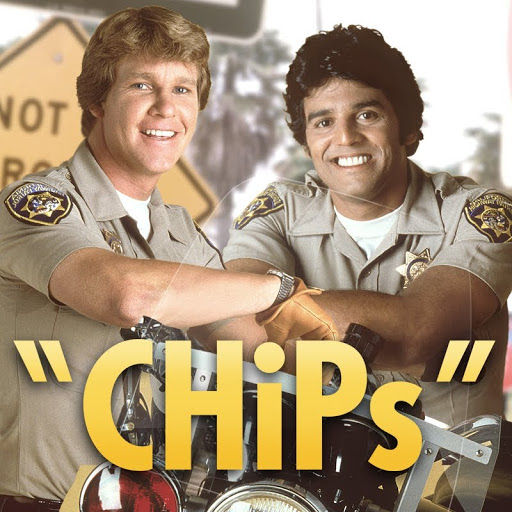
This week, it’s all about bio-rhythms!

Episode 2.19 “Bio-Rhythms”

(Dir by Don Weis, originally aired on February 17th, 1979)

The Davis family is back!

Now, if you don’t remember the Davises. they were the family of independent truckers who appeared in an episode called The Volunteers.  Patriarch Charley Davis (Tige Andrews) is taciturn and protective.  Their friend, Sam (Steve Franken), is taciturn and protective …. actually, to be honest, he and Charley are kind of interchangeable.  Daughter Robbie (Katherine Cannon) is in charge of the business and is being pressured by another trucker (Michael Conrad), who is willing to resort to sabotage to keep Robbie from making her deliveries.  It’s a good thing that Robbie has got Ponch on her side!

Technically, Robbie also has Baker on her side but this is definitely a Ponch episode.  Baker is present but he does very little.  Instead, it’s Ponch who flirts with Robbie.  It’s Ponch who stops by Robbie’s apartment and uses her shower.  It’s Ponch who spends an extended period of time wearing just a towel.  Somewhat inevitably, Charley shows up around the same time that Ponch steps out of the shower.  Ponch is kicked out of the apartment and his clothes are tossed out the window.  Ponch loses his towel while retrieving his clothing.  Cue the close-ups of an old woman staring at him with a impressed look in her eyes and Erik Estrada flashing his Estrada smile.  It’s not that Erik Estrada wasn’t nice to look at.  It’s just that he was so obviously aware that he was nice to look at that the whole scene ends up feeling rather smarmy.  One gets the feeling that there was a clause in Estrada’s contract specifying that he, and only he, would be allowed to show off on the show.

While Ponch helps Robbie deal with her rivals, he also learns about biorhythms, the pseudo-science that says that, by calculating how long someone’s been alive, it can be determined which days are going to be good for them and which days are going to be bad.  Sindy Cahill is doing a study on biorhythms for her master’s degree.  Getraer tells his squad that the department is also very interested in whether or not biorhythms effect an officer’s productivity.  Baker is skeptical about biorhythms but Ponch believes in them and even buys a biorhythm calculator.

Believing the Baker’s biorhythms have him at peak physical perfection, Ponch arranges for Baker to play handball against Getraer.  Ponch even takes bets.  Unfortunately, Ponch spent so much time figuring out Baker’s biorhythms that he never stopped to consider Getraer’s.  The episode ends with Getraer on his way to victory and Baker looking embarrassed.

Handball?  Biorhythms?  Corrupt labor unions?  Could this episode be more Californian?

This episode was fairly dull.  A huge problem was that the Davis family and their drama are never as interesting as the show seems to think that they are.  Much as with The Volunteers, I felt like I was watching a backdoor pilot for a show about the Davises when I really just wanted to watch a show about the Highway Patrol.  This episode didn’t do much for me.  Maybe everyone’s biorhythms were off when they filmed it.
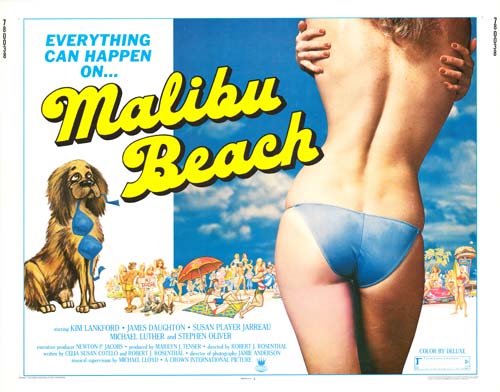
Life is a Beach #2: Malibu Beach (dir Robert J. Rosenthal)


MALIBU-BEACH

Yesterday, I started my 2-week miniseries of reviews on beach movies by taking a look at 1963’s Beach Party.  For my next review, I will be jumping forward 15 years and taking a look at 1978’s Malibu Beach.  

Just by comparing the two films, you can tell that a lot changed during those 15 years.  As opposed to the euphemism-spouting surfers of Beach Party, the teenagers that hang out on Malibu Beach know exactly what they want and they’re not ashamed to say it.  What Beach Party could only hint at, Malibu Beach has the freedom to make explicit.  The film’s poster claims that “everything can happen on Malibu Beach” and, in theory, that’s certainly true.

And yet, at the same time, Malibu Beach has more in common with Beach Party than you might think.  Ultimately, they’re both about the same thing: celebrating the idea of being young and having freedom.  Both films are a bit of a chore to try to watch today but are interesting as cultural time capsules.  Beach Party had no plot.  Malibu Beach has no plot.  Beach Party featured some oddly generic music.  Malibu Beach features the same three generic songs being played over and over and over again.  Beach Party features Erich Von Zipper and his motorcycle gang.  Malibu Beach features a muscle-bound bully named Dugan (Steve Oliver).  Beach Party featured a cameo appearance from Vincent Price.  Malibu Beach features a dog that steals bikini tops.  Beach Party was produced by American International Pictures.  Malibu Beach was produced by Crown International Pictures.

That’s right!  Malibu Beach is a Crown International Picture and anyone who loves 70s exploitation knows what that means.  Malibu Beach is a cheaply produced film that was made to exploit then-current trends and bring in a lot of money.  Like a lot of Crown International Films, it’s technically a pretty bad film but it’s so sincere and honest about what it is that it almost feels petty to be too critical of it.

CIP_Logo

Oddly enough, Malibu Beach pretty much feels like a remake of a previous Crown International Picture, The Pom Pom Girlsthe main difference being that, while the visual style of The Pom Pom Girls was almost oppressively ugly, Malibu Beach at least features some pretty beach scenery.

Much like in the Pom Pom Girls, the heroes of Malibu Beach are two high school jocks, one of whom, Bobby (played by James Daughton, who, that same year, also played the evil Greg in National Lampoon’s Animal House), is dark and brooding while the other, Paul (Michael Luther), is skinny and dorky.

Much as in The Pom Pom Girls, one of the heroes has a nemesis for no particular reason.  Seriously, I never could figure out why Bobby and Dugan hated each other but they certainly did.  What’s odd is that, whenever there’s a confrontation between the two of them, Malibu Beach suddenly gets extremely serious.  Bobby and Dugan glare at each other and speak through clenched teeth.  Suddenly, there’s no music on the soundtrack and all we can hear are seagulls above and the tide rolling in and it all feels very ominous.  I sat through Malibu Beach expecting either Dugan and Bobby to be dead at the end of the film, that’s how seriously their conflict is portrayed.

Also, much like The Pom Pom Girls, Bobby and Paul each have girlfriends.  Paul is dating the spacey Sally (Susan Player).  Bobby, meanwhile, is romancing the new lifeguard, Dina (Kim Lankford).  Dina has a big scene where she tells Bobby that she can’t handle being caught in the middle of his increasingly intense rivalry with Dugan.  Again, it’s a deadly serious scene and it’s just so strange to see it there, awkwardly dropped in between scenes of a bumbling cop smoking weed and a dog stealing bikini tops.

Finally, the main similarity between The Pom Pom Girls and Malibu Beach is that the exact same three songs appear in both films!  Obviously, somebody at Crown International, really loved those three songs.

Malibu Beach is one of those films that was obviously made to appeal to hormonal teens at a drive-in but, by today’s standards, it’s rather tame.  It’s currently playing on Hulu and it’s also available in several of those Mill Creek box sets that we all know and love.  Is the film any good?  No.  Do I recommend it?  Not really.  But, much like Beach Party, it is a portal into the past.

http://www.youtube.com/watch?v=gp9NtaOzd1k