14 Days of Paranoia #3: The Lincoln Conspiracy (dir by James L. Conway)


When it comes to conspiracy theories involving presidential assassinations, the theories surrounding JFK may get all the attention but it’s the theories surrounding the death of Abraham Lincoln are usually far more plausible.

Unless, of course, it’s the theories that are pushed in the 1977 docudrama, The Lincoln Conspiracy.

A mix of documentary-style narration and really cheap-looking historical reenactments, The Lincoln Conspiracy essentially indicts almost everyone who was alive in 1865 as being a part of either the conspiracy or the subsequent cover-up.  Really, it’s remarkable how many historical figures are implicated in this film.

With the Civil War coming to a close, President Lincoln (John Anderson) hopes to pursue a generous reconstruction policy for the former Confederate States.  Secretary of War Edwin Stanton (Robert Middleton), Senator Ben Wade (Dick Callinan), and a host of other are all opposed to this plan, both because they want vengeance and they also want to make as much money as possible off of the Southern cotton fields.  They come up with a plan to impeach Lincoln but, in order to draw up the articles, they have to make sure that Lincoln is not seen for a few days.  When Col. Lafayette Baker (John Dehner) discovers that an actor named John Wilkes Booth (Bradford Dillman) is planning on kidnapping Lincoln, Stanton and his conspirators decide to give Booth their unofficial support.  However, when the plan changes at the last minute and Stanton decides that it would actually be a bad idea to kidnap Lincoln, an angry Booth decides to just kill Lincoln, Andrew Johnson, and William Seward.

Booth succeeds in shooting Lincoln and making his escape.  The other members of Booth’s group all fail in their assignments.  Andrew Johnson becomes president.  Though grievously wounded, William Seward survives.  Booth flees to Canada and …. oh, you thought Booth died?  No, that was just a look alike who was shot by a bizarre soldier named Boston Corbett.  By allowing everyone to believe that Booth was killed, Stanton is able to cover up any role he and his allies played in inspiring the assassination.  Unfortunately, Col. Baker keeps a diary and it seems like he might be planning on revealing the truth but he dies mysteriously before he can.

(And, to give the film some credit, Col. Baker’s sudden death at 41 was an odd one.  And, though it’s not really explored in the film, Boston Corbett, the man who shoot Booth, really was a weirdo who was described by contemporaries as being a religious fanatic who castrated himself and claimed to hear the voice of God.)

It’s a big conspiracy theory that is presented in The Lincoln Conspiracy.  In fact, it’s a bit too big to really be taken seriously.  The film pretty much accuses everyone in Washington of having a part in the assassination.  The film itself has the cheap look of a community theater production and the use of Dr. Samuel Mudd as a narrator only adds to the film’s silliness.  If you’re a fan of gigantic and thoroughly implausible conspiracy theories, as I am, the film is entertaining in its way.  If nothing else, Bradford Dillman certainly looks like how most people probably imagine John Wilkes Booth to have looked.  Otherwise, The Lincoln Conspiracy is far-fetched and not at all realistic, which is why I assume that a lot of people in 1977 probably believed every word of it.

Previous entries in 2025’s 14 Days Of Paranoia:
  1. The Fourth Wall (1969)
  2. Extreme Justice (1993)

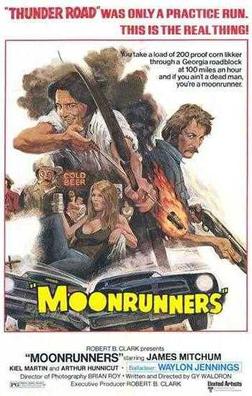
Moonrunners (1975, directed by Gy Waldron)


Does this sound familiar?

Grady and Bobby Lee Hagg (played by Kiel Martin and Jame Mitchum) are just some good ol’ boys, never meaning no harm, but they’ve still been in trouble with the law since they day they were born.  They live in rural Georgia, on a farm owned by their Uncle Jesse (Arthur Hunnicutt).  Uncle Jesse’s an expert on two things: the Bible and how to brew the best whiskey.  Uncle Jesse is moonshiner with integrity.  No one knows his formula and he won’t sell his moonshine to just anyone.  He doesn’t want anything to do with the New York mob and their efforts to move in on the moonshine racket.

Uncle Jesse’s main rival is Jake Rainey (George Ellis), the corpulent county commissioner who used to be Jesse’s business partner but who now is in league with the Mafia.  Jake and the Hagg boys have a rivalry that is sometimes friendly but still dangerous.  Helping Jake control the county is a formerly honest lawman named Rosco P. Coltrane (Bruce Atkins).

The Hagg boys are on probation so they can’t leave the county and they can’t carry guns.  Instead, they hunt with bow and arrow.  They drive a fast car that they’ve named Traveller (after General Lee’s horse).  Grady dreams of going to Nashville with Beth Anne Eubanks (Chris Forbes) and becoming a country music star.  Bobby is a laid back race car driver who is having an affair with Jake Rainey’s wife.

The film follows the Hagg boys as they transport moonshine, outrun the police, and occasionally get into bar fights.  The movie was shot on location on Georgia, features several car chases, and it’s narrated by country singer Waylon Jennings.

Moonrunners was filmed in 1973 but not released until 1975.  It didn’t get much attention when it was released but it did go on to inspire a television series called The Dukes of Hazzard.   Even considering the show’s popular success and current cult status, Moonrunners is still a largely unknown film.  (It’s so obscure that Warner Bros. was reportedly shocked to discover that they were required to pay several million in royalties to the film’s producers before they could move ahead with their own film adaptation of The Dukes of Hazzard.)  However, Moonrunners is superior to The Dukes of Hazzard in every way.

Of course, being better than The Dukes of Hazzard may seem like a low bar to clear but Moonrunners is still one of the better moonshiner films out there.  The car chases are genuinely exciting and well-filmed and the cast feels authentic.  Arthur Hunnicutt and George Ellis both seem like they naturally belong next to a still while James Mitchum and Kiel Martin are well-paired as Grady and Bobby Lee.  Mitchum, in particular, channels the laconic charisma of his father, Robert.  Not surprisingly, Moonracers is far rougher and has more of an edge than The Dukes of Hazzard.  The TV show may have been for kids but the movie is not.

It’s a B-movie, of course.  The soundtrack, which is full of outlaw country, is sometimes obtrusive.  I burst out laughing at the film’s most dramatic moment because Waylon Jennings suddenly started singing a song called “Whiskey Man.”  The DVD release appears to have been copied straight from a VHS tape so the images were often grainy.  It’s not a perfect movie but I still enjoyed Moonrunners for what it was, a celebration of fast cars, pretty girls, and rebellious attitudes.  Your collection of car chase films is incomplete without it!