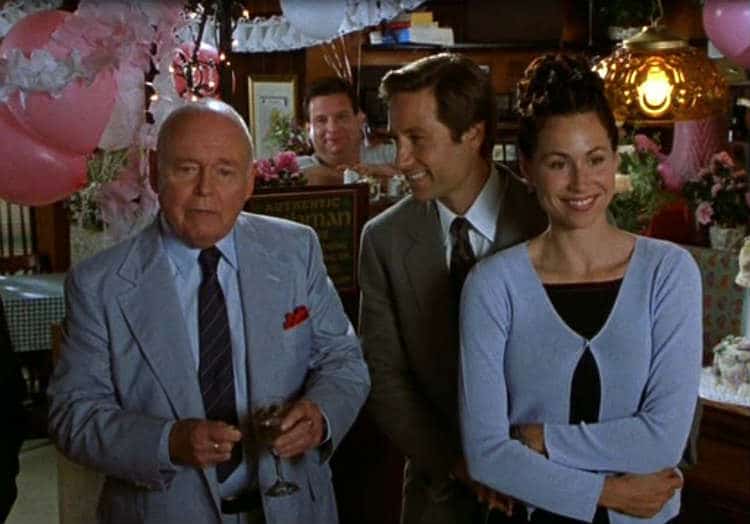
Brad reviews RETURN TO ME (2000), starring David Duchovny and Minnie Driver!


I’m a sucker for a good romance. Every year during tax season, I like to stream romantic films while I prepare my clients’ tax returns late into the evening. They make me feel good and help my mood as I work the necessary 80 to 90 hours every week leading up to April 15th. My list of favorites includes movies like HITCH (2005) with Will Smith, NOTTING HILL (1999) with Julia Roberts and Hugh Grant, and YOU’VE GOT MAIL (1998) with Tom Hanks and Meg Ryan. I also really enjoy the period romance movies based on the novels of Jane Austen, films like Ang Lee’s SENSE AND SENSIBILITY (1995) and the five-hour mini-series version of PRIDE AND PREJUDICE (1995) starring Colin Firth and Jennifer Ehle. There’s a decent chance that if you walk into my office at the end of one of these films you might even catch me wiping a tear from my eye as the obstacles finally clear, and we’re left with two people in love embarking on their specific “happily-ever-after” together. One such movie, that I don’t hear mentioned very often, but that I personally love, is the 2000 romantic film RETURN TO ME.

RETURN TO ME opens by introducing us to two families. First, we meet Bob Rueland (David Duchovny), a successful architect, and his wife Elizabeth (Joely Richardson), a kind-hearted zoologist, who are clearly very much in love. We follow the couple as they attend a fund-raising dinner that’s been organized to help expand the zoo’s gorilla habitat, a cause that’s very dear to Elizabeth’s heart, with Bob volunteering his own time and talents to design the new facility. The evening includes many sweet words and some quality slow dancing. Next, we meet Grace Briggs (Minnie Driver), who is very sick and in need of a heart transplant in the worst possible way. Her Catholic family and her friends, which includes her loving grandpa Marty O’Reilly (Carroll O’Connor) and her best friend Megan Dayton (Bonnie Hunt), are a wonderful support system, but without the new heart, she won’t be able to live much longer. On the same night that unspeakable tragedy strikes the Rueland’s on their way home from the fundraiser, Grace and her Grandpa’s prayers are answered when they get the call that a healthy heart is now available. A year later, Bob and Grace meet by chance at Marty’s business, O’Reilly’s Italian Restaurant. Bob has been a shell of the man he once was as he’s been unable to deal with his wife’s passing, while Grace has attempted to figure out life with her new heart. There’s just something about Grace though, so Bob asks her out and, after a series of sweet dates, it seems the two may be falling in love. But when Grace accidentally discovers that the heart that Bob is falling in love with was once beating inside the chest of his deceased wife Elizabeth, Grace doesn’t know how to tell him. Feeling guilty, as well as fearful of how Bob may respond to the shocking information, Grace decides she has no choice but to tell him. Will their blossoming love survive this unexpected and tragic revelation?

I love RETURN TO ME, and the main reason is that I love the characters, and especially the world that director Bonnie Hunt creates inside the film. The love story at the center is played well by Duchovny and Driver, but the greater love of family and friends is what sets this movie apart for me. In a way, Hunt creates a world that contains the kind of friends and family that we’d all love to have in real life. She does this by spending a lot of time with the entertaining supporting characters, showing them to be kind and decent people, the kind who make our lives valuable. As an example, O’Connor’s performance as the doting grandpa to Grace is wonderful, but we also get to see the interplay between Grace, Marty and their “family” at the restaurant, played by such great character actors as Robert Loggia, Eddie Jones, William Bronder and Marianne Muellerleile. Hunt herself is excellent in the role as Grace’s best friend Megan, but the time we spend with her blue-collar husband, played perfectly by James Belushi, and their kids are some of the best and funniest of the film. Based on the time and attention to these characters, as well as the time spent at “O’Reilly’s Italian Restaurant,” Hunt has created a scenario that feels like we’re watching real family and friends, in the best possible way. I never watch this film that I don’t want to go eat a big plate of spaghetti afterwards. The relationship between Bob and his best friend Charlie (David Alan Grier) isn’t quite as successful, but it has its moments as well.

RETURN TO ME is the kind of romantic film that we don’t get to see very often these days. A snarky, cynic would probably have a field day with this film, with its outrageous set-up, its old-fashioned values, and even older-fashioned characters. But that’s what I love about this film. As an example, this is the kind of movie where characters ask each other to pray, they do it, and the only purpose of it being shown is so we know how much these people care about each other. That feels very old-fashioned for 2025, but based on my own experiences in life, it’s something I can completely identify with.

Ultimately, RETURN TO ME is not a perfect film. Clocking in at almost 2 hours, there are definitely some scenes that could have been shortened or eliminated all-together. And it may seem like a criticism that I find the central love story of the film less appealing than the love shown by the main characters’ family and friends, but it’s really not. RETURN TO ME is a movie I return to every year because, at the end of the day, it’s an entertaining film that helps me appreciate the love of a family and the possibility that sometimes love is just meant to be.
Embracing the Melodrama Part II #113: Gran Torino (dir by Clint Eastwood)


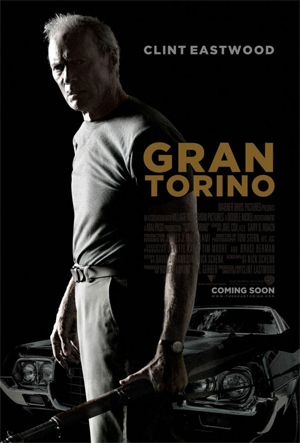
Gran_Torino_posterWalt Kowalski (Clint Eastwood) is a grumpy man.  And by that, I mean that he’s extremely grumpy.  Remember how grumpy Bill Murray was in St. Vincent?  He’s got nothing on Walt Kowalski.

Walt served in the Korean War and, five decades later, his experiences still haunt him.  After the war, he lived in Detroit and he worked on an assembly line.  He’s since retired but he still loves his old Ford Gran Torino, a car that he could very well have helped to build.  His wife has recently passed away and his children are eager to move him into a nursing home.  Walt is slowly smoking himself to death and the only person who visits him regularly is an earnest young priest (Christopher Carley, playing the ideal priest).

Just as Walt’s life has changed as he’s gotten older, so has his neighborhood.  The neighborhood is now dominated by Hmong immigrants.  When Walt catches Thao Vang Lor, a 16 year-old Hmong, attempting to steal his car, it leads to an unlikely friendship between Walt, Thao, and Thao’s sister, Sue.  When the same local gang that put Thao up to stealing Walt’s car subsequently attacks Sue, Thao wants revenge but Walt says that if Thao kills a man, it’s something that he’ll never recover from.  After locking Thao in his house, Walt goes off to confront the gang on his own…

And, since Walt is played by Clint Eastwood, you’d be justified in thinking that Walt’s confrontation would amount to a lot of quips and violence.  But actually, it’s the exact opposite.  Gran Torino does not find Eastwood in the mood to celebrate violence.  Instead, the film is a meditation on both the cost of violence and the impossibility of escaping one’s own mortality.

Whenever people talk about the 2008 Oscar race, the focus always seems to be on the snubbing of  The Dark Knight.  However, I would say that Gran Torino (among other films) was snubbed even more than The Dark Knight.  After all, The Dark Knight may have missed out on best picture but it still received 8 nominations and won an Oscar for Heath Ledger.  Gran Torino, on the other hand, received not a single nomination.

Don’t get me wrong.  I’m not arguing that Gran Torino deserved a best picture nomination.  It’s a fairly predictable film and some of the symbolism, particularly during Walt’s final confrontation with the gang, gets a bit too heavy-handed.  (Any time a character spontaneously strikes a crucifixion pose in a movie, you know that things are starting to get out of hand.)  But I would argue that Clint Eastwood definitely deserved a nomination for best actor.  In many ways, Walt is a typical Eastwood character but, right at the moment when we’re expecting him to behave like every other Eastwood character that we’ve ever seen, Walt surprises us by doing something completely different.  As a director, Eastwood subverts our expectations of Clint Eastwood as both an actor and a character.  As a result, the audience is taken by surprise by Walt, if not by the film’s plot.

I remember, at the time the film was released, there was some speculation that Gran Torino would be the last time we ever saw Clint Eastwood onscreen.  That proved to be false, as he subsequently starred in Trouble With The Curve.  However, even if it wasn’t his final acting role, Gran Torino still serves as the perfect monument to Eastwood’s unique screen presence.

Film Review: Devil’s Knot (dir by Atom Egoyan)


After having spent close to a year hearing only negative things about it, I finally watched Atom Egoyan’s Devil’s Knot last night.  On the basis of what a lot of critics had said about the film, I have to admit that I was mostly watching it to see if I needed to include it on my upcoming list of the 16 worst films of 2014.

But you know what?

Devil’s Knot really isn’t a bad film.  It’s just an extremely unnecessary one.

Devil’s Knot opens with a title card that reads, “Based on a true story.”  Honestly, the title card could have just as easily read, “Based on a true story and if you doubt it, there’s four other movies you can watch.”  The trial, conviction, and subsequent imprisonment of the West Memphis Three is perhaps the most famous miscarriage of justice in recent history precisely because so many documentaries have been made about it.  Paradise Lost and Paradise Lost Part Three are two of the most disturbing true crime documentaries ever made.

(As for Paradise Last Part Two, it displays a stunning lack of self-awareness as it attempts to prove the guilt of John Mark Byers by using many of the same techniques that were used to convict the West Memphis Three.  The less said about it, the better.)

The story is so well-known that I almost feel like retelling it would be like taking the time to inform you that George Washington was our first president.  But here goes — in 1993, 3 eight year-old boys were murdered in the small town of West Memphis, Arkansas.  Three teenagers were arrested for the crime and, on the flimsiest of evidence, were convicted.  As is seen in the documentaries, their conviction had more to do with community hysteria and paranoia than anything else.  The supposed leader of the West Memphis Three, Damien Echols, was accused of being a Satanist.  Why?  Mostly because he wore black clothing.

Eventually — and largely as a result of the documentaries made about the case — the West Memphis Three would be freed from prison.  (However, their convictions would still legally stand, meaning that their exoneration would be limited to the court of public opinion.)  Devil’s Knot, however, doesn’t deal with any of that, beyond a lengthy scroll of “this is what happened after the movie” information that rolls up the screen after the final scene.  Instead, Devil’s Knot deals with the first trial of the West Memphis Three and the small town atmosphere of fear and hysteria that led to them being convicted in the first place.

And — though the film is surprisingly conventional when you consider the reputation of director Atom Egoyan — it’s all fairly well-done.  As a former resident of and frequent visitor to Arkansas, I was happy to see that Egoyan didn’t indulge in as many stereotypes as I feared he would.  (One need only watch the self-important Northern activists in Paradise Lost Two to see the attitude that I feared Egoyan would bring to the project.)  Reese Witherspoon is perfectly cast as the mother of one of the murdered boys.  Kevin Durand is properly intimidating at John Mark Byers.  Even Colin Firth manages to make for a convincing Arkansan.

But, ultimately, Devil’s Knot just feels so unnecessary.  It doesn’t bring anything new to the story and there’s ultimately nothing here that you couldn’t have learned from the original Paradise Lost.

Probably the best thing that I can say about Devil’s Knot is that it’s better than Paradise Lost Part Two.

Horror Film Review: Annabelle (dir by John R. Leonetti)


Annabelle

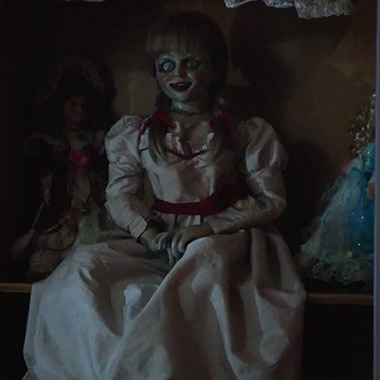
Remember Annabelle, the tres creepy doll from The Conjuring?

Well, she’s back and she’s starring in a film of her very own!  Annabelle is the first horror film to be given a wide release this October and, judging from the commercials, New Line Cinema and Warner Bros. are really hoping that you’ll remember just how scary and effective The Conjuring was when it comes time to decide whether you want to see Annabelle or Gone Girl this weekend.

Of course, Annabelle actually have very little do with The Conjuring.  Though Father Perez, the token concerned priest played by Tony Amendola, mentions Ed and Lorraine Warren, neither one of them actually appears in the film.  Neither do any of the other characters or ghosts from The Conjuring.  The only link between the two films is that doll.

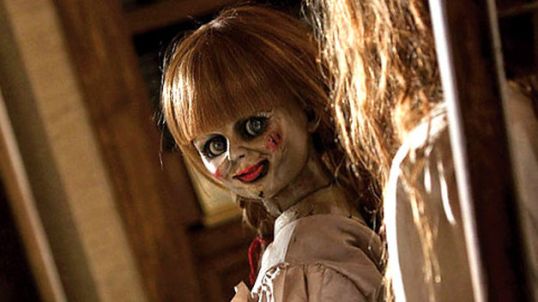
Taking place in 1969, Annabelle is an origin story of sorts.  Doctor John Gordon (Ward Horton) buys a doll for his pregnant wife, Mia (Annabelle Wallis).  The doll looks evil from the minute that Mia unwraps it but, according to the film, it was actually harmless until a psychotic hippie girl (Tree O’Toole) bled on it.  That blood seeped into the doll’s eye and the next thing you know…

Annabelle2

No,  I’m not going to spoil it for you.  In fact, it’s really not necessary for me to spoil it for you because I imagine you can probably guess everything that’s going to happen.  If you’ve ever seen a haunted house film, you know exactly what’s going to happen when John goes to work and Mia gets left in the house alone.  If you’ve ever seen a demonic possession film, you can guess what’s going to happen when Mia happens to stumble across the occult book store next door.  And, if you’ve ever seen any film, you can guess that the book store is managed by a sassy mystic played by Alfre Woodard.

That’s right!  There’s nothing surprising about Annabelle!

But that’s not necessarily a bad thing. Horror films are unique in that they often times actually benefit from being so predictable.  You watch in dread because you know that something terrible is going to happen even though the characters in the film do not.  You know enough to yell, “Don’t open that door!” but the characters in the film don’t.  That’s exactly what makes a film like Annabelle scary.

The Conjuring, I thought, was not only a great horror film but it was also one of the best films of 2013.  That’s because, along with being a scary movie, The Conjuring also dealt quite intelligently with very real issues of faith and family.  The Conjuring was fun to watch because it was scary but it stayed with you because it was full of subtext.  Annabelle, on the other hand, is a film without subtext.  Everything important about Annabelle can be found right on the surface.

Annabelle is a film that exists solely to scare you and how much you enjoy it will probably depend on how much you enjoy  horror films to begin with.  The shock scenes are handled well, with an emphasis on sudden noise on the soundtrack and intimidating shadows appearing in the background.  Everything that distinguished The Conjuring — the attention to detail, the lively performances, and the imaginative plotting — has been pushed to the side to make room for the next scare.

As a result, Annabelle is one of those films that makes you jump while you’re watching it but doesn’t stick around in your head afterwards.  If you’re a fan of the horror genre and like a good scare, you’ll probably find something to enjoy in Annabelle.  (It’s no Devil’s Due but it’s still better than the latest Paranormal Activity film.)  If you’re not a horror fan — well, then you probably weren’t planning on seeing Annabelle in the first place.

1408696589_annabelle-oo4