Film Review: Hud (dir by Martin Ritt)


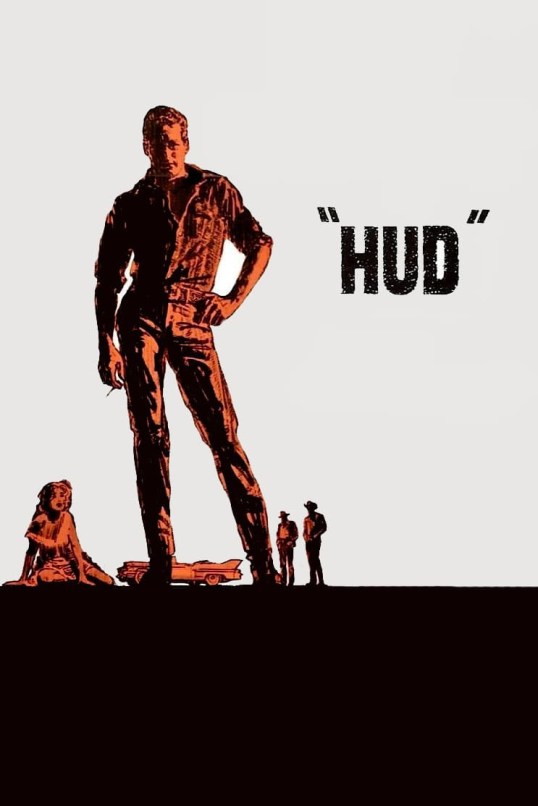
In 1963’s Hud, Paul Newman plays a monster named Hud.

Hud Bannon is the son of rancher Homer Bannon (Melvyn Douglas).  Hud lives in a small Texas town, where he’s known for his pink Cadillac, his heavy-drinking, and his womanizing.  When we first meet him, he’s leaving the home of a married woman and narrowly escaping the rage of her husband.  Throughout the film, he mentions that he’s heading into town to meet “Mrs.” So-and-So.  Hud’s father fears that Hud might be incapable of caring about anyone but himself.  Hud’s nephew, Lonnie (Brandon deWilde), at first looks up to Hud but, over the course of the film, he comes to see his uncle for who he truly is.  Though Hud is quick to defend Homer from others, he himself views Homer with contempt and even plots to have the old man declared incompetent so that he can take over the ranch.  His flirtation with the family housekeeper, Alma (Patricia Neal), soon crosses the line into something much more dangerous.  Hud is charming and handsome in the way that only a 30-something Paul Newman could be.  But he’s also a complete monster.

In Hud, Newman gave one of his best performances and director Martin Ritt and cinematographer James Wong Howe captured some haunting images of the most barren parts of the Texas panhandle.  Howe’s black-and-white imagery not only captures the harsh landscape but also the harsh outlook of the people who live there.  Hud’s ruthless personality as is much a product of the demands of the land as his own narcissism.  The characters in Hud live in a land that doesn’t allow sentimentality.  It’s a land that’s allowed Hud to become the monster that he is.

At least, that’s the way that Paul Newman saw Hud.  That was also the way that the film’s director, Martin Ritt, viewed Hud.  They viewed him as being about as villainous and unlikable as a character could be but, to Newman’s surprise, audiences actually walked out of the film embracing the character and making excuses for him.  Newman was shocked to learn that teenagers were putting posters of him as Hud on their walls.

Why did viewers embrace Hud?

Some of it is due to the fact that Brandon deWilde gives a remarkably bland performance as Lonny.  We first see Hud through Lonny’s eyes and we are meant to share Lonny’s growing disillusionment with his uncle.  But Lonny comes across as being such an empty-headed character that it’s hard to really get emotionally invested in his coming-of-age.  When Hud eventually dismisses Lonny and his concerns, Lonny really can’t defend himself because there’s not much going on inside of Lonny.  On the other hand, Paul Newman gives such a charismatic performance as Hud that we find ourselves continually making excuses for his bad behavior.  When he talks about how he was raised and his difficult relationship with his father, we have sympathy for him even though we know we shouldn’t.  The viewer makes excuses for Hud because that’s what we tend to do when it comes to charismatic bad boys who don’t follow the rules.

Indeed, Hud is proof of the power of charisma and screen presence.  As a character, Hud does some truly terrible things and yet, because he’s Paul Newman, we want to forgive him.  We want to try to figure out why someone who is so handsome and so charismatic would also be so angry.  Lonny may be the “good” character but Hud is the one who we want to get to know.  When Lonny flips through a paperback to read the sex scenes, he comes across as being creepy.  When a drunk Hud flirts with a woman who he has just met, we ask ourselves what we would do if Hud ever tried that with us.  The truth is that we all know what we would do.  That’s what makes Hud both a dangerous and an intriguing character.

In the end, Hud is an excellent film that features Paul Newman at his best and which uses the downfall of Homer’s ranch as a metaphor for a changing American society.  Though Hud was  not nominated for Best Picture, it was nominated for almost everything else.  Melvyn Douglas and Patricia Neal won acting Oscars.  James Wong Howe’s cinematography was also honored.  Paul Newman was nominated and perhaps would have won if not for the fact that Sidney Poitier was nominated for playing the exact opposite of Hud in Lilies of the FieldHud was meant to be a picture about Lonny discovering his uncle was a monster.  Instead, the film became about Hud’s refusal to compromise.  It turns out that people like good-looking rebels who do what they want.

Even if viewers missed the point, Hud was one of the best films of the early 60s and Paul Newman’s powerful performance continues to intrigue.


Lisa Reviews An Oscar Nominee: Shane (dir by George Stevens)


“Hey, Shane!  Come back, Shane!”

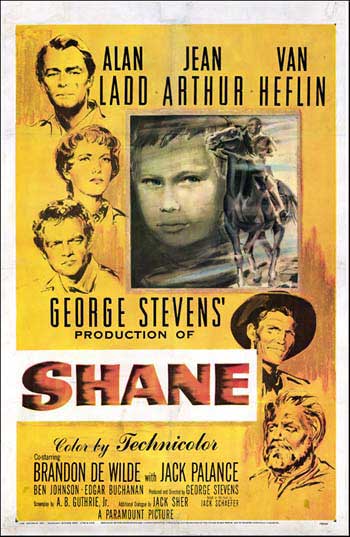
There’s a few ways in which you can view the 1953 film, Shane.

The more popular view is that it’s a Western about a man named Shane (Alan Ladd) who rides into town and gets a job working for the Starretts, Joe (Van Heflin) and Marian (Jean Arthur).  Joe is a farmer who is determined to hold onto his land, despite the efforts of cattle baron Rufus Ryker (Emile Meyer) to force him off of it.  While we don’t learn much about Shane’s background, it becomes apparent that he’s a man who can fight.  That comes in handy when Ryker brings in a sinister gunfighter named Wilson (Jack Palance).

Another view is that Shane is the story of a man who just wants to settle down but, instead, finds himself continually hounded by an annoying little kid, to the extent that he finally gets involved in a gun battle just so he’ll have an excuse to leave town and get away from the little brat.  Little Joey Starrett (Brandon deWilde) idolizes Shane from the minute that he comes riding up.  When he hears that Shane refused to get into a fight at the local saloon, Joey demands to know whether it was true.  He tells his mom that he loves Shane almost as much as he loves his father.  When Shane does get into a brawl with all of Ryker’s men, Joey stands in the corner and eats candy.  And then, when Shane tries to leave town, Joey runs behind him shouting, “Come back, Shane!  Come back!”

Myself, I think of it as being the story of Frank Torrey (Elisha Cook, Jr.).  Frank is the farmer that’s been nicknamed “Stonewall,” due to his status as a former Confederate and his quick temper.  Stonewall may be smaller than the other farmers but he’s usually the quickest to take offense.  Still, it’s impossible not to like him, largely because he’s played by Elisha Cook, Jr.  When Wilson feels the need to put the farmers in their place, he does so by picking a fight with Torrey.  Standing on a porch in the rain, looking down on the smaller man, Wilson starts to insult both him and the South.  When Torrey finally starts to reach for his gun, Wilson shoots him dead.  While Torrey lies in the mud, Wilson smirks.  It’s a shocking scene, all the more so for being shown in a long shot.  (By forcing those of us in the audience to keep our distance from the shooting, the film makes us feel as powerless as the farmers.)  If you didn’t already hate Wilson and Ryker, you certainly will after this scene.

Shane is a deceptively simple film, one in which many of the details are left open for interpretation.  We never learn anything about Shane’s background.  He’s a man who shows up, tries to make a life for himself, and then leaves.  He’s a marksman and an obviously experienced brawler but, unlike Ryker’s men, he never specifically looks for violence.  In fact, he often seems to avoid it.  Why?  The film doesn’t tell us but there are hints that Shane is haunted by his past.  Shane seems to want a chance to have a life like the Starretts but, once he’s forced to again draw his gun, he knows that possibility no longer exists.

Is Shane in love with Marian Starrett?  It certainly seems so but, again, the film never specifically tells us.  Instead, it all depends on how one interprets the often terse dialogue and the occasional glances that Marian and Shane exchance.  When Shane and Joe get into a fist fight to determine who will face Ryker and Wilson, is Shane really trying to protect Joe or is it that he knows Marian will be heart-broken if her husband is killed?

One thing’s for sure.  Little Joey sure does love Shane.  “Come back, Shane!”  Little Joey follows Shane everywhere, with a wide-eyed look on his face.  To be honest, it didn’t take too long for me to get sick of Little Joey.  Whenever director George Stevens needed a reaction shot, he would cut to Joey looking dumb-founded.  Brandon deWilde was 11 years when he appeared in Shane and he was nominated for an Oscar but he’s actually pretty annoying in the role.  Elisha Cook, Jr. was far more impressive and deserving of a nomination.

I know that many people consider Shane to be a classic.  I thought it was good, as long as the action was focused on the adults.  Alan Ladd plays Shane like a man who is afraid to get too comfortable in any situation and the film works best when it compares his reticence to Wilson’s cocky confidence.  Whenever Joey took center stage, I found myself wanting to cover my ears.

Shane was nominated for Best Picture but lost to From Here To Eternity.

Horror on TV: Thriller 1.36 “Pigeons From Hell”


In this episode of Thriller, two brothers from up north (played by Brandon De Wilde and David Whorf) have car trouble while driving through Louisiana and, naturally, they decided to spend the night in a deserted mansion that happens to be sitting in the middle of a swamp.  Needless to say, as is usually the case whenever Yankees get stranded in the bayou, bad things happen….

Pigeons From Hell is actually a surprisingly effective horror story.  Director John Newland creates a pervasive atmosphere of dread and De Wilde makes for a sympathetic protagonist.  This episode was originally broadcast on June 6th, 1961 and watching it today, it’s hard not to suspect that a lot of the kids who watched Pigeons From Hell later grew up to the be the directors who made the slasher films of the late 70s and 80s.

Incidentally, Pigeons From Hell is based on a short story by native Texan Robert E. Howard.  Apparently, Stephen King once said that this was one of his favorite TV shows ever but we won’t hold that against it.