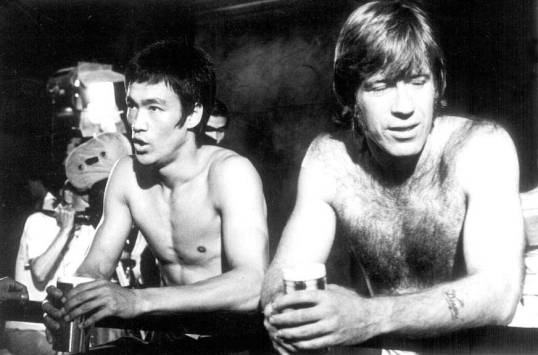
Bruce Lee vs. The Star Whackers: Game of Death (1978, directed by Robert Clouse)


Billy Lo (played by archival footage of Bruce Lee and two stand-ins) is the world’s biggest film star and the Syndicate (represented by Dean Jagger and Hugh O’Brian) want a piece of the action.  When Billy refuses to allow the Syndicate to take control of his career, the Syndicate responds by threatening both Billy and his girlfriend (Colleen Camp).  After a Syndicate hitman sneaks onto the set of Billy’s latest film and shoots him in the face, Billy allows the world to believe that he’s dead.  Using a variety of disguises, Billy seeks revenge on the Syndicate and all of its assassins, including the 7 foot tall Hakim (Kareem Abdul-Jabbar).

Lee’s original plan for the Game of Death was that it would feature him as a retired martial artist who, in order to save the lives of his family, had to make his way up a five-level pagoda, defeating a different guardian on each floor.  Each guardian would represent a different fighting style and the journey up the pagoda would allow Lee to discuss his beliefs regarding the principles of martial arts.  Serving as both director and star, Lee did during the making of the film, of cerebral edema though some said Lee was either murdered or that he had faked his own death.

Released seven years after his death, the final version Game of Death has little in common with Lee’s original vision.  Only about 11 minutes of footage from the original film was used in the revised version and most of Lee’s philosophical concerns were abandoned for a plot that, today, feels like it could have been lifted from Randy Quaid’s twitter timeline.  (Also, when watching the film today, it’s also impossible to watch the Syndicate’s assassins disguise Billy Lo’s shooting as an on-set accident without being reminded of what would happen to Brandon Lee on the set of The Crow.)  Game of Death opens with footage lifted from Lee’s battle with Chuck Norris at the end of Way of the Dragon and the other fight scenes are full of close-ups of Lee that were obviously lifted from other films.  There’s even a scene in Billy’s dressing room where a cardboard cut-out of Lee’s face has obviously been taped onto a mirror.  After Billy fakes his own death, footage of Bruce Lee’s actual funeral is shown, including a shot of Lee in his coffin.

If you can overlook the ethical issues of making a Bruce Lee film without the actual participation of Bruce Lee, Game of Death is actually a pretty entertaining movie.  Director Robert Clouse had previously directed Enter the Dragon and obviously knew how to direct a fight scene while even stock footage of Bruce Lee has more charisma than the average action star.  Best of all, Bruce Lee battles Kareem Adbul-Jabbar, in an epic scene that Lee himself directed for the original version of Game of Death.  When the 7’2 Kareem Abdul Jabber plants his foot in the middle of Bruce Lee’s chest, Game of Death achieves pop cultural immortality.

Thorny ethical concerns aside, Game of Death proves that Bruce Lee will live forever.
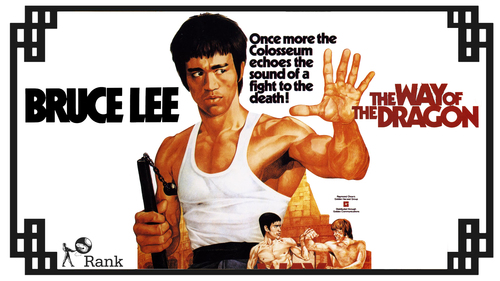
A Movie A Day #161: The Way of the Dragon (1972, directed by Bruce Lee)


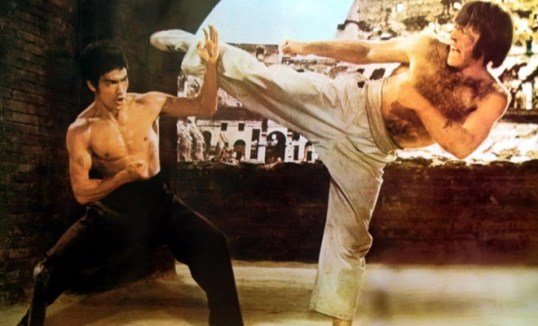
Bruce Lee vs. Chuck Norris in a battle to the death!

That alone makes The Way of The Dragon worth seeing.  This was Bruce Lee’s only completed directorial effort and it was the last of his films to be released during his lifetime.  (Lee’s best known film, Enter the Dragon, was released 6 days after Lee’s death.  When Lee died, he was directing Game of Death.)  In Way of the Dragon, Lee plays Tang Lung, a martial artist who travels from Hong Kong to Rome to help protect the owners of a restaurant from the Mafia.  At first, everyone dismisses Tang Lung as being an unsophisticated bumpkin and he does little to convince them otherwise.  But when the Mafia tries to intimidate him, Tang reveals how dangerous it is to underestimate him.

The only version of Way of the Dragon that I have seen is the badly dubbed version that was released in the United States so it’s hard for me to judge either the script or the acting, through Bruce Lee was a natural-born movie star and, even when dubbed, as charismatic as ever.  During the first half of the film, there is so much humor that it almost seems like a comedy but, unless you find Bruce Lee begging someone to tell him where the bathroom is, a lot of that humor falls flat.  Far more interesting is the scene where Tang and a waiter debate the merits of Japanese vs Chinese martial arts.  This scene reveals that Lee was just as serious about the philosophy behind the martial arts as he was about the actual fighting.

Most people who watch The Way of the Dragon will do so for the fighting and the film does not disappoint.  The Way of the Dragon features some of the best martial arts action ever captured on film.  The Mafia hires three martial artists to take on Tang, which means that, along with the usual collection of Mafia thugs, Bruce Lee also fights Bob Wall, Hwang In-shik, and Chuck Norris.

Bruce Lee’s final battle with Chuck Norris is The Way of the Dragon’s most famous scene and perhaps one of the greatest scenes in the history of world cinema.  Both Norris and Lee are in top physical form and the two real-life friends held nothing back.  The fight was filmed in the Roman Colosseum, confirming that Norris and Lee are meant to be modern-day gladiators, battling to the death but never viewing each other with anything less than respect.  Neither Norris nor Lee say a word during their climatic face-off.  They let their fists and their feet do the talking.  It’s a brutal battle between not just two men but also two different philosophies of fighting.

The Way of the Dragon was Lee’s biggest hit during his lifetime.  A modest success when first released in the west, it was re-released following Lee’s death and was retitled The Return of the Dragon.  While the American co-production Enter The Dragon is a bigger and slicker production, The Way of the Dragon is the best of Lee’s Hong Kong films and his final battle with Chuck Norris remains the perfect showcase for his skill as a fighter.