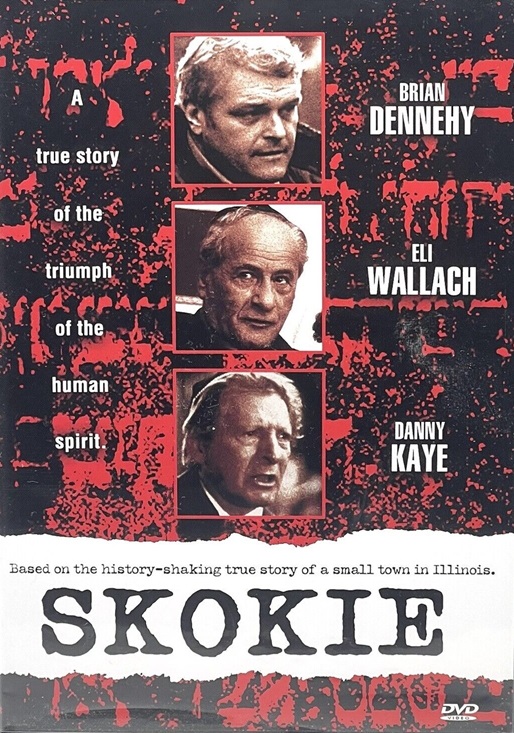
Skokie, a 1981 made-for-television movies, opens in a shabby Chicago office.
A group of men, all wearing brownshirts and swastika armbands, listen to their leader, Frank Collin (George Dzundza). Collin says that they will be holding their next rally in the town of Skokie. Collin explains that Skokie has a large Jewish population, many of whom came to the United States after World War II. Collin wants to march through their town on Hitler’s birthday.
If not for the swastika and the brownshirt, the overweight Collin could easily pass for a middle-aged insurance salesman, someone with a nice house in the suburbs and an office job in the city. However, Frank Collin is the head of the American National Socialist Party. a small but very loud group of Nazis who specialize in marching through towns with large Jewish populations and getting fee media attention as a result of people confronting them. Making Frank Collin all the more disturbing is that he isn’t just a character in a made-for-television movie. Frank Collin is a real person and Skokie is based on a true story.
The Mayor (Ed Flanders) and the police chief (Brian Dennehy) of Skokie are, needless to say, not happy about the idea of modern-day Nazis marching through their city. Though they inform Collin that he will have to pay for insurance before he and his people will be allowed to hold their rally, they know that the courts have been striking down the insurance requirement as being a violation of the First Amendment. While the mayor and the police chief worry about the political fallout of the rally, the Jewish citizens of Skokie debate amongst themselves how to deal with the Nazis. Bert Silverman (Eli Wallach) and Abbot Rosen (Carl Reiner) argue that the best way to deal with Collin and his Nazis is to refuse to acknowledge them, to “quarantine” them. As Rosen explains it, Collin is only marching to get the free publicity that comes with being confronted. If he’s not confronted, he won’t make the evening news and his rally will have been for nothing. However, many citizens of Skokie — including Holocaust survivor Max Feldman (Danny Kaye) — are tired to turning their back on and ignoring the Nazis. They demand that the Nazis be kept out and that, if they do enter the city, they be confronted.
With the support of the ACLU, Collin sues for his right to march through Skokie. The ACLU is represented by Herb Lewishon (John Rubinstein), a Jewish attorney who hates Collin and everything that he stands for but who also feels that the First Amendment must be respected no matter what. When Lewishon is asked how he, as a Jew, can accept a Nazi as a client, Lewishon relies that his client is the U.S. Constitution.
Skokie is a thought-provoking film, all the more so today when there’s so much debate about who should and should not be allowed a platform online. (Indeed, Collin and his Nazis would have loved social media.) Lewishon argues that taking away any group’s First Amendment rights, regardless of how terrible that group may be, will lead to slippery slope and soon everyone’s First Amendment rights will be at risk. Max Feldman, and others argue that the issue isn’t free speech. Instead, the issue is standing up to and defeating evil. The film gives both sides their say while, at the same time, making it clear that Frank Collin and his Nazis are a bunch of fascist losers. It’s a well-acted and intelligently written movie, one that rejects easy answers. Needless to say, at a time when so many people feel free to be openly anti-Semitic, it’s a film that’s still very relevant.
As for the real Frank Collin, he would eventually be charged with and convicted of child molestation. After three years in prison, he changed his name to Frank Joseph and became a writer a New Age literature. He’s looking for Atlantis but I doubt they’d want him either.
 Through the Shattered Lens