Welcome to Late Night Retro Television Reviews, a feature where we review some of our favorite and least favorite shows of the past! On Thursdays, I will be reviewing Highway to Heaven, which aired on NBC from 1984 to 1989. The entire show is currently streaming on Freevee and several other services!
This week, Jonathan and Mark find themselves in a Douglas Sirk-style melodrama.
Episode 2.23 “Children’s Children”
(Dir by Victor French, originally aired on April 30th, 1986)
When I watched this episode, I saw that the script was credited to David Thoreau and I immediately assumed that it had to be a pseudonym for the actual writer. Fortunately, for once, I actually did some research and I discovered that the writer’s name actually was David Thoreau. He wrote a few scripts that were produced in the 80s and 90s and, in fact, this was the first of seven scripts that he wrote for Highway to Heaven. He’s also credited as writing the screenplay for the classic beach volleyball film, Side Out.
As for this episode, it finds Mark and Jonathan working at a home for unwed mothers. Just the term “home for unwed mothers” brings to mind the 50s melodramas of Douglas Sirk and I found myself thinking about just how old-fashioned Highway to Heaven must have seemed even in the 80s. I did a google search and I discovered that homes from unwed mothers do still exist, though they’re now called “maternity homes.”
The manager of the home for unwed mothers is Joyce Blair (Bibi Besch), who finds herself being hounded by a reporter named Dan Rivers (Robert Lipton). Dan is determined to take Joyce down and, to do so, he brings up a past incident in which Joyce was arrested. Dan twists the facts to make Joyce look like a criminal and soon, Joyce finds that she might not be able to keep the home open. Why is Dan doing this? Like most reporters on Highway to Heaven, he’s just plain evil. But when one of the girls at the home suggests that Dan might be the father of her child, Dan learns what it’s like to be falsely accused.
Meanwhile, evil businessman Jack Brent (James T. Callahan) hopes for a chance to foreclose on the home so that he can bulldoze it and replace it with condominiums. (Bad guys in the 80s always wanted to build condos.) But how will he react when he discovers that his teenage son (Scott Coffey) is going to be a father and that the girl he impregnated in currently living at the home?
This episode is the type of episode that most people think of when they dismiss Highway to Heaven as just being an old-fashioned and slightly preachy melodrama. There’s not a single subtle moment or particularly nuanced moment to be found in this particular episode. It’s note quite as heavy-handed as that episode where Mark begged the President to talk to the Russians and reduce amount of nuclear missiles but it’s close.
Welcome to Late Night Retro Television Reviews, a feature where we review some of our favorite and least favorite shows of the past! On Wednesdays, I will be reviewing Monsters, which aired in syndication from 1988 to 1991. The entire series is streaming on YouTube.
This week features the most fearsome monster yet.
Episode 2.18 “The Offering”
(Dir by Ernest Farino, originally aired on February 18th, 1990)
After a serious auto accident, Lewis (Robert Krantz) wakes up in a hospital with a bandage wrapped around his head. Dr. Hubbard (Orson Bean) tells Lewis that he’s suffered a concussion and must rest. All Lewis wants to know is whether or not his mother’s surgery went okay. Dr. Hubbard sighs and says that they were not able to get all of the cancer.
Lewis’s comatose mother is a patient at the same hospital and, when Lewis sneaks into her room to visit with her, he’s shocked to discover that he can see a giant insect-like creature that is hovering over the bed and producing slugs that are burrowing under his mother’s skin. Lewis sees the same thing when he looks at other cancer patients but Dr. Hubbard insists that Lewis is only having hallucinations.
In order to try to help Lewis come to terms with both his accident and his mother’s cancer, Dr. Hubbard allows Lewis to watch as a patient undergoes radiation treatment. Lewis is the only one who can see that the slugs are drawn to the radiation and will leave a patient’s body to find the source of it. Still unable to convince Hubbard that what he’s seeing is real, Lewis sneaks out his room, steals a radioactive isotope, and prepares to make the ultimate sacrifice to save his mother.
The Offering is a return to form for Monsters. Full of atmosphere and featuring a genuinely disturbing set of monsters, this is an effective and well-acted episode that works because it captures the helplessness that everyone will feels when a family member or loved one is seriously ill. I lost my mother to cancer and my father to Parkinson’s, two diseases that are still not as understood as they should be. Like Lewis, I spent a lot of time wishing that I could somehow just see and understand what was causing their illnesses so that I could know how to save them. Cancer and Parkinson’s and dementia are all monsters that we wish we could just squash under our heel as easily as we could a bug.
In the end, Lewis eats a glowing radioactive isotope so that all of the cancer slugs will be drawn to his body. Couldn’t he have just used the isotope to lead the slugs out into the middle of the street or something? Lewis offers up his own life to save his mother. It reminds me of the old Norm McDonald joke, that dying of cancer is the equivalent of beating cancer because the cancer dies with you. That’s a good way to look at it. Cancer never wins.
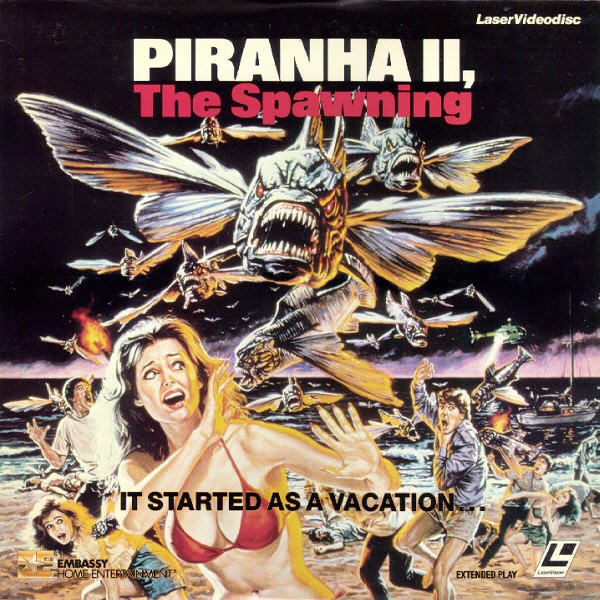
The American artist Bob Larkin may be best known for the covers that he painted for Marvel Comics in the 1970s and the 1980s but he has also painted several horror movie posters. You can see some of them below and be sure to visit the Bob Larkin Blog for more information about the artist and his work!
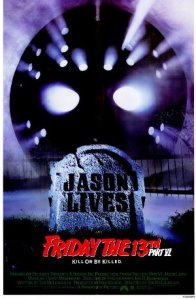
Continuing my series reviewing the Friday the 13th films, today we take a look at one of the pivotal installments in the saga, Friday the 13th Part VI: Jason Lives.
Following the financial success of Friday the 13th: A New Beginning, it was pretty obvious that there would be another installment in the Friday the 13th franchise. Mindful of the extremely negative reaction to the previous attempt to make a Friday the 13th film without Jason, Paramount hired director Tom McLaughlin to bring Jason back to life. In the process, they also abandoned plans to have the protagonist of the previous two films — Tommy Jarvis — turn into a psychotic murderer.
(Which, if nothing else, ensured that this would be the last Friday the 13th to feature a cameo appearance from Corey Feldman.)
Jason Lives opens a few years after the end of New Beginning. The residents of Crystal Lake have finally wised up and changed the name of their unfortunate little town to Forrest Green. Corporate executives spend the weekend playing paintball in the woods while blissful lovers safely picnic a few feet away. Even the old summer camp has opened back up and, for the first time in a Friday the 13th film, has managed to stay open long enough for actual campers to show up. Gruff Sheriff Garris (David Kagan) keeps an eye on the town while his rebellious daughter Megan (Jennifer Cooke) works as a counselor at the camp.
Yes, everything’s perfect until, once again, Tommy Jarvis comes to town and get everyone killed.
Now played by Thom Matthews, Tommy has apparently changed a lot since the end of New Beginning. No longer is he simply willing to silently suffer from nightmares and hallucinations. Now, Tommy is a man of action and his first action is to go back to where it all began, find Jason’s grave, and dig him up. Why? “Jason belongs in Hell,” Tommy tells us, “and I’m gonna see that he gets there.” Okay, whatever you say, Tommy. You’re just lucky that you look like Thom Matthews.
Anyway, Tommy, dragging his reluctant friend Hawes (Ron Pallilo) with him, tracks down Jason’s grave and digs him up. Apparently not remembering his pre-credits nightmare from New Beginning, Tommy does this on a rainy night when there’s lightning striking all around. Once Tommy digs up the coffin, he starts to stab it with a metal post and, before you can even say, “I knew that was going to happen,” lightning strikes the post, electricity surges through the coffin, and suddenly, Jason (played here by C.J. Graham) comes back to life as an unstoppable zombie. He also proceeds to kill Hawes, which seems a bit unfair since this was all Tommy’s stupid idea to begin with.
(Tommy Jarvis, in this film, is a part of that proud horror film tradition of heroes who do everything wrong and get a lot of people killed but are somehow never held responsible for their stupidity. Again, it’s a good thing that he looks like Thom Matthews.)
Tommy goes to Sheriff Garris and explains what happened. Garris responds by promptly locking Tommy in a cell and refusing to listen as Tommy tries to explain that “Jason’s still out there!” For once, Tommy is correct. Jason is still out there and he’s heading straight for the summer camp…
There’s a scene early on in Jason Lives that pretty much sums up the entire film. Alcoholic cometary caretaker Martin (played by Bob Larkin) mutters to himself, “Why’d they have to go and dig up Jason?” before looking directly at the camera and adding, “Some folks sure got a strange idea of entertainment.” In short, this is the comedic, meta Friday the 13th, populated with characters who have seen the previous installments of the series and who fully understand that they’re in a slasher film but who still manage to get killed anyway. This is the movie where Lizbeth (played by the director’s wife, Nancy McLaughlin) says, “I’ve seen enough horror movies to know that a weirdo with a mask is never friendly” but then tries to reason with him anyway. This type of self-referencing is pretty common in slasher films today but this is the first time that it ever showed up in a Friday the 13th film and it stands in stark contrast to the rather dark films that came before. When I first saw Jason Lives, I thought it was a little bit too jokey (though I loved the line, delivering between two frightened campers: “So, what did you want to be when you grew up?”) but, on my second viewing, I better came to appreciate what McLaughlin was going for. As opposed to other installments, Jason Lives doesn’t even try to be a horror film. Instead, it’s a communal experience that is specifically designed for an audience that wants to play along with the film. Jason Lives is the fun Friday the 13th.
Oddly enough, it’s probably also the most Christian. Along with containing no nudity, it also features Jason deciding not to kill one girl because he hears her praying and, finally at the conclusion, Tommy being brought back to life through a combination of CPR and prayer. (As opposed to the jokey nature of most of the film, the prayer scenes are played relatively seriously.) This is probably as close as the Friday the 13th franchise ever got to being family friendly and it stands in marked contrast to just about every other film in the series.
Jason Lives is a bit of an oddity in the Friday the 13th series and it was also the first installment in the series to gross less than $20,000,000 at the box office. Despite the fact that this film is as much of a comedy as a horror film (and despite the fact that Jason appears here for the first time as a zombie), Jason Lives is also probably the last truly Jason-centered film in the series. Each subsequent film would match Jason with a gimmick in an attempt to revive the franchise’s declining box office prospects and, not surprisingly, those subsequent films would suffer from a marked decrease in quality.
Tomorrow, we’ll look at the first of the gimmick films, Friday the 13th part VII: A New Blood.




 Through the Shattered Lens