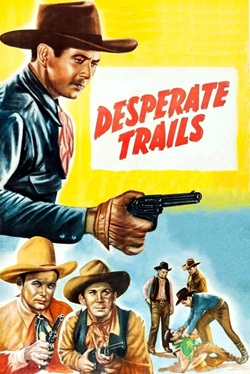
 The frontier town of Denton has become lawless, plagued by murders, robberies, and cattle rustling. The town’s sheriff (Russell Simpson) just cannot seem to bring peace to the streets. That’s because the sheriff is secretly responsible for all the crime. He’s working in cahoots with the town banker (Clarence Wilson) and he’s sets his sights on taking over a ranch owned by Frances Robinson. As was so often the case with B-westerns, it all comes down to stealing someone else’s land.
The federal government sends Marshal Johnny Mack Brown to bring some order to the town. Working undercover, Brown gets hired as Robinson’s ranch and he quickly chases off all of the bad ranchhands, He brings his friend, singing cowboy Bob Baker, onboard to work as the ranch foreman. With Fuzzy Knight providing comic relief, Brown sets out to thwart the next stagecoach robbery and to expose the evildoers of Denton.
This was the first western that Brown made with Universal Pictures. Bob Baker, who had previously been the star of the studio’s B-westerns, was demoted to second lead and, eventually, he quit making films for Universal all together. Unlike Baker, who was angry at being demoted, Fuzzy Knight was always happy to provide sidekick duty and would go on to co-star in all of Brown’s Universal westerns. From the start, Brown and Knight had the chemistry that made them a good B-movie team.
Desperate Trails is a typical B-western but, as always, Brown elevates things with his performance. From the minute that Brown rides into town, he screams authenticity. He’s pretty tough in this film, which includes a scene where he coolly takes care of a gang of outlaws with just one rifle. The best performance here comes from Russell Simpson, who gets angrier and angrier as the film goes on and all of his plans fall apart.
For fans of the B-western genre, Desperate Trails has a lot of entertainment to offer.

 Through the Shattered Lens