…zum Tode hin was the most pleasant surprise of 2009. Like Turisas in 2007 and Nekrogoblikon in 2011, Finsterforst managed to rise from the depths of mediocrity to greatness in a single album. I’d spun Weltenkraft often enough to know them when I heard them, but there was absolutely nothing special about it. I only grabbed …zum Tode hin in the first place because I was very actively keeping up with metal in general at the time, and it ended up on my top 10 list come the end of the year.
…zum Tode hin adopts a folk-black sound which should immediately appeal to fans of Moonsorrow, while maintaining the strong emphasis on accordion that characterized Weltenkraft. But unlike Moonsorrow (at least for me), Finsterforst’s melodies are extraordinarily memorable. I can’t tell you how many times I’ve got Urquell stuck in my head, and this never proves a nuisance. Looking over my 2009 list again, …zum Tode hin is fairly unique in having stood the test of time. I still have yet to grow tired of listening to it.
Finsterforst are a German band that formed in 2004. Their name means “dark forest”. The album title translates to “Towards Death”, and this particular track to “Original Source”. They haven’t released an album since …zum Tode hin, and singer Marco Schomas has since left the band. That’s a bit disconcerting, because his vocals fit their style perfectly, but the good news is a new record’s finally on its way. “Rastlos” should be available by November 27th. Cheers.
Nokturnal Mortum is a name one should only ever drop with caution. They are unfortunately the flagship band of the Ukrainian white supremacist nsbm scene. One might expect idiotic ideas to lead to pretty dim-witted music, but Nokturnal Mortum broke the mold. In fact, they’re one of the most talented bands I have ever heard. Knjaz Varggoth has a seemingly unshakable knack for infusing his music with the all of the pride and hatred that his ideology implies. From 1996 up to the present they have remained on the cutting edge of the folk/pagan metal scene, like it or not.
Cheremosh is conveniently a track with no ideological strings attached. Appearing initially on the 1997 Marble Moon ep and then in slightly more refined form on To the Gates of Blasphemous Fire in 1998, Cheremosh is an instrumental song. The name refers to the Cheremosh river in western Ukraine. With a distinct build-up and climax characteristic of many of their finest songs, Cheremosh transitions from a secluded scene of the river rolling along to some convincing and bizarre pagan ritual. The folk is mostly keyboards–Nokturnal Mortum did not begin to employ traditional instrumentation extensively until the following year on NeChrist. (NeChrist, I recently discovered, is a pun. “Nechist” are evil spirits in Russian folklore.) Nokturnal Mortum did a pretty impressive job of inventing their own folk sound through synth though, and their first three albums gain a lot from it. If you can stomach their ideology, Nokturnal Mortum present some of the most compelling pagan metal on the market, and this isn’t the last time I’ll be featuring them this month.
What I especially love about this song is the sustained, poor production quality noise. Utuk Xul, hailing from Cali, Colombia, are not a band to write home about, and The Goat of the Black Possession is not a particularly special album. One especially degrading review on Encyclopaedia Metallum gives it a lowly 25%, and I’m afraid there’s not much in the review that I can argue with. But what may well be entirely generic songs are masked by a really menacing and constant wall of sinister noise. The quality of the recording is spot on, whatever one might say about the song writing. On one hand “The Ancient God of Light (part II)” really captures the aural spirit of black metal. On the other hand it captures everything that’s especially cheesy about the genre it represents.
Kicking off with a liturgical ode to Satan, the album goes on to mimic every stereotype of the genre in fairly generic form. It’s impossible to tell whether the band is trying really, really hard to be evil or whether the whole thing is tongue-in-cheek a la Carpathian Forest, but unlike Carpathian Forest they lack the relative fame to make that distinction relevant. This song’s title refers to Lucifer–the band present themselves as devout Satanists of the literal Christian sort, not LaVey’s variety–and the lyrics are everything one could hope for in especially cheesy black metal: “Call the moon, Lucifer, the morbid star! The ancient god of the light, my force! Lucifer prince of the abyss! Morbid star, light of the abyss! The hell light of the storms!”, etc.
The one thing the 25% review got definitively wrong, I think, is in chastising them for buying into the Swedish scene he dubs “norsecore”. The term is an entirely appropriate insult for one of black metal’s weakest subgenres, but part of what makes most bands in the Swedish scene pretty bad is their refined recording quality; the blast beat ad nauseam routine isn’t an innately bad thing. On “The Ancient God of Light (part II)” (What became of “part I” is anyone’s guess. It doesn’t appear on this album.) I think Utuk Xul really nailed it. The atmospheric noise just screams evil here, and, moreso than other tracks on the album, this song is sufficiently devoid of attempts at song construction to function as one continuous, sustained explosion. I love it.
I actually find The Goat of the Black Possession as a whole fairly enjoyable for the same reason I like this song, but there might be a bit of nostalgia playing into that too. It was the product of one of my earliest completely arbitrary purchasing sprees in search of unknown black metal bands, and in 2003 I had a lot less to compare it to. “The Ancient God of Light (part II)” is the only track I’ll flaunt without reservations, but if you really enjoy its effects as a background piece then you probably won’t be disappointed by the rest.
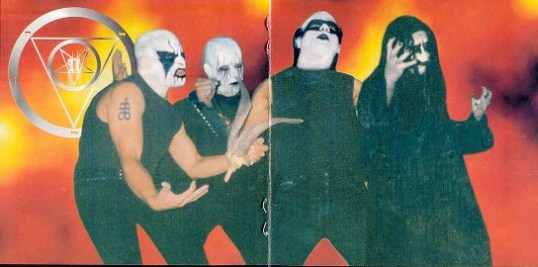
Whether Utuk Xul really take themselves seriously is anyone’s guess, but intentionally or not they succeeded in producing one of the lamest photo shoots I have ever seen. Enjoy:
Well, here it is mid-June, and I’ve yet to write any album reviews. Getting back into the habit is the hardest part, especially in the wake of one of the finest years for music I can recall. But after half a year of enjoying 2011’s finest fruits, I can no longer pretend that there are no new releases out there. Serpent Sermon seemed like a logical place to begin. Marduk, after all, have been lurking in the shadows for 22 years now, and it’s nice to start things off somewhere familiar.
Video removed by the capitalist pigs at Century Media who don’t want you to sample their products before buying them.
Serpent Sermon
I had very mixed expectations going into Serpent Sermon. The band has gone through a number of transitions over the years, and since the replacement of vocalist Legion with Mortuus in 2004 they just haven’t appealed to me all that much. On the other hand, last year’s Iron Dawn ep was some of the most appealing material they’ve yet released. I read that the band did not intend Serpent Sermon to be a continuation of Iron Dawn, but you never know.
This album kicks off in typical Marduk fashion, with blast beats entering precisely where you expect them and, soon enough, that quintessential Marduk climbing chord progression (around 1:25). The song briefly perks up with a strikingly catchy chorus twenty seconds later, then repeats, with some nuance variations and a particularly tortured howl out of Mortuus towards the end.
It is immediately apparent that, just as the band had stated, Serpent Sermon does not take the same approach as last year’s effort. But where it is headed is hard to say. My love/hate relationship with Mortuus shines in the opening track, where he bores me to tears at 1:10 and 2:20 and then gives me shivers at 3:45. It feels to me as though the singer and the rest of the band aren’t always on the same page. Where they hit it off they’re better than ever, but they just as often seem to be in opposition. Do Mortuus’s twisted vox require a stronger break from standard Marduk riffs than Morgan Håkansson and co are ready to grant, or does he ham it up just a bit too much to lend the songs consistency? Serpent Sermon exemplifies a persistent problem throughout the album: a lot of songs have their greatness broken by sudden lapses into drivel.
Video removed by the capitalist pigs at Century Media who don’t want you to sample their products before buying them.
Messianic Pestilence
The more I listen to the album, the more I am inclined to define it by Mortuus and Håkansson’s successes and failures to engage each other. The album as a whole is widely varied in style, much to its benefit. It provides samples of the various ways in which the band functions together, sometimes for better and sometimes for worse. On tracks like Messianic Pestilence, Mortuus willingly embraces an older school of Marduk with great success, and you get a taste for what they might sound like today if no real stylistic variance had accompanied 2004’s change in lineup. Good stuff, but nothing new.
Video removed by the capitalist pigs at Century Media who don’t want you to sample their products before buying them.
M.A.M.M.O.N.
But M.A.M.M.O.N. is where it really all clicks. From the driving blast-beat opening, erratic deviations into darkness and twisted chaos writhe forth. The initial sudden cessation of aggression is complete, giving Mortuus uncontested center stage, and from the ooze he spews across the soundscape a chaotic torment of guitar fury explodes. The entire song structure repeats, typical of Marduk, but in the end we are treated to a twisted amalgamation of slow, demented guitar tones laid over seemingly incompatible blast beats that give off an air of madness. On this track more than any other, I really feel as though the band has all come together and really accepted their own new sound without any misgivings.
That being said, I must confess that I’ve barely given Marduk’s last few full-length albums the time of day. I listened to them in the background a handful of times at best and quickly lost interest. It is quite possible that what struck me as great on M.A.M.M.O.N. was nothing “new”, and I simply failed to notice it before. But either way, I think it’s Serpent Sermon’s strongest point.
Video removed by the capitalist pigs at Century Media who don’t want you to sample their products before buying them.
Into Second Death
What makes late ’90s/early 2000s era Marduk my favorite is its unrelenting, almost comical brutality. Songs like Christraping Black Metal and Fistfucking God’s Planet are so aurally and lyrically offensive that I can’t help but love them. The whole Swedish black metal sound is perfect for this sort of thing. It’s a style with little room for variation, and it always seems to work best for me when taken to extremes, whether the result is comical, as on Panzer Division Marduk, or gut-wrenching, as on the Iron Dawn ep. I would absolutely love to hear a follow-up of Iron Dawn, but in the meantime, harking back to Panzer Division, let’s not forget that this band has a sense of humor.
If they didn’t, I don’t think Into Second Death would be entirely possible. It’s the most “black and roll” song I’ve heard since Carpathian Forest released Fuck You All!!!! (one of the best things to ever happen to metal), and if Marduk could throw together a full album of it I would be absolutely delighted.
As a whole, Serpent Sermon has a lot of ups and downs. Expect a lot of variation both in style and in quality (at least by Swedish black metal standards). It is no landmark album, but it’s true to Marduk past and present, and as such it’s better than most else out there. At the same time, it leaves me really wondering where the band is headed. It’s a definite to be continued… M.A.M.M.O.N. showed a lot of promise for the path they’re currently on, while the album’s total distinction from Iron Dawn leaves me wondering whether the band has had two separate full lengths in mind all along. On the other hand, you just know they’re going to love playing Into Second Death live, and my biggest hope is that that inspires an album.
The years I most actively indulge my musical interests are the ones I find most difficult to wrap up in any sort of nice cohesive summary. December always begins with a feeling that I’ve really built up a solid basis on which to rate the best albums of the year, and it tends to end with the realization that I’ve really only heard a minute fraction of what’s out there. I’m going to limit this to my top 15. Anything beyond that is just too arbitrary–the long list of new albums I’ve still yet to hear will ultimately reconfigure it beyond recognition.
15. Thantifaxath – Thantifaxath EP
Thantifaxath’s debut EP might only be 15 minutes long, but that was more than enough to place it high on my charts. The whole emerging post/prog-bm sound has been largely a product of bands with the resources to refine it, and it’s quite refreshing to hear sounds reminiscent of recent Enslaved without any of the studio gloss. That, and I get a sort of B-side outer space horror vibe from it that’s not so easy to come by. (Recommended track: Violently Expanding Nothing)
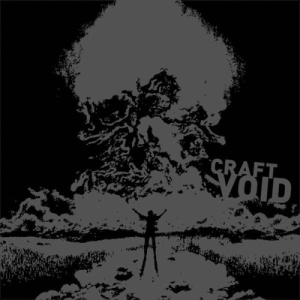
14. Craft – Void
This is the straight-up, no bullshit black metal album of the year. It doesn’t try anything fancy or original. It’s just good solid mid-tempo bm–brutal, evil, conjuring, and unforgiving. Hail Satan etc. (Recommended track: any of them)
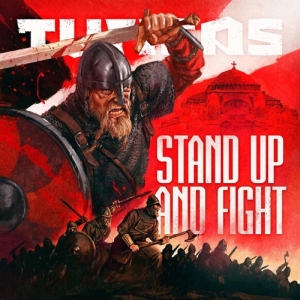
13. Turisas – Stand Up and Fight
Stand Up and Fight doesn’t hold a candle to The Varangian Way, but I never really expected it to. As a follow-up to one of my all-time favorite albums, it does a solid job of maintaining that immensely epic, triumphal sound they landed on in 2007. It lacks their previous work’s continuity, both in quality and in theme, but it’s still packed with astoundingly vivid imagery and exciting theatrics that render it almost more of a movie than an album. (Recommended tracks: Venetoi! Prasinoi!, Hunting Pirates)
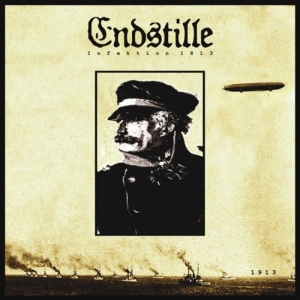
12. Endstille – Infektion 1813
Swedish-style black metal seldom does much for me, and it’s hard to describe just what appeals to me so much about Germany’s Endstille. But just as Verführer caught me by pleasant surprise two years ago, Infektion 1813 managed to captivate me in spite of all expectations to the contrary. Like Marduk (the only other band of the sort that occasionally impresses me), they stick to themes of modern warfare, but Endstille’s musical artillery bombardments carry a sense of something sinister that Marduk lacks. The dark side of human nature Endstille explores isn’t shrouded in enticing mystery–it’s something so thoroughly historically validated that we’d rather just pretend it doesn’t exist at all. The final track, Völkerschlächter, is one of the best songs of the year. Stylistically subdued, it pummels the listener instead with a long list of political and military leaders responsible for mass murder, named in a thick German accent over a seven second riff that’s repeated for 11 minutes. It’s a brutal realization that the sensations black metal tends to arouse are quite real and quite deplorable, and it will leave you feeling a little sick inside.
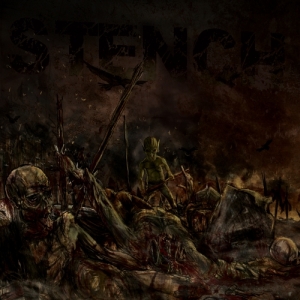
11. Nekrogoblikon – Stench
Nekrogoblikon released a folk metal parody album in 2006 that was good for laughs and really nothing else. The music was pretty awful, but that was intentional. It was a joke, with no presumption to be any good as anything but a joke. They’re the last band on earth I ever expected, a full six years after the fact, to pop back up with a really fucking solid sound. But Stench is good. I mean, Stench is really good. It’s still comical in theme, but the music has been refined beyond measure. Quirky, cheesy guitar and keyboard doodles have become vivid images of little flesh-eating gremlins dancing around your feet, whiny mock-vocals have taken the shape of pretty solid Elvenking-esque power metal, pretty much everything about them has grown into a legitimate melo-death and power infused folk metal sound. Don’t get me wrong, it’s still not meant to be taken seriously, but they’re now of Finntroll caliber. (Recommended tracks: Goblin Box, Gallows & Graves, A Feast)
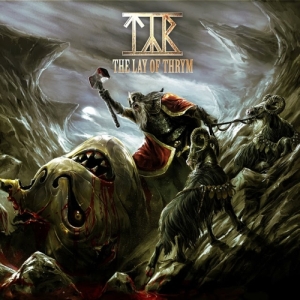
10. Týr – The Lay of Thrym
I thought By the Light of the Northern Star was a fairly weak album, and because The Lay of Thrym maintains some of the stylistic changes they underwent then, a part of me keeps wanting to say it can’t be as good as say, Land or Eric the Red. But of all the albums I acquired in 2011, I’ve probably listened to this one the most. Týr have one of the most unique sounds on the market, and it’s thoroughly incapable of ever boring me or growing old. Heri Joensen’s consistently excellent vocal performance alone is enough to make them perpetual year-end contenders. (Recommended track: Hall of Freedom)
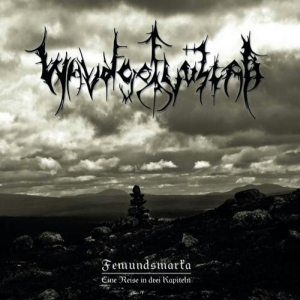
9. Waldgeflüster – Femundsmarka – Eine Reise in drei Kapiteln
This is some of the most endearing black metal I’ve heard in a while. Intended as a musical reminiscence of Winterherz’ journey through Femundsmarka National Park in Scandinavia, it’s a beautiful glorification of nature that takes some of the best accomplishments of Drudkh and Agalloch and adds to them a very uplifting vibe. Someone made an 8 minute compilation of the album on youtube which does a good job at previewing without revealing all of its finest moments. (Recommended track: Kapitel I: Seenland)
8. Ygg – Ygg
Ygg is an hour-long trance, evoking ancient gods in a way that only Slavic metal can. You could probably pick apart the music and discover plenty of flaws, but that would miss the point. I think that a lot of these Ukrainian and Russian bands are true believers, and that the purpose of music like this is more to create an experience in the listener than to be good for its own sake. This is a spiritual journey, and if it fails to move you as such it will probably come off as rather repetitive and generic, but I find it impressively effective. (Recommended track: Ygg)
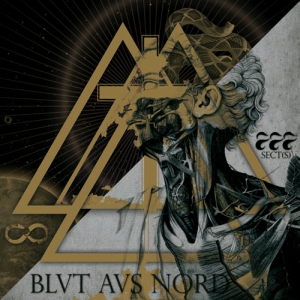
7. Blut aus Nord – 777: Sect(s)
I don’t know where to put this really. I could just as easily have labeled it second best album of the year. Dropping it down to 7th might seem a little unjustified, but eh, this is a list of my top albums, not of the “best” albums of the year. There’s no denying Sect(s) credit as a brilliant masterpiece, but it’s an ode to madness. I mean, this music scares the shit out of me, and if that means it’s accomplished something no other album has, that also means I don’t particularly “enjoy” listening to it. (Recommended track: Epitome I)
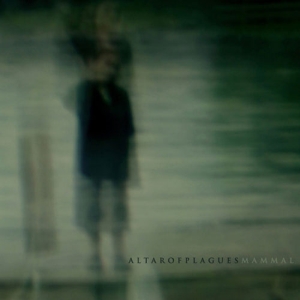
6. Altar of Plagues – Mammal
I never did listen to Mammal as actively as I would have liked. I never sat down and gave it my undivided attention from start to finish. But it’s served as a background piece for many late nights at work. It zones me in–stimulates my senses without ever distracting them from the task at hand. I don’t feel like I can really say much about what makes it great, because that’s not the sort of thing I’ve considered while listening to it, but I absolutely love it. It’s a big improvement from White Tomb, which was itself an excellent album, and more so than most other releases of 2011 I will probably continue to listen to it frequently in years to come. (Recommended track: Neptune is Dead)
5. Primordial – Redemption at the Puritan’s Hand (track: No Grave Deep Enough)
Redemption at the Puritan’s Hand is by no means perfect. It’s got a few sub-par tracks detracting from the full start to finish experience, but when it’s at its best all else can be easily forgiven. Call it folk metal or call it black metal, whichever you prefer, but first and foremost call it Irish, with every good thing that might entail. The vocals are outstanding, the music rocks out in folk fashion without ever relenting from its metal force, and while the lyrics don’t always make sense, they always hit like a fucking truck. Where they do all come together, delivered with Nemtheanga’s vast and desperate bellows, the result is overwhelming. O Death, where are your teeth that gnaw on the bones of fabled men? O Death, where are your claws that haul me from the grave? (Other recommended tracks: The Puritan’s Hand, Death of the Gods)
4. Falconer – Armod (track: Griftefrid)
Prior to 2011 I’d largely written Falconer off as one of those power metal acts that were just a little too cheesy to ever excite me. Maybe it was bad timing. Maybe I just happened to hear them for the first time while Kristoffer Göbel was filling in on vocals. Or maybe Armod is just their magnum opus–a spark of genius they’ve never neared before. Flawless if we ignore the “bonus tracks”, Armod takes that early folk metal sound Vintersorg pioneered with Otyg, merges it perfectly with power metal, and offers up 11 of the most well-written and excellently produced songs of the year. Mathias Blad’s vocals are absolutely phenomenal. (Other recommended tracks: Herr Peder Och Hans Syster)
3. Falkenbach – Tiurida (track: Sunnavend)
A lot of people might voice the legitimate complaint that Tiurida, Vratyas Vakyas’s first studio album in six years, sounds absolutely indistinguishable from his prior four. For me, that’s exactly why it ranks so high. Vakyas landed on a completely unique, instantly recognizable sound which, alongside Bathory, defined viking metal as a genre, and he’s refused to change it one bit. I fell in love with this album ten years ago. (Other recommended tracks: Where His Ravens Fly…)
2. Liturgy – Aesthethica (track: Harmonia)
Yes, Liturgy. It’s immature, childish, and imperfect, but it’s uplifting in a completely new way. No matter how far Hunt-Hendrix might go to embarrass himself and his band mates, behind all of his pompous babble there just might be some truth to it. (Other recommended tracks: True Will)
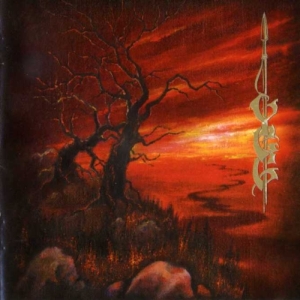
1. Krallice – Diotima (track: Dust and Light)
More than the album of the year, Diotima is one of the greatest albums ever made. I can’t fathom the amount of skill it must take to perform with the speed and precision that these guys do, but if they battered down a physical barrier to metal in 2008, they finally grasped hold of what lies beyond it in 2011. They claim that the songs on their first three albums were all written at the same time by Mick Barr and Colin Marston, before their self-titled debut. If that’s the case, then it must be the experience of performing together and the creative contributions of Lev Weinstein and Nick McMaster that raised Diotima to a higher level. It’s not just that they’ve improved in every way imaginable; the songs themselves are overwhelming, breathtaking, and chaotic to a degree they’d never before accomplished. Krallice perform an unwieldy monster that took a few albums to thoroughly overcome. Now they’re in complete control, and their absolutely brilliant song-writing can shine through. With the exception of the dubious Litany of Regrets, this is possibly the greatest album I have ever heard. (Other recommended tracks: Inhume, Diotima, Telluric Rings)
It’s not really a coincidence that the two genres of music I’ve listened to most over the years are black metal and post-rock. Something about tremolo guitar very consistently inspires me, and these are the two styles that most frequently and effectively utilize it. But post-rock is one of the most diverse styles of music on the market, and if it employs techniques found in black metal to capture its most intense moments, its other reaches are inexhaustible. It’s characterized more by the effect it produces in the listener than by the means it employs towards this end, and tremolo guitar just happens to be the best–certainly not the only–technique suited for it. The effect it produces is, you might say, a general sense of awe.
When we speak of post-black metal we’re suggesting a branching out from something that is much more locked in place. Technically black metal means tremolo guitar and blast beats, plain and simple. Thematically it goes a bit beyond post-rock, exploring and reveling in a very wide array of human emotions which, to conform to a cultural misconception, might be generally described as negative. Sometimes a post-black metal tag suggests bands that break out from tremolo and blast beats but stick to the same “negative” themes, as in say, Agalloch. Sometimes a post-black metal tag suggests something more like “progressive black metal” which finds creative new ways to employ blast beats and tremolo picking, like Ihsahn or Krallice.
Obviously musical classifications are dubious, sometimes illogical, and only really practical as a shorthand for “you might like this band if you like x”. But with a great deal of discretion they may also be employed to track the general evolution of music–the emergence of new methods and themes, the passive and active influences of any of these upon another, etc–and to predict where it is headed next.
Violet
Deafheaven are a brand new band out of San Francisco. They haven’t been releasing demo tapes unnoticed for a decade like a lot of “new” bands; they only just formed in 2010, and Roads to Judah is their debut album. It was the logical next album for me to review, in a sense. I love Krallice, I was told if you like Krallice check out Liturgy, Liturgy’s popularity lead me to reconsider Wolves in the Throne Room, and a broader consideration for “popular” black metal meant the next band to listen to was Deafheaven. (I would imagine I’ll be completing this path by checking out Ash Borer some time next week.)
Now, stylistically none of these four bands have very much in common. Furthermore, I am standing by my opinion that Wolves in the Throne Room are overrated, mediocre, and generic. But Krallice, Liturgy, and Deafheaven all deserve acute attention. Each, in very different ways, is completely redefining black metal. Krallice are doing so by pretty much perfecting everything I’ve ever loved about the style. Liturgy are doing so by embracing a subtle theme within it. Deafheaven, the band I am exploring now, are something of a grand amalgamation of pre-existing genres of music which have often shaken hands but never before so fully embraced each other. As regards my opening observations, they could just as easily be described as “blackened post-rock” as “post-black metal.”
I think the significance of this has been obscured by people calling them shoegaze black metal. Yes, one of their guitarists, Nick Bassett, was in a shoegaze band prior to Deafheaven (Whirr), but you can’t honestly tell me you hear it in this music. Post-rock is greatly in debt to shoegaze in a lot of ways, but it’s not the same thing, and you can’t tell me this sounds more like The Jesus and Mary Chain than Mono. Not that shoegaze black metal isn’t itself a creative new genre, the fact that Alcest already did it (though Neige denies any direct influence) and a lot of bands copies him drastically downplays its significance. But calling Deafheaven shoegaze is like calling it classic rock, because, you know, somewhere down the line The Who influenced metal. No, this is an amalgamation of post-rock and black metal. That is why it’s on the cutting edge. That is why there’s no obvious term with which to describe it.
I’m not sure exactly what all to take from it. Violet doesn’t inspire me in the way that a lot of black metal does, but that’s not to say it falls short. I almost want to say I’d have to see them live to fully appreciate them. I mean, very few post-rock bands deliver on their studio albums. With the exceptions of Explosions in the Sky and Godspeed! You Black Emperor I almost always have to see a post-rock band in concert to appreciate them, and even then no matter how much they blow me away I don’t necessarily enjoy their albums. I get the same vibe from the four opening minutes of Violet that I get from bands like Mono and This Will Destroy You–a pleasant bore through my stereo and a total mindfuck live. You have to feel this sort of music encompassing you and see the musicians creating it to fully take it in.
Language Games
The second track, Language Games, is much more accessible and immediately appealing. What’s more, it progresses into something which feels an awful lot like screamo to me, most notably in the emotionally tortured screams laid over a simple undistorted melody at 3:50 and the drum roll that follows. I wouldn’t be the first to describe Deafheaven as a screamo black metal crossover, and they are, after all, on Converge frontman Jacob Bannon’s record label, Deathwish Inc. Am I then to call this blackened post-screamo? That’s fucking stupid. I think what you can really take from Deafheaven is something a little more inspiring. Like Liturgy, it is a grand realization of hidden trends growing within music in general, and as such it fits no “genre” tags at all until more bands come along that sound like it.
Whatever you want to call Liturgy’s sound, I’ve been pointing out signs of it for a while now, here in an Ulver song, there in an Alcest song, and many other places besides. As regards Deafheaven, black metal and post-rock have always shared a bit in common, and I would argue that screamo is no foreigner either. It’s a word I’ve been hesitantly coughing up to describe more and more black metal recently. Ars Poetica by Drudkh bewildered me with its likeness to Envy, I explicitly noted a post-rock/screamo vibe at the end of The Puritan’s Hand by Primordial, and I pointed out similarities in Altar of Plagues as well, to name a few. Deafheaven took up a growing theme and ran with it.
Unrequited
Deafheaven are definitely at the top of my bands to see live list, and Roads to Judah is an exceptional album, but it’s kind of a downer in so far as none of the tracks deeply move me. I can get into the vibe but I can’t latch on to any particular moment. It’s significance for me is more in what it accomplishes as the most pronounced and maintained example of a combination of stylistic crossovers long in the making.
But let’s end this on a cautionary note. To suggest black metal broke out of its shell in 2011 would be ridiculous. If I turn to Sagas by Equilibrium in 2008, Ballade cuntre lo Anemi francor by Peste Noire in 2009, Luna by Boris in that same year (the Chapter Ahead Being Fake split with Torche), or Blut aus Nord right now, I can find plenty of examples of older bands doing much more progressive (and impressive) things with black metal than what you’re hearing on Roads to Judah. Deafheaven (and Liturgy for that matter) feel pretty immature when competing in the big leagues. The uniqueness of these bands arises from their willingness to shout out something previously only whispered, not from their having perfected anything. (Mind you I am not suggesting they sound remotely similar.)
This act of shouting is only one of many features which have given rise to a lot of derision. With Deafheaven boldy embracing screamo, Liturgy sounding like the Neutral Milk Hotel of black metal, and both bands dressing like trendy assholes, it’s no wonder “hipster” denunciations are flying right and left. “Emo” and “black metal” go together like two gay cowboys at a Texas Republican convention. But really, the more we admit that black metal has always been a little emo the more we detract from the power of subtlety, and there’s some legitimate concern that their appearance is more likely to catch on than their performance. Liturgy and Deafheaven are both great, and some really shitty bands are going to follow in their wake. But it was there all along. This was all bound to happen.
I heard this band before you did. No, really. It was completely by accident, to be honest. I had just found out about Agalloch bassist Jason William Walton sideproject and indisputable worst band in existence Especially Likely Sloth. Youtube didn’t exist yet so I had to actually go to the Vendlus Records website, where they were really pushing preorders of Wolves in the Throne Room’s debut album. It was only like $8 so I threw it in the cart. Two years later I almost saw them live, opening for Jesu on their 2007 US tour. I thought it would be kind of cool, being the one kid in the house who had actually heard of them (I had no idea Southern Lord picked them up), but they made the mistake of scheduling all their Texas stops the exact same areas/days as Finntroll, and the opportunity to see the latter two days in a row won out.
Next thing I know they’re the most popular black metal band in the world. Go figure.
Thuja Magus Imperium
I guess what shocked me most about that was I never thought they were very good. I mean, I had heard Diadem of 12 Stars plenty of times, and to me they were just another black metal band, with no distinguishing features to speak of.
By the time I found out about their success though, they had just released a third album. I hadn’t heard about the second, I didn’t remember the first (because it is very forgettable), and I was not feeling up to the task of attentively engaging three albums which I didn’t have high hopes for. All of the hype was coming from outside of metal circles, and sure, Pitchfork has pushed good metal before (Mastodon for one outstanding example), but nine times out of ten their selections are borderline arbitrary–the first metal experience of ‘experts’ completely foreign to the genre or maybe even just the newest release from a record label helping to pay their bills. No, when metal bands become popular in non-metal crowds, it usually has nothing to do with their music.
Last week though, I heard Liturgy. Hyped by all of the same dubious sources, it was comparisons to Krallice and Hunter Hunt-Hendrix’s outlandish interview that ultimately compelled me, but in light of the fact that Aesthethica is fucking amazing, I thought it high time I gave a few other “Pitchfork metal” bands a try. For obvious reasons both in fame and personal experience, Wolves in the Throne Room were the first casualty.
I had Celestial Lineage on repeat for two solid days trying desperately to derive something, anything special and significant out of it. I couldn’t. At the surface they were the same generic status quo black metal act I heard demo recording samples of back in 2005. But as it always goes, when it came down to actually spelling out what in particular I found boring about them I finally found myself noticing some of the appeal. Not much, mind you, but a little bit.
Let’s look at this opening track. I hear a chick singing to some simple piano and synth, some basic tremolo lurking in the background–a mood setting introduction, like 50% of the genre. Nothing in particular sets it above average. I’m not really feeling it yet, still just hearing a recording studio session. The black metal fades out of the ambiance rather than exploding, and I like that. Once again, it’s nothing unique, but always an effective way of stating your intentions up front. There’s an obvious Agalloch influence, most distinct in the guitar solos, and by the time they end I’m definitely getting a dark, reflective vibe–nature themes, something really earthy. The transition back into a female chant, a synthy night sky with chime-spawned stars, a slow resurrection of guitar painting the celestial horizon in different shades of black, blotting out the stars in an auroral haze… It’s exceptionally visual, and it’s visual in a distinctly American way. You know: earth spirituality; something native to the soil; American folk metal, which possesses virtually no stylistic commonality with its pantheon-laden European namesake.
The second track is a two minute ambient piece, and I find it irritably overdone. It is accented by a vocal chant which just doesn’t fit the picture, and I think if they’d left that out it would have been perfect. At any rate, the third song explodes back into black metal.
Subterranean Initiation
This is what I remember forgetting about their first album: really generic black metal. A mix of second wave and Ukrainian sounds, it is moody and scene-setting only to the extent that all black metal is, and offers absolutely no leads as to what the band had in mind beyond “Ok dudes at this part let’s sound like Emperor or Drudkh or some shit, it’ll be cool.”
A little over 4 minutes in the song comes to a standstill, and the residual distortion and drums kind of scrape along in a not particularly coherent mishmash. Out of it emerges a shamefully obnoxious guitar hammering the same meh chords over and over and over (and over) and I would probably have shot myself at this point, but beneath it all the drummer is actually tearing it the fuck up with subtly accented blast beats that I found simultaneously intense and relaxing. The guitar eventually goes post-rock kind of out of nowhere and ends a mostly boring song on a pretty good note.
Astral Blood
I kind of wanted to end this on Woodland Cathedral, a 5+ minute ambient track that impressed me in ways similar to the latter half of the opening song, but since it’s mainly their black metal that I’ve been bashing, Astral Blood is probably the better choice. Here they do it right, and I never need to question their originality because I’m already too caught up in it to care. The mood sets in instantly, unleashing black metal’s potentially soothing effects–the sort of feel good in the cold contemplative darkness track that I like having on as a background piece. When the ambiance returns it’s gorgeous, and the song doesn’t really go down hill until 5:30 (at which point the guitar repeat is once again merely obnoxious), periodically recovering and digressing through to the end.
So, what’s the final verdict? On the surface, generic. In depth, too diverse for its own good. The first track, Thuja Magus Imperium, is really brilliant, but it is perhaps the only track I can say such things about. There is a fine line between meditative repetition and a broken record, and Wolves in the Throne Room seem pretty oblivious to it. What’s more, their fastest metal moments lack emotion and intensity, and their slowest lack subtlety. Their ambient tracks are nice, but they have a habit of overdoing them, especially vocally (including the female vocals at times), where once again a little subtlety could have saved the day. I was pretty impressed by the drummer the few times I tuned in to him, and perhaps another listen as attentive as the few I put in writing this would position me to praise him more thoroughly, but I am out of time and patience.
It’s because Celestial Lineage does possess a few moments of brilliance, however, that a thorough critique is even possible. The album as a whole is not at all generic in the sense of say, the new Demonaz album, and, while I might enjoy listening to that one slightly more, it’s got a lot less to appreciate. Celestial Lineage is only generic in its methods for creating complexity; it’s not generic at its core. But it is also nothing special, as I’d originally perceived.
Wolves in the Throne Room have reportedly claimed that their music is meant to be meditative rather than aggressive, and that they play black metal on their own terms. They’re fooling themselves with the latter claim, and while I’ll grant that it’s meditative, those non-metal fans who think it is exceptionally so simply have not experienced much of the genre.
Two months ago I thought I could actually finish reviewing every album I wanted to before it came time for the year-end lists. Then I got hooked on Diotima by Krallice again, bought Skyrim, and had finals. (Yes, I will be a student until I’m pushing 40 at this rate.) So much for writing the rest of the reviews I’d intended to. But there remains one band that’s just too loud to pass up, and I am not necessarily referring to their music.
Returner
In certain ways, Aesthethica is the triumphal conclusion to a seed I first noticed begin to sprout on Ulver’s Nattens madrigal, recorded back in 1996. Hymn VI: Of Wolf and Passion accomplished something completely unprecedented in the history of black metal up to that time. The song began with a frightfully fleeting glimpse at something beautiful; it wasn’t an “introduction” to the song, prefixed for the purpose of defilement. No, it was an ecstatic jubilation shouting out from the depths, proclaiming a profound sublimity hidden beneath this shroud of loathsome chaos. Almost a decade later, in 2005, Neige found himself transfixed upon a fleeting vision of a word of pure light and recorded Le Secret. This is, roughly, a description he himself has used in attempting to articulate his muse. Feeling that the original recording failed to capture this, he recently released a new version of the EP. It, like Souvenirs d’un autre monde and more so Écailles de Lune, has a tendency to overemphasize the aural light, with angelic vocals and an uplifting shoegaze fuzz drowning out the cold death of traditional black metal. He has turned to what you might regard as stereotypical representations of purity in order to recreate his vision.
But this sense of something whole and eternal falls on deaf ears. To me it is merely pretty, never spiritual, because it fails to capture what made the original Le Secret so profound. There, the black metal never made amends. It was an ever present, undeniable force, fulfilling its original purpose and not merely conforming to a new creative whim. The beauty rested within it, perpetually fleeting, not beyond it and eternal. Neige was never aware of his own masterpiece. Perhaps that sort of innocence is what made it possible in the first place. I applaud him for seeing through his own vision to completion and not settling for mine, but the future of Alcest is of no further relevance to the musical progression I have been anticipating these past few years.
For that I turn to Liturgy. On Aesthethica we hear one of the first conscious recognitions of that seed I detected in Ulver, which has been slowly blossoming in the darkness ever since.
Harmonia
In case the video to Returner did not suffice, Liturgy’s frontman, Hunter Hunt-Hendrix, made a complete fool of himself in an interview last year while attempting to explain the philosophy behind his music. I will make no apologies here; he deserves every ounce of ridicule he’s received from it. At one point he suggested that fans read his ‘manifesto’, which is free to download, and I did. It is crammed to the hilt with pomp and self-righteousness, amidst which the following constitutes, I believe, his main idea: He describes metal as a pursuit of maximum intensity. The closer music evolves towards that end, the more apparent it becomes that “totality is indistinguishable from nothingness” (Hideous Gnosis: Black Metal Theory Symposium I, 57). Black metal long embraced nihilism as the ultimate end, but nihilism is a hollow reward. The true apex of humanity lies in the penultimate, one step from the void, reveling in the finite.
What I find interesting here is not what he’s saying (well, I do find it interesting, but I’ll keep those thoughts to myself), but rather the fact that paradigms are beginning to emerge which attempt to define the sensation I expressed in terms of my experiences with Ulver and Alcest. I call Aesthethica a triumphal conclusion because it is the first thoroughly self-conscious result of a musical trend I’ve been following for quite some time now–triumphal because, well, it’s pretty damn good. It marks the end of an evolutionary process, from which a new cycle will begin. Transcendental black metal is going to happen whether we like it or not, and in the process we will witness a very peculiar clash of values. I mean, just look at these guys:
High Gold
Aesthethica isn’t always this good. Some tracks bore me to tears. It’s in their intense moments that Liturgy really shine, and while these comprise the bulk of the album, the band seems to have little else to offer. Generation is a rhythmic plod which dreams of being post-metal but feels more like my cd is skipping. Glass Earth is a vocal chant that inspires only laughter; it sounds like something off a really bad indie rock album, and this amidst a genre as intimately connected to folk as metal. The intentional 60 seconds of silence at the end of Sun of Light is annoying, though forgivable in the wake of the album’s best track; but the three minute doodle filler track that follows seems to serve no purpose whatsoever.
Its finest moments though, such as High Gold, are amazing. I can’t say that the album is great, because it’s so inconsistent, but I will acknowledge that it contains some of the best songs written this year, and moreover, it is unique in what it attempts to accomplish. Perhaps a lot more could be said on its behalf had Hunter Hunt-Hendrix declined all interviews and published no ‘manifesto’, but I’m kind of glad he did what he did. It confirmed a message which I’ve been preaching for years now; not, that is, his precise philosophy, but at least a feeling. There has been something entirely positive and uplifting lurking out there in the black metal scene for a very long time. Liturgy are the first band I know of to not merely incorporate it but embrace it as the fundamental focus of their entire sound. Other bands have occasioned to evoke it in passing more effectively (Krallice for instance), or have consistently approximated it without ever fully cashing in (post-Le Secret Alcest and associated acts), but Liturgy provide me with something solid to point at and say unequivocally that is what I was talking about.
I woke up this morning thinking “I want to listen to some new black metal.” I pulled up my usual sources and subsequently spent about 20 minutes scrolling through “shoegaze black” and “post-black” and “progressive black” “transcendental esoteric aesthetic neo-black” and, well, I was getting annoyed. Then I remembered I’d overlooked a new Marduk EP back in May, and now I am happy.
Warschau 2: Headhunter Halfmoon
Because Marduk never disappoint. They certainly aren’t among my favorite black metal bands, but they come with a sort of guarantee. When you see “Marduk”, you hear violent, completely unforgiving Swedish-style black metal, pretty much without exception. Even their mellow moments are by average standards brutal. That has at least been the case since I started listening to them (Panzer Division Marduk, 1999), and it certainly holds on Iron Dawn.
Typical Swedish-style black metal has always been a little bland to me, and I think that’s the only reason I don’t sing their praises more. Within that limited genre, of the bands I’ve heard they’re second only to Endstille.
Modern warfare has been a common theme in their music for a long time now, and they don’t necessarily bring anything new to that perspective on Iron Dawn, but I do think this EP, especially this song, makes exceptionally good use of sound effects. The sirens and exploding bombs seem to meld with the relentless blast beats perfectly to maintain the song’s intensity.
Prochorovka: Blood and Sunflowers
The album progressively mellows out, though “mellow” is a very relative term here. For the sake of not posting the EP in its entirety, I’ll go ahead and skip the middle track. (Though I must say, until I read the track title, “Wacht Am Rhein: Drumbeats of Death”, I thought he was screaming “droppings of death”, as in a broken English attempt at describing aerial bombardment, and had in mind a vision of especially volatile poop.)
Prochorovka is a slow plod that maintains the brutality in spite of dropping the blast beats. Again the warfare sound effects serve as percussion and paint a nasty vision of sub-human slaughter. Good times.
I don’t have much to say about Iron Dawn, or any other Marduk album for that matter. They’ve just kept doing their thing over the years, and if you like one album there’s a good chance you’ll like them all. In a time when straight up brutal black metal with no pretentious trappings is getting harder and harder to come by, it served my momentary mood well.
October has always been my favorite month. It marks the beginning of a seasonal reclamation of man by the world, in which civilization’s mask of sensibility begins to slip away. Tasteless architectural symbols of control over nature digress to their more appropriate forms, as frail refuge against forces beyond our control or comprehension. It is, to misappropriate Agalloch, “a celebration for the death of man… …and the great cold death of the Earth.”
Last year I posted a six part series on some of my favorite black metal, folk metal, and related genres for the season. I had intended to do something similar this year, but time just did not allow for it. I never got around to coming up with a central concept on which to focus. Perhaps it is no coincidence that the two bands I have listened to the most this month, Opeth and Summoning, both defy all standards of classification.
I would like to showcase both, but I can’t imagine doing so properly without embarking on a project way beyond the scope of my time and desire to write at the moment. So I will keep this short and sweet, featuring only Opeth’s Orchid (1995) and Summoning’s Let Mortal Heroes Sing Your Fame (2001), and perhaps in the process still introduce you to some amazing music you had not heard before.
Opeth – The Apostle in Triumph
Everyone has heard Opeth, right? Their fame is fairly unprecedented among metal bands that are actually worth a damn. Yet, out of touch with what is and is not popular today as I am, I still get the impression that what I think of as Opeth is just as relatively obscure as it had been when I first heard them well over a decade ago.
Opeth as a popular band, in fact, is entirely foreign to me. Their first album to make the US charts, Damnation, came out right around the time I stopped listening to them altogether, and long after my interest had begun to wane. I was introduced to Opeth, like everyone around the turn of the century, via Demon of the Fall. My Arms Your Hearse was one of the most emotionally charged and breathtaking albums I’d ever heard. At the time, if you wanted to hear more, you had to look backwards, to Orchid and Morningrise, both of which were very different beasts. With them, if no one reminded you of the distortion and growled vocals, you might forget, amidst Akerfeldt’s soft, subtle lamentations, that you were listening to metal at all.
It took both a long time to grow on me. It’s not that they were inaccessible, but that peculiar teenage ability to focus in on a single masterpiece with no appreciation whatsoever for its surroundings had hold of me. There I was covering My Arms Your Hearse from start to finish on my new guitar (sure wish I could still do so now), and I’d listened to Morningrise maybe five times. Orchid never broke through the cellophane. I finally turned to them just barely in time to soak them up before history left them in the dust, a last minute love affair I was conscious of at the time. They ended up becoming my two favorite Opeth albums, and still are.
Even though My Arms Your Hearse was, alongside Blind Guardian’s Nightfall in Middle-Earth, easily the most influential album in my life, Orchid and Morningrise are the two I look back on most nostalgically, and their melancholy beauty always reverberates the sensation.
Opeth – The Twilight is My Robe
So maybe Orchid isn’t really Opeth’s best album. Perhaps I am biased beyond reconciliation. But at any rate, my obsession with it certainly isn’t some subconscious desire to show I am an “old school” fan–the sort of accusation I tend to see on those rare occasions that the album is mentioned at all. Whether you find my placement of it at the top of Akerfeldt’s discography unjust or not, I encourage you to give The Apostle in Triumph and The Twilight is My Robe long hard listens. Agalloch being a decidedly winter-oriented band, I have experienced no music which captures the melancholy side of the autumnal season better than this.
Summoning – A New Power is Rising
I obsessed over The Hobbit as a child, the Lord of the Rings as a teen, and The Silmarillion in my earliest adult years. J.R.R. Tolkien pretty well haunted most of the formative years of my life, and I am forever indebted to him. A few months ago I picked up one of his books for the first time in perhaps a decade, committed to reading them all, but time simply did not allow for it. As with all undertakings though, it influenced my taste in music for the time at hand. I spent much of the summer re-exploring Summoning–a band I’d never actually encountered until Oath Bound in 2006. Thus they were readily at hand at the start of October, and since then they’ve comprised over half of everything I have listened to.
I dare say no single author has had more impact on music than Tolkien, and while I will always regard Nightfall in Middle-Earth as the greatest relevant triumph, Summoning’s discography is a close second. The one band I know of which has taken Tolkien as their lyrical and musical muse pretty much exclusively, they have forged an entirely new style of music over the years that captures that feeling I always got reading him to perfection.
Summoning – South Away
Summoning emerged from black metal, but from the very beginning they stood apart. By Let Mortal Heroes Sing Your Fame in 2001, my favorite album of theirs, this connection had dwindled to little more than the vocals and some tremolo guitar. The constant use of keyboards (often set to replicate brass) and the heavily reverberated, slow drumming are what characterize them best, along with frequent spoken vocal loops.
Perhaps they intend to sound fairly sinister, with lyrics focused more often than not on the darker forces of Tolkien’s tales, but the effect for me is nothing of the sort. The drums paint a vast, diverse landscape of mountains, forests, rivers and plains that are entirely neutral–dangerous to be certain, but more enticing than aversive. They beckon you out to explore the unknown, steeped in mystery–a fantasy world which is here Middle-Earth, but could just as soon be your own back yard on an autumn day, when the changes at hand call on you to leave humanity behind and wander off into the amoral wilderness.
Summoning – Runes of Power
I love black metal, horror, and everything of the sort, but I think the word “neutral” best describes what I have been tapping into this Halloween season. No real glorification of evil for its own sake, nor any embrace of bygone cultures and values here. Orchid and Let Mortal Heroes Sing Your Fame both tap into the individual’s relation to the world absent civilization’s presumptions and impositions–to the mystery of nature and the manifold possibilities within it which mundane daily life denies–be the experience melancholy or thrilling.


 Through the Shattered Lens