Horror Film Review: The Invisible Man’s Revenge (dir by Ford Beebe)


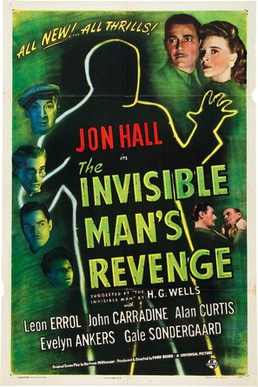
1944’s The Invisible Man’s Revenge opens with Robert Griffin (Jon Hall) arriving in England.

Despite his last name and the fact that he’s played by the star of Invisible Agent, this Robert Griffin would not appear to be in any way related to the previous invisible men.  Instead, he is someone who has just escaped from a mental institution in South Africa.  He has already murdered two orderlies and now, he’s come to England to take vengeance on Sir Jasper Herrick (Lester Matthews) and his wife, Lady Irene (Gale Sondergaard), two old friends who the paranoid Robert thinks tried to kill him in Africa so that they could steal his money.  When Robert sees Sir Jasper and Lady Irene, he informs them that they can either give him half of their fortune or they can allow him to marry their daughter, Julie (Evelyn Ankers).  Lady Irene responds by drugging Robert and having him kicked out of the house.

Dejected, Robert eventually comes across the cottage of Dr. Peter Drury (John Carradine, giving a surprisingly low-key performance in the mad scientist role).  Dr. Drury reveals to Robert that he has developed a serum that can turn living things invisible.  Drury goes on to “show” Robert all of the invisible pets that he has hanging out around the cottage, from an invisible dog to an invisible parrot.  When Robert asks how long the invisibility lasts, Drury says that it will last until the invisible person dies.  That sounds pretty good to Robert so he volunteers to be Drury’s latest test subject.

Soon, Robert is invisible and going out of his way to haunt that Herrick family.  Some of Robert’s antics are merely playful.  He helps a cobbler (Leon Errol) win a game of darts and later turns the man into his personal servant.  Robert’s other actions are a bit more destructive.  Robert, after all, was a murderer to begin with and using a serum that cause additional insanity is definitely not helping him with his temper.  When Robert decides that he wants to be visible again, he discovers that there’s only one temporary way to do it and it involves a lot of blood.

After being portrayed as being a hero in Invisible Agent, The Invisible Man is once again a villain in The Invisible Man’s Revenge and it just feels right.  There’s just something inherently sinister about the idea of someone being invisible.  Jon Hall, who was so boring in Invisible Agent, is far more compelling here, playing Robert as a paranoid megalomaniac who has so convinced himself of his own cleverness that he can’t even understand that he’s writing the script for his own downfall.  This is a good, solid Universal horror movie.  The true hero of the movie is Drury’s dog, played by a talented canine actor named Grey Shadow.  It takes more than invisibility to fool that dog!
Previous Universal Horror Reviews:

  1. Dracula (1931)
  2. Dracula (Spanish Language Version) (1931)
  3. Frankenstein (1931)
  4. Island of Lost Souls (1932)
  5. The Mummy (1932)
  6. The Invisible Man (1933)
  7. The Bride of Frankenstein (1935)
  8. Dracula’s Daughter (1936)
  9. Son of Frankenstein (1939)
  10. The Invisible Man Returns (1940)
  11. The Wolf Man (1941)
  12. Ghost of Frankenstein (1942)
  13. Invisible Agent (1942)
  14. Frankenstein Meets The Wolf Man (1943)
  15. Son of Dracula (1943)
  16. House of Frankenstein (1944)
  17. House of Dracula (1945) 
  18. Creature From The Black Lagoon (1954)

Horror Film Review: Dracula’s Daughter (dir by Lambert Hillyer)


draculas_doughter_original_poster_1936

Did you know that Dracula had a daughter!?

Well, Bram Stoker might disagree but, according to Universal Studios, he did.  Her name was Countess Marya Zaleska and, as played by Gloria Holden, she is the title character in 1936’s Dracula’s Daughter!  Like her father, the Countess was also a vampire.  The film never gets into just how she became a vampire.  Was she born a vampire or, far more disturbingly, was she once a mortal who turned into a vampire by her own father?  The film doesn’t tell us but it does establish early on that she hates being one of the undead.  Unlike her father, she struggles with her urge to drink blood.  When she discovers that Dracula has been staked, she and her servant, Sandor (Irving Pichel), steal the body from the morgue and burn it.  The Countess thinks that this will cure her of her urges.

Sadly, it does no such thing.

So, what’s a reluctant, 20th century vampire to do?  Well, she can always go to a psychiatrist and hope that science can somehow break the curse.  She ends up as a patient of Dr. Jeffrey Garth (Otto Kruger).  By coincidence, Dr. Garth has another famous patient — Dr. Edward Von Helsing.  (That’s right, they changed the “van” to a “von” in Dracula’s Daughter.  Despite the name change, Edward van Sloan returns to play the veteran vampire hunter.)

Von Helsing in on trial, accused of murdering Dracula in the previous film.  Oddly enough, nobody mentions Renfield who, seeing as how we’re told Dracula’s Daughter starts exactly where Dracula left off, would have been found dead in the crypt as well.  Even stranger, no one steps forward to defend Von Helsing.  Dr. Seward, Mina, Johnathan Harker?  Forget about them.  Not a single one is to be found while Von Helsing is accused of murder.

Bastards.

Fortunately, Von Helsing has a defense!  Since Dracula was already dead and had been for 500 years, Von Helsing could not have killed him.  Helping him out with this defense is Dr. Garth…

Meanwhile, the Countess tries to resist the urge to attack every woman that she sees.  She pours her frustrations out into painting.  One night, Sandor brings the Countess a new model, a beautiful young woman named Lil (Nan Grey).  The Countess orders Lil to undress and then, after staring at her, gives into her urges and attacks…

If you’re thinking that there’s a subtext here, that’s because there is.  (In fact, Universal’s tagline for the film was, “Save the women of London from Dracula’s Daughter!”)  Perhaps even more so than in Dracula, Dracula’s Daughter uses vampirism as a metaphor for forbidden sex.  When the Countess stares at Lil and, later, when she prepares to bite the neck of Dr. Garth’s fiancée, she is embodying the hysterical fears of a puritanical society.  When she unsuccessfully seeks a cure for her vampirism, we’re reminded that, in the 1930s, psychiatry classified homosexuality as being a mental illness.  When the Countess struggles with her urge to drink blood, she is a stand-in for everyone who has struggled with their sexuality.

Gloria Holden plays the Countess as being as much a victim as a victimizer.  Whereas Bela Lugosi turned Dracula into the epitome of evil, Gloria Holden gives a performance that is full of ambiguity.  In fact, she at times seems to be so tortured by her vampiric state that, when she finally fully embraces the fact that she’s a vampire, you have to cheer a little.  At least she’s finally being honest with herself!  At least she’s no longer making apologies or allowing society to punish her for being who she is.  Was Countess Zaleska the first reluctant vampire in film history?  I’m not sure but Holden’s performance undoubtedly set the bar by which all other self-loathing vampires should be judged.

Dracula’s Daughter holds up surprisingly well.  It’s definitely one to look for during this Halloween season.

Horror Film Review: The Picture of Dorian Gray (dir by Albert Lewin)


picture-of-dorian-gray-32

Hello and welcome to the start of TSL’s annual October horrorthon!  All through the month of October, our focus will be on horror.  We will be sharing reviews and thoughts on some of the best (and worst) horror films ever made!  I have to admit that this is my favorite time of the year.  I love horror … like all good people!

I want to start things off by taking a look at a film from 1945.  The Picture of Dorian Gray is based on the famous novel by Oscar Wilde (a novel that some people think was inspired by the Jack the Ripper murders).  Dorian Gray (played by Hurd Hatfield) is a young and handsome aristocrat who lives in 19th century London.  When we first meet him, Dorian is intelligent, kind and virtuous.  He’s also more than a little boring.  He is the bland face of the establishment, a man destined to be celebrated for his position in society and largely forgotten after his death.

Dorian is posing for a painting that’s being done by his friend, an artist named Basil Hallward (Lowell Gilmore).  One day, Lord Henry Wotton (George Sanders) stops by the studio while Basil is painting Dorian.  Lord Henry is everything that Dorian Gray is not.  He’s a worldly and cynical man and he is very proud to live a life devoted to complete and total hedonistic pleasure.  He immediately sets out to corrupt Dorian and it turns out to be a lot easier than he was expecting.  Henry convinces Dorian that he can have everything that he wants as long as he’s young and handsome.  Dorian announces that he wishes the painting could age instead of him…

Now, here’s where the film takes a huge departure from Wilde’s novel.  In the novel, the painting ages while Dorian stay young.  No specific reason is given.  Instead, it’s just something that happens.  In the film, it turns out that Basil owns an ancient Egyptian statue and that the statue has mystical powers.  Dorian makes his wish in front of the statue and that’s why the painting starts to age.  Personally, I think the bit with the Egyptian statue is unnecessary and a little bit silly.  To me, the story is a lot more effective if the painting starts to age without an explanation.  The filmmakers obviously disagreed.

But no matter!  In the end, the Egyptian statue isn’t that important.  What is important that, freed from getting old or physically suffering for his actions, Dorian transforms into a different person.  Soon, he’s even more hedonistic than Lord Henry.  When he breaks the heart of a tragic singer named Sybil Vane (Angela Lansbury, in a poignant and Oscar-nominated performance), Dorian sees that the painting is now cruelly smirking while his own face remains innocent and untouched.  When Dorian eventually commits a murder to keep his secret from getting out, the blood appears on the painting’s hands while his own remain clean.

And the years pass.  Dorian finds himself both being hunted by Sybil’s brother (Richard Fraser) and falling in love with the niece (Donna Reed) of a man that he earlier murdered.  Dorian never ages but his portrait becomes more and more twisted.  What’s particularly interesting is that we see little of Dorian’s evil actions.  Instead, we watch and listen as other characters whisper about the horrific things that he’s done.  Physically, Dorian remains an innocent and young aristocrat.  But all we have to do is look at the picture and we can see what a monster Dorian has become…

The Picture of Dorian Gray is an absolutely gorgeous film, one that is full of elaborate sets that are often cast in shadow.  (It’s interesting to note that the more corrupt Dorian becomes, the darker and more shadowy his estate becomes.)  The film is in black-and-white, with the exception of three scenes in which the portrait is revealed in all of its Technicolor glory.  If that sounds like a gimmick … well, it is.  But it’s an amazingly effective gimmick.

The Picture of Dorian Gray is a classic exercise in psychological horror.  See it the next chance you get!

portrait-de-dorian-gray-1945-01-g

Embracing the Melodrama Part II #14: Suspicion (dir by Alfred Hitchcock)


Suspicion_film_poster

First off, a warning.  The following review of the 1941 best picture nominee Suspicion will include spoilers.  So, if you haven’t seen the film and you’re obsessive about avoiding major spoilers, then don’t read the review.  Simple, no?

Two years ago, I was having lunch with some of my fellow administrative assistants.  One of them was talking about how she had watched an “old movie” the previous night.  From listening to the vague details that she offered up, I was able to figure out that she had apparently stumbled across TCM for the first time in her life.  From listening to her talk, I would not be surprised if she was literally describing the first time she had ever actually seen a black-and-white movie.  Needless to say, my first instinct was to correct everything she was saying but I resisted.  (For some reason, at that time, I was feeling self-conscious about being perceived as being a know-it-all.)  But, as she kept talking, I found it harder and harder to keep quiet.  Listening to her talk about old movies was like attending an art history lecture given by someone who had flunked out of a finger painting class.  Finally, when the conversation had moved on to someone who we all knew was sleeping with her much older boss, our self-proclaimed old film expert announced that age didn’t matter.  “I’d go out with Cary Grant,” she said, “and he’s old.”

Before I could stop myself, I added, “He’s also dead.”

Oh my God, the look of shock on her face!  I actually felt really guilty because I could tell that she had apparently taken a lot of happiness from the idea that suave, witty, and handsome Cary Grant was still out there.  And can you blame her?  In a career that spanned three decades and included several classic dramas and comedies, Cary Grant epitomized charm.  Some of his movies may seem dated now but Grant was such a charismatic and natural actor that it’s impossible not to get swept up in his performances.

(Who would be the contemporary Cary Grant?  I’ve heard some people compare George Clooney to Grant.  And it’s true that Clooney has Grant’s charm but, whereas Grant always came across as very natural, you’re always very aware that George Clooney is giving a performance.)

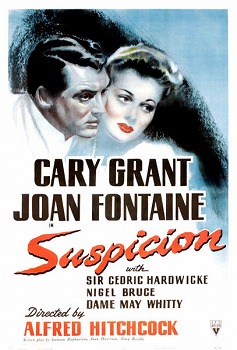
It was Grant’s charm that made him the perfect choice for the male lead in Suspicion but it was that same charm that made the film so controversial.  In Suspicion, Grant plays Johnnie.  Johnnie meets, charms, and — after the proverbial whirlwind courtship — marries Lina (Joan Fontaine), a sheltered heiress.  It’s only after Lina marries Johnnie that she discovers that he’s broke, unemployed, and addicted to gambling.  With everyone from her family to her friends telling her that Johnnie is only interested in her money, Lina starts to worry that Johnnie is plotting to kill her.  Lina starts to view all of Johnnie’s actions with suspicion, wondering if there’s an innocent explanation for his occasionally odd behavior or if it’s all more evidence that he’s planning to kill her.  When he brings her a glass of milk, Lina has to decide whether or not to risk drinking it…

Suspicion was based on a novel in which Johnnie was a murderer and which ended with Lina voluntarily drinking that poisoned milk.  In the film, however, Johnnie is not a murderer.  Apparently, it was felt that Grant was so charming and so likable that audiences would never accept him as a murderer.  Instead, he’s an embezzler and all of his strange behavior is due to him being ashamed of his past and feeling that he’s not worthy of Lina.  Once Lina realizes that Johnnie isn’t trying to kill her, she promises him that she’ll stay with him.

And a lot of people (including director Alfred Hitchcock, who claimed it was forced on him by the film’s producers) have criticized that ending but you know what?

It works.  If I had to choose between Joan Fontaine essentially committing suicide or Joan Fontaine promising to love Cary Grant even if Grant goes to prison, I’m going to go with the second choice.  Ultimately, Suspicion works because you can imagine being swept off your feet by Grant’s character.  But what makes Suspicion enjoyable, to me, is that Johnnie ultimately turns out to be exactly who we were hoping he would be.

Needless to say, Suspicion works as a great double feature with Rebecca.  Watch one after the other and have a great night of menace and romance.