Retro Television Review: King Of The Building 1.1 “Pilot”


Welcome to Retro Television Reviews, a feature where we review some of our favorite and least favorite shows of the past!  On Thursdays, I will be reviewing King of the Building, which aired on CBS in 1987.  The entire show is currently streaming on YouTube!
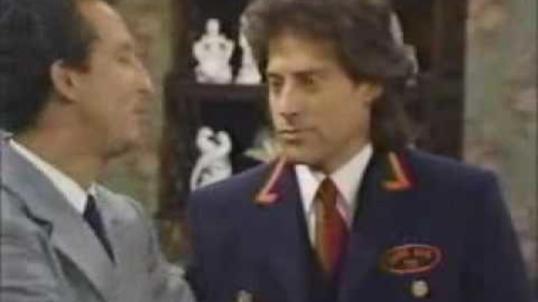
This week, Richard Lewis is a doorman.

Episode 1.1 “Pilot”

(Dir by James Komack, originally aired on July 31st, 1987)

Joey (Richard Lewis) is the …. KING OF THE BUILDING!

Well, no.  Actually, he’s just a doorman for a Park Avenue apartment building.  The owner of the building, Mr. Jamison (Simon Jones), is the real king of the building but the elderly residents all prefer to deal with Joey.  That’s because Mr. Jamison is greedy and venal and always looking for an excuse to kick people out of their apartments.  His latest target is Mrs. Gladstone (Billie Bird), who has dementia and thinks that Joey is her son, Elliot.

(Mrs. Gladstone has a sitcom form of dementia, where all of her mistakes are quirky and she never loses her temper or gets paranoid or disappears for hours on end.)

When Mr. Jamison brings in a social worker (Lora Staley) to try to get Mrs. Gladatone ruled incompetent, Joey and the other workers at the building conspire to make it appear as if all of Mrs. Gladstone’s confusion is due to Mr. Jamison keeping her apartment in disrepair.  The social worker declares that Mrs, Gladstone will be fine as long as Joey is working at the building.

(Personally, I would think this would lead to Mr. Jamison just firing Joey so he could then get rid of Mrs. Gladstone but that doesn’t seem to occur to him.  Of course, Joey also mentions that he’s a member of a union so maybe Joey has his job for life.  I hope it pays well.)

This was a pilot for a series that presumably would have followed Joey as he protected the elderly residents from Jamison.  It only aired once and it didn’t lead to a series.  Watching the pilot, it’s easy to see why.  Richard Lewis, who passed away two days ago, was a comedian who was acclaimed and famous for his ability to comedically explore what it meant to be truly neurotic.  There’s not really anything neurotic or obsessive or even particularly interesting about Joey.  He gets nervous and he complains a lot but, in the end, he’s just a blue collar doorman who doesn’t like his boss.  Lewis is likable but miscast in the role.  Watching him, one gets the feeling that Lewis was holding back all of his natural instincts to play the rather subdued and sensible Joey.

Despite the failed pilot, Richard Lewis would continue to appear in television and moves for the rest of his life and he became a bit of a cultural institution.  On Curb Your Enthusiasm, he often played the voice of reason to Larry David and proved that one could play sensible without losing his edge.  And, of course, a generation will always remember him as King John.
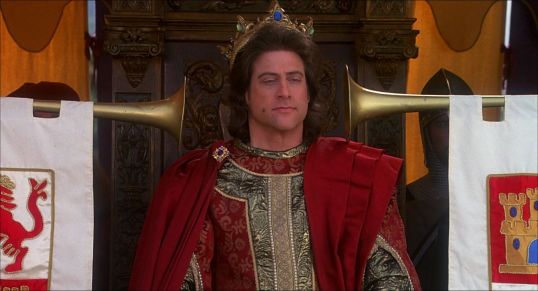
Rest in peace, Richard Lewis.

Police Academy 4: Citizens on Patrol (1987, directed by Jim Drake)


Long before the end credits of 22 Jump Street imagined Jonah Hill and Channing Tatum going to culinary school, the flight academy, and into outer space, the Police Academy films bravely tested just how far one already thin premise could already be stretched.

In Police Academy 4, Commandant Eric Lassard (George Gaynes) comes up with another plan to make the city safer.  (Since Lassard has been coming up with plans for three years without any success, it may be time to let the old man retire peacefully.)  This time, he wants to institute Citizens on Patrol, which would mean training citizens to act like cops.  It sounds like the type of terrible idea that could get a city sued into bankruptcy but considering that this is a city where a human sound effects machine and the former head of the 16 precinct’s biggest gang can become decorated police officers, I guess it’s as good an idea as any.

As usual, Carey Mahoney (Steve Guttenberg) and the gang are ready to help Lassard.  Bruce Mahler’s Fackler is no longer a part of the ensemble but Bubba Smith, Bobcat Goldthwait, Michael Winslow, David Graf, Tim Kazurinsky, Marion Ramsey, and Brian Toschi are all back.  Also returning, after skipping out on the first two sequels, is Capt. Harris (G.W. Bailey).  Harris wants to see Lassard fail so that he can take over the police academy.  It’s the same thing as the first three films.  As in previous Police Academy films, there’s a visit to the Blue Oyster leather bar and a last minute crime wave to give the Citizens on Patrol a chance to prove they belong in the program.  The Citizens on Patrol include Billie Bird, Brian Backer, David Spade, wrestler Tab Thacker, and Corrine Bohrer as a love interest for Bobcat Goldthwait.  Sharon Stone also makes an appearance, playing a journalist and improbably falling for Steve Guttenberg.  Watching the film, it is obvious that the idea was that, in future Police Academy films, the Citizens on Patrol could replace any of the regular cast members who wanted too much money to return.  As a result, almost every veteran of the cast has a doppelganger in the Citizens on Patrol.  Brian Backer could replace Steve Guttenberg.  Tab Thacker is there to put Bubba Smith on notice that no one is irreplaceable.  Is Bobcat Goldthwait being difficult?  Just remind him that David Spade can play a crazy eccentric too.

Police Academy 4 is the most crowded of the Police Academy films and, even by the franchise’s undemanding standards, most of the jokes fall flat.  Jim Drake took over as director after the director of the previous two films, Jerry Paris, died of a brain tumor and Drake struggles to balance low comedy with police action.  Guttenberg and company don’t have the same energy in this installment as they had in the previous three and the new cast members all feel as if they’re out place sharing scenes with the veterans, like a group of underclassmen who have been invited on the senior trip.

This would be the final Police Academy film for Steve Guttenberg.  Would the franchise be able to survive without him?  Check here tomorrow to find out with my review of Police Academy 5!

Back to School #35: Sixteen Candles (dir by John Hughes)


11171951_800

The 80s are often considered to be the golden age of teen films and that’s largely due to the work of one man, John Hughes. A  former advertising copywriter and a contributor to National Lampoon, Hughes went on to direct and write some of the most influential films of all time.  By deftly mixing comedy with themes of alienation, rebellion, and youthful disillusionment, Hughes changed the way that teenagers were portrayed onscreen and his influence is still felt today, in everything from Juno to Superbad to Easy A to … well, just about any other recent film starring Michael Cera.

(Okay, I know Michael Cera was not in Easy A but it really seems like he should have been…)

Hughes made his directorial debut in 1984 with Sixteen Candles, a comedy about love, birthdays, and weddings set in an upper class suburb of Chicago.  (I have to admit that, much like with My Tutor, one reason that I like this film is because I like seeing where everyone lives.)  As the film opens, Samantha Baker (Molly Ringwald) is not having a particularly good time.  For one thing, everyone is so wrapped up in her older sister’s wedding that they’ve forgotten about Sam’s sixteenth birthday.  Her house is full of wacky grandparents (and one foreign exchange student named Long Duk Dong).  At school, Sam is in the unenviable position of being neither popular enough nor unpopular enough to actually be noticed by anyone.  Instead, she’s just there.  She has a crush on Jake Ryan (Michael Schoeffling) but is convinced that Jake doesn’t even know that she’s alive.  (Of course, she’s wrong.)  She’s also being pursued by a character who is occasionally referred to as being “Farmer Ted” but is listed in the end credits as simply being “The Geek.”  (I’m going to refer to him as “The Geek” because Farmer Ted makes him sound like he should be killing people in a SyFy original movie.)  As played by Anthony Michael Hall, The Geek isn’t your typical high movie nerd.  Instead, he’s the outspoken and confident king of the nerds and he’s proud of it.  The Geek is madly pursuing Sam and has made a bet with his friends (including John Cusack) that he’ll not only have sex with her but he’ll prove it by bringing them her panties.  (BAD GEEK! — but fortunately, Anthony Michael Hall gives such an energetic and likable performance that you can forgive him.)

There are parts of Sixteen Candles that have not aged well.  And, by that, I’m mostly referring to the character of Long Duk Dong, who is so well-played by Gedde Watanabe that it’s tempting to ignore just how racist the portrayal of his character really is.  As well, I know that a lot of my more erudite friends would probably only briefly look away from their copy of Thomas Piketty’s Capital In The 21st Century, just long enough to pronounce that Sixteen Candles is essentially a film about “first world problems.”

Well, maybe it is.  But I don’t care.  I like it.  John Hughes’s script is full of classic lines and funny characters, Anthony Michael Hall is likable as the Geek, and, as played by Michael Schoeffling, Jake Ryan is the epitome of the perfect guy.  If your heart doesn’t melt a little when he says that he’s looking for true love, it can only be because you don’t have a heart.  And finally, Sam remains a character that we can all relate to.  As played by Molly Ringwald, she’s the perfect sullen everygirl.

Of course, an undeniable part of the charm of Sixteen Candles comes from the fact that it really is a film that could not be made today.  Sixteen Candles may take place in an entirely different world from films like The Pom Pom Girls and Suburbia, but it’s still just as much of a time capsule.

First off, there’s about a thousand apps out there that will make sure that you never forget anyone’s birthday.  If the film was made today, Sam’s parents would have checked their e-mail and found a message from Facebook telling them that “Samantha Baker has a birthday this week!”  They could have just written “Happy birthday to a wonderful daughter!” on her wall and half of Sam’s problems would have been solved.

Secondly, it’s doubtful that, if the film was made today, the Geek would be able to get away with just showing everyone’s Sam’s panties.  Instead, they would have demanded nude pics, which would have then been posted on the internet for the entire world to see.  And let’s be honest: “Can I send my friends naked pics of you?” doesn’t quite have the same ring to it as “Can I borrow your underpants for ten minutes?”

hero_EB19840101REVIEWS401010384AR

—–

*And, no, I haven’t read Piketty’s tome.  I have a life to live and movies to see.