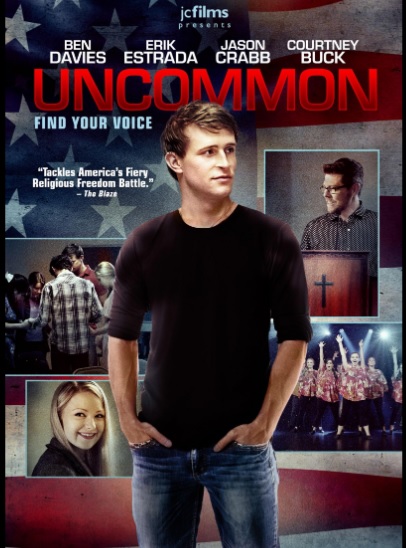
The 2015 film, Uncommon, opens with narration from Marc Garcia (Erik Estrada), a high school maintence worker. Marc tells us that he’s seen a lot at his school. He’s seen many changes. He’s watched as school has gone from a home away from home to a frightening place where students come to class carrying bullet-proof backpacks. He wonders what has caused the change in school. He suggests that it all started in 1962, when the Supreme Court ruled the school prayer was a violation of the separation of church and state….
And let’s just stop right there.
On the one hand, I do think that, for a growing number of people, there’s a feeling that their life has no purpose and that their existence is empty and meaningless. Some people would say that’s because our increasingly online world has left people unsure of how to relate to one another and express their emotions. Some people would say that’s because of the decline of religion. Some would say that’s because society is obsessed with fame. Regardless of the reason, when you feel that your life has no purpose, it is undoubtedly a lot easier to justify doing things that, in the past, would have been unthinkable.
That said, when it comes to prayer in public, state-funded schools, the Supreme Court made absolutely the right and the Constitutional decision. Separation of church and state is one of the most important amendments to be found in the Constitution. Not only does it prevent the State from telling you what to believe, it also prevents the State from ordering you what not to believe. If you think the government has a tendency toward being authoritarian now, just imagine what it would be like if they could claim that they were passing the laws of God.
Believe it or not, this is relevant to the film because Uncommon is all about the separation of church and state. As you may have already guessed, the film’s opinion is the opposite of mine.
Uncommon does open strongly, with Aaron (Ben Davies) helplessly watching as a gunman shoots up his school. His brother dies in the shooting and Aaron transfers to another high school. While attending church, Aaron meets and befriend Mike Garcia. Mike recruits Aaron and his friend, Drew (Wesley Elder), to volunteer at the local assisted living facility.
Meanwhile, at Aaron’s new school, budget cuts have led the principal to announcing that there is no more money to fund the Drama Department or the choir. The drama kids freak out, especially Hailey (Courtney Buck). Hailey was counting on getting a theater scholarship to college but how is that going to happen without a theater department!? Eventually, Hailey and the theater kid come up with a clever idea. They’ll start a drama club and just put on a show themselves! But they have to find a faculty sponsor and all of the teachers are busy. Hey, how about Mike Garcia? Mike agrees, on the condition that the drama club also help out at the assistant living facility.
Meanwhile, Aaron wants to start a bible study group. Mr. Stevens (Don Brooks), the atheist social studies teacher, throws a fit and announces that the school cannot sponsor a bible study group. To be honest, it seems like the easy solution would be for Aaron to just do his bible study group off school grounds but whatever.
Anyway, Mike introduces Aaron to the Drama kids and Aaron agrees to write their school play, which is based on stories from the Bible and…. well, you can see where this is going, right? Again, Mr. Stevens throws a fit. The school board announces that the school cannot sponsor a religious play. Mike somehow knows a lawyer who files a lawsuit on the behalf of the drama club. Somehow, the drama kids win their lawsuit and they perform their show. We only see the first musical number, in which the kids sing that “You got to have faith,” which would seem to prove that Mr. Stevens was right about the show being intended to push religion on the audience.
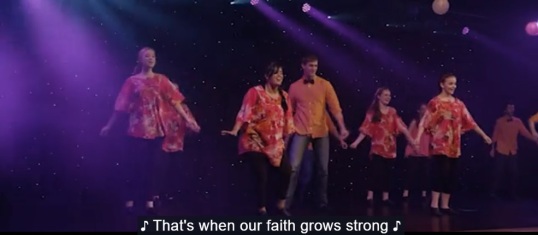
When people talk about preachy religious films that beat their audience over the head with their message, they’re talking about films like Uncommon. Uncommon is a very earnest film but, in the end, it’s mostly just a case of wish fulfillment. Despite the fact that there’s no way that the drama club should have been allowed to put on their show at the high school, they were. Why? Because this film wanted them to be able to. But, in the end, Mr. Stevens was right. Mr. Stevens was obnoxious and hateful but, when he said that a public school can’t put on a show that promotes one religion over another, he was absolutely correct.
Beyond the film’s theological and legal arguments, Uncommon is also a poorly-acted film that is full of corny humor. The drama kids are so overdramatic. The old people are so quirky. It gets old pretty quickly. Erik Estrada was a lot more fun when he was starring in Guns.
 Through the Shattered Lens