Late Night Retro Television Reviews: Chips 1.3 “Dog Gone”


Welcome to Late Night Retro Television Reviews, a feature where we review some of our favorite and least favorite shows of the past!  On Mondays, I will be reviewing CHiPs, which ran on NBC from 1977 to 1983.  The entire show is currently streaming on Freevee!

This week, Baker gets a dog and Ponch makes an enemy!

Episode 1.3 “Dog Gone”

(Dir by Michael Caffey, originally aired on September 29th, 1977)

When an adorable sheepdog puppy ends up on the Los Angeles highway, Baker and Ponch manage to rescue it, though not before it causes a minor wreck on an overpass.  The official CHiP policy is that all stray animals should immediately be turned over to the shelter but Baker takes one look at the puppy and decides that he can’t just leave it with anyone else.  In fact, every member of the highway patrol quickly falls in love with the dog.

Everyone except for Sgt. Getraer, who is allergic to dogs and makes it clear that the puppy is not to be kept around the station.

At first, Baker tries to keep the dog in his apartment but it turns out that the dog likes to bark.  So, Baker heads out to the trailer park where Ponch lives in an RV and apparently spends all of his time watching football while only wearing his boxer shorts.  (One gets the feeling that Erik Estrada had an “at least one shirtless scene per episode” clause in his contract.)  Baker leaves the dog in the RV and then runs off before the half-naked Ponch can protest.

Fortunately, for Baker, Ponch decides that he loves the dog, which he named Fido.

Unfortunately, for Ponch, Fido’s owners eventually show up at the station and ask if anyone has seen their dog.  The dog — who even I, while admittedly not being a dog person, has to admit is cute — is reunited with his family and I guess Ponch is alone again.

Meanwhile, three really stupid criminals — Boots (Bill Adler), Zero (Jeffrey Druce), and Little John (James Crittenden) — are really angry with Ponch because, at the scene of the earlier accident, Ponch prevented Boots from threatening another motorist.  Boots and his friends hops into their dune buggy and decide to stalk Ponch and Baker.  Boots even decides to sabotage Ponch’s motorcycle by loosening the front bolt so that the wheel will eventually come off while Ponch is riding it.  However, these three criminals are so stupid that they sabotage the wrong motorcycle.  As a result, the entire second half of the episode is full of close-ups of Baker’s front tire wobbling as he speeds down the highway.

The subplot with the criminals is really dumb but the way it plays out shows that Larry Wilcox had a point when he complained about the show’s producers always favoring Erik Estrada.  Not only is Ponch the one who faces off against Boots at the scene of the accident but he’s also the one who gets to save Baker’s life at the end of the episode.  When a guilt-stricken Zero goes to Getraer and tells him about what Boots did to the motorcycle, it doesn’t take long for Getraer to figure out that they accidentally sabotaged Baker’s motorcycle instead of Ponch’s.  With Baker unable to hear his radio due to being involved in a high-speed chase, it falls to Ponch to chase after Baker and warn him.  The bike still crashes but Baker is not seriously injured and Ponch …. well, Ponch is just a big damn hero!

(Admittedly, there is a scene earlier in the episode where Baker performs mouth-to-mouth recitation on a motorist who has had a heart attack and saves the man’s life.  But even then, Ponch is the one pushing on the man’s chest to try to get his heart going again.  Baker’s a good cop, the show tells us, but Ponch is a big damn hero.)

This episode …. well, at least the dog was cute!  And the California scenery was lovely to look at.  Still, a cop show like this needs to have some smart or at least intimidating criminals for the cops to do battle with and Boots was such an idiot that it was hard to take anything he and his gang did seriously.  In the end, this was a typical episode of CHiPs, full of stiff acting but impressive motorcycle stunt work.  Probably the most interesting thing about this episode was discovering that Baker was the one with a swinging bachelor pad while Ponch was the one living a solitary life in a trailer park.  I’m just happy that the dog was reunited with its family.
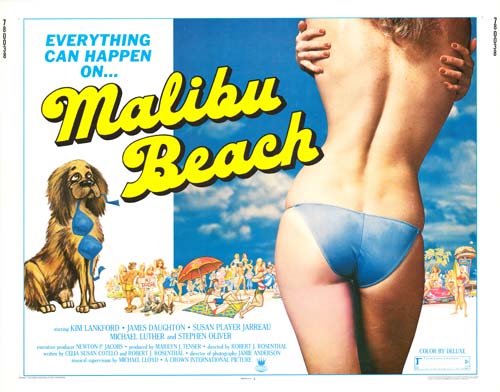
Life is a Beach #2: Malibu Beach (dir Robert J. Rosenthal)


MALIBU-BEACH

Yesterday, I started my 2-week miniseries of reviews on beach movies by taking a look at 1963’s Beach Party.  For my next review, I will be jumping forward 15 years and taking a look at 1978’s Malibu Beach.  

Just by comparing the two films, you can tell that a lot changed during those 15 years.  As opposed to the euphemism-spouting surfers of Beach Party, the teenagers that hang out on Malibu Beach know exactly what they want and they’re not ashamed to say it.  What Beach Party could only hint at, Malibu Beach has the freedom to make explicit.  The film’s poster claims that “everything can happen on Malibu Beach” and, in theory, that’s certainly true.

And yet, at the same time, Malibu Beach has more in common with Beach Party than you might think.  Ultimately, they’re both about the same thing: celebrating the idea of being young and having freedom.  Both films are a bit of a chore to try to watch today but are interesting as cultural time capsules.  Beach Party had no plot.  Malibu Beach has no plot.  Beach Party featured some oddly generic music.  Malibu Beach features the same three generic songs being played over and over and over again.  Beach Party features Erich Von Zipper and his motorcycle gang.  Malibu Beach features a muscle-bound bully named Dugan (Steve Oliver).  Beach Party featured a cameo appearance from Vincent Price.  Malibu Beach features a dog that steals bikini tops.  Beach Party was produced by American International Pictures.  Malibu Beach was produced by Crown International Pictures.

That’s right!  Malibu Beach is a Crown International Picture and anyone who loves 70s exploitation knows what that means.  Malibu Beach is a cheaply produced film that was made to exploit then-current trends and bring in a lot of money.  Like a lot of Crown International Films, it’s technically a pretty bad film but it’s so sincere and honest about what it is that it almost feels petty to be too critical of it.

CIP_Logo

Oddly enough, Malibu Beach pretty much feels like a remake of a previous Crown International Picture, The Pom Pom Girlsthe main difference being that, while the visual style of The Pom Pom Girls was almost oppressively ugly, Malibu Beach at least features some pretty beach scenery.

Much like in the Pom Pom Girls, the heroes of Malibu Beach are two high school jocks, one of whom, Bobby (played by James Daughton, who, that same year, also played the evil Greg in National Lampoon’s Animal House), is dark and brooding while the other, Paul (Michael Luther), is skinny and dorky.

Much as in The Pom Pom Girls, one of the heroes has a nemesis for no particular reason.  Seriously, I never could figure out why Bobby and Dugan hated each other but they certainly did.  What’s odd is that, whenever there’s a confrontation between the two of them, Malibu Beach suddenly gets extremely serious.  Bobby and Dugan glare at each other and speak through clenched teeth.  Suddenly, there’s no music on the soundtrack and all we can hear are seagulls above and the tide rolling in and it all feels very ominous.  I sat through Malibu Beach expecting either Dugan and Bobby to be dead at the end of the film, that’s how seriously their conflict is portrayed.

Also, much like The Pom Pom Girls, Bobby and Paul each have girlfriends.  Paul is dating the spacey Sally (Susan Player).  Bobby, meanwhile, is romancing the new lifeguard, Dina (Kim Lankford).  Dina has a big scene where she tells Bobby that she can’t handle being caught in the middle of his increasingly intense rivalry with Dugan.  Again, it’s a deadly serious scene and it’s just so strange to see it there, awkwardly dropped in between scenes of a bumbling cop smoking weed and a dog stealing bikini tops.

Finally, the main similarity between The Pom Pom Girls and Malibu Beach is that the exact same three songs appear in both films!  Obviously, somebody at Crown International, really loved those three songs.

Malibu Beach is one of those films that was obviously made to appeal to hormonal teens at a drive-in but, by today’s standards, it’s rather tame.  It’s currently playing on Hulu and it’s also available in several of those Mill Creek box sets that we all know and love.  Is the film any good?  No.  Do I recommend it?  Not really.  But, much like Beach Party, it is a portal into the past.

http://www.youtube.com/watch?v=gp9NtaOzd1k

Shattered Politics #42: Blue Sunshine (dir by Jeff Lieberman)


(I wrote an earlier version of this review for HorrorCritic.Com.)

Blue_Sunshine_(film)

Occasionally, on twitter, I would take part in the Drive-In Mob live tweet session.  Every Thursday night, a group of exploitation, grindhouse, and horror film fans gog together and watched the same film and, via twitter, provided their own running commentary track.  It was always terrific fun and a good opportunity to discover some films that you might have otherwise missed.  It was through the Drive-In Mob that I first discovered a low-budget cult classic from 1978, Blue Sunshine.

Blue Sunshine (directed by the underrated horror director Jeff Lieberman) opens in the late 1970s.  Across California, people are suddenly going bald and turning psychotic.  At a party, singer Frannie Scott (played by Richard Crystal) has a nervous breakdown when another reveler playfully pulls off his wig and reveals Frannie to be hairless.  Frannie responds by tossing half of the guests into the fireplace and then running out into the night.  He’s pursued by his best friend Jerry Zipkin (played by future director Zalman King) but when Frannie is accidentally killed while running away, Jerry finds himself accused of being a murderer.  Even as the police pursue him, Jerry starts his own investigation.  He quickly discovers that there’s an epidemic of bald people suddenly murdering those closest to them.  The one thing that these people have in common: they all attended Stanford University in the late 1960s and they all used a powerful form of LSD known as “blue sunshine.”  Now, ten years later, they’re all having the worst flashback imaginable.

And, perhaps most dangerously, the campus drug dealer, spoiled rich kid Edward Fleming (Mark Goddard), is on the verge of being elected to the U.S. Congress.  Not only it is possible that Edward may have taken the acid himself but Edward and his campaign manager have their own reasons to try to make sure that Jerry never reveals the truth behind Blue Sunshine.

Blue Sunshine is probably one of the best of the old grindhouse films, a film that embraces the conventions of both the horror and the political thriller genres while, at the same time, neatly subverting our expectations.  Director Jeff Lieberman emphasizes atmosphere over easy shocks and the film’s cast does a pretty good job of making us wonder who is normal and who has dropped the blue sunshine.  Wisely, Lieberman doesn’t resort to giving us any easy villains in this film.  Much like the best horror films, the monsters in Blue Sunshine are as much victims as victimizers.  I especially sympathized by one poor woman who was driven to rip off her wig by the sound of two particularly obnoxious children chanting, “We want Dr. Pepper!” over and over again.  Seriously, that’s enough to drive anyone crazy.

Blue Sunshine is one of those wonderfully odd little cult films that makes me thankful that I own a DVD player.  First released in 1978, Blue Sunshine mixes psychological horror with political conspiracy and the end result is an unusually intelligent B-movie that remains relevant even when seen today.  Blue Sunshine was originally released on DVD by Synapse Entertainment and it has since been re-released by the New Video Group.  I own the Synapse edition, which features a very entertaining director’s commentary with Jeff Lieberman as well as a bonus CD of the film’s haunting and atmospheric score.

http://www.youtube.com/watch?v=vJAAZZiFQ1Y

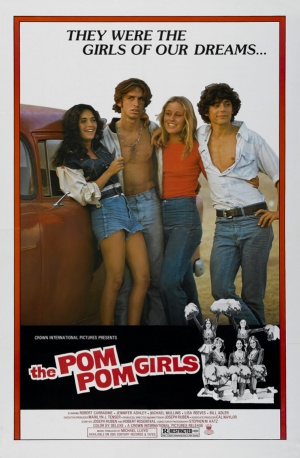
Back to School #19: The Pom Pom Girls (dir by Joseph Ruben)


The Pom Pom Girls was released in 1976, the same year as Massacre at Central High.  It also features two actors who made quite an impression in Central High — Robert Carradine and Rainbeaux Smith.  However, that is where the similarities end because, whereas Central High was a political allegory disguised as an exploitation film, The Pom Pom Girls is an almost prototypical 70s teen comedy.  Whereas Central High was all about subtext, The Pom Pom Girls has no subtext.  Try to look between the lines of The Pom Pom Girls and all you’ll find is blank space.  And, finally, while Central High remains a difficult film to see, I’ve lost track of how many of my Mill Creek box sets include The Pom Pom Girls.

300px-Pompom_girls_2

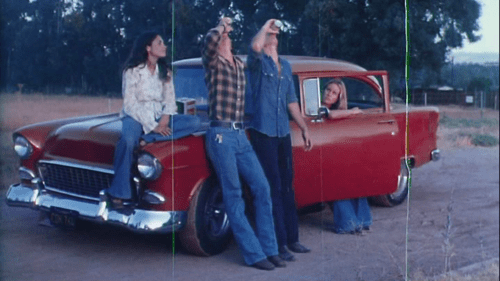
The Pom Pom Girls is about … well, close to nothing.  Johnnie (Robert Carradine) and Jesse (Michael Mullins) are students at Rosewood High School in California.  Because the film was made in 1976, they spend most of their time driving around in a van and listening to MOR radio stations.  Johnnie and Jesse are also star football players, which is one of the odd things about the film because, while Carradine is genuinely likeable and Mullins makes for a plausible sullen high school student, neither one of them comes across as if they could be football players.  The big game comes up against rival Hardin High, so there’s a prank war that involves a little more nudity than the ones on Saved By The Bell ever did.  Johnnie and Jesse also have girlfriends, both of whom are cheerleaders.  Jesse cheats on his girlfriend but apparently, the audience is supposed to sympathize with him because she refused to go to the beach with him.  Johnnie, meanwhile, has a leather jacket-wearing nemesis named Duane (Bill Adler), who is upset because Johnnie is dating his ex.  As often happens, it all ends with a recreation of the famous “chicken run” from Rebel Without A Cause.  We watch a car explode from three different angles. In order to leave you with some suspense, I will not mention whether anyone was in the car.

You’re welcome.

And a fun time was by all...

And a fun time was by all…

One of the strange things about The Pom Pom Girls is that while the two main characters and their girlfriends are all presented as being rebels, they’re also presented as being the most popular kids in school.  Johnnie and Jesse are the captains of the football team.  They’re dating the captains of the cheerleading squad.  Despite the movie’s attempts to convince us otherwise, these people are not rebels fighting the establishment.  Instead, they are the establishment.  This is actually something that The Pom Pom Girls has in common with Richard Linklater’s far superior Dazed and Confused.  The difference, however, is that Dazed and Confused actually calls its character out on the hypocricy of their posturing while The Pom Pom Girls just tries to have the best of both worlds.  Johnnie is both a star football player and the class clown who breaks the rules.  Jesse is both a great team player and an angry individualist.  I guess that’s the 70s for you.

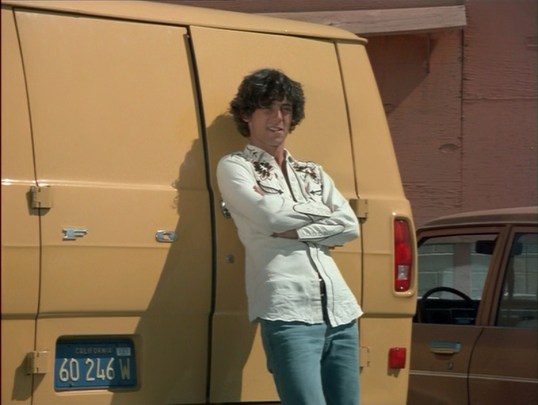
He owns a van.  It has shag carpeting and a strobe light.

He owns a van. It has shag carpeting and a strobe light.

Back in high school, I was often asked to try out for cheerleading but I never did.  For one thing, I didn’t see why I should have to try out when they could have just easily approached me and said, “Hi, will you please be the new head cheerleader?”  Even beyond that, I couldn’t stand the idea of always having to be happy.  And, perhaps most importantly, my sister was already a cheerleader and I wanted to establish my own thing.  However, I still made Erin watch The Pom Pom Girls with me and I asked her if the film was a realistic portrait of high school cheerleading.  In response, she rolled her eyes which I believe was her way of saying no.

But, even if it isn’t exactly Bring It On, The Pom Pom Girls still does have some worth as a time capsule of the clothing, attitudes, and vans of the 70s.  To be honest, that’s probably the only thing of value that The Pom Pom Girls has to offer because, otherwise, it’s basically a film about a likable guy who spends all of his time hanging out with a guy who will literally not stop whining about being a football player and how nobody is willing to go to the beach with him.

Incidentally, The Pom Pom Girls was released by Crown International Pictures.  Much like the company’s previous film, The Young Graduates, the main message here appears to be that the 70s kind of sucked.

CIP_Logo