(With the Oscars scheduled to be awarded on March 4th, I have decided to review at least one Oscar-nominated film a day. These films could be nominees or they could be winners. They could be from this year’s Oscars or they could be a previous year’s nominee! We’ll see how things play out. Today, I take a look at the 1983 best picture nominee, The Dresser!)
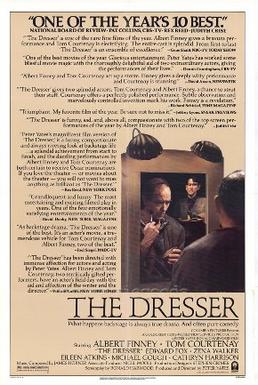
Taking place during World War II, The Dresser is a story of the theater.
Sir (played by Albert Finney) was once a great and famous Shakespearean actor but that was a long time ago. Now, he is reduced to playing in regional theaters, traveling across Britain with a company made up of a motley collection of forgotten has-beens and never-weres. He can still draw an audience, one made up of elderly theater goers who remember seeing him in London and people who are merely looking for a distraction from the war. While bombs echo outside, Sir alternates between playing Othello and King Lear. Backstage, Sir talks about the memoir he’s going to write and barks out orders to the members of his company.
Though Sir’s overly florid style of acting may seem old-fashioned, there’s no denying that his talent. We don’t see much of his performance but, when we do see him, we never doubt his claim that he was once declared to the greatest King Lear to have ever appeared on the British stage. Onstage, Sir is in complete control. Offstage, he often struggles to remember where he is or what play he’s going to be performing. At one point, when he’s meant to be getting ready to play Lear, he puts on his Othello makeup.
Fortunately, Sir has a dresser. Norman (Tom Courtenay) doesn’t appear to have much of a life outside of taking care of Sir’s every whim. Perpetually high-strung but blessed with a biting wit and an all-important bottle of Brandy that he takes a drink from whenever Sir gets too difficult to deal with, Norman is the one who holds the theatrical company together and who, most importantly, protects Sir. When Sir can’t remember who he’s playing, Norman reminds him. When Sir harasses a young actress, Norman is the one who hushes it up. When Sir insults another actor (Edward Fox), Norman is the one who brokers a peace. When it’s time for Sir to play King Lear, Norman is the one who helps Sir to transform into Shakespeare’s most tragic monarch. Neither Sir nor the rest of the acting company seems to have much respect for Norman. The other actors consider Norman to be an ass-kisser and Sir … well, Sir doesn’t have much respect for anyone. But for Norman, a gay man living at a time when homosexuality was illegal in Britain, Sir’s theatrical company provides him with the only safe place he’ll ever find.
The Dresser is an adaptation of a stage play. (A few years ago, another version was produced for the BBC with Ian McKellen as Norman and Anthony Hopkins as Sir.) It’s a good film, though I imagine that it’ll be best appreciated by people who have actually worked in theater. Finney and Courtenay are both great and I also liked the performance of Edward Fox. That said, it’s definitely a filmed play the feels more appropriate for PBS than for a movie screen. As a result, it seems to be a bit of an odd pick for a Best Picture nomination. I imagine that, much like Birdman, it benefitted from being a movie about actors and performing.
The Dresser lost Best Picture to Terms of Endearment. It’s still worth seeing, if just for Courtenay’s final monologue.
 Through the Shattered Lens