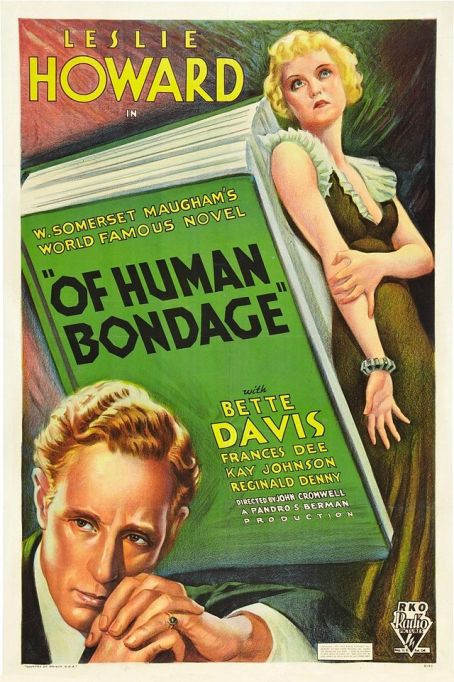
Embracing the Melodrama Part II #7: Of Human Bondage (dir by John Cromwell)


Of_Human_Bondage_Poster

“I don’t mind.” 

— Mildred Rogers (Bette Davis) in Of Human Bondage (1934)

For the next three weeks, I will reviewing, in chronological order, 126 cinematic melodramas.  It’s a little something that I like to call Embracing the Melodrama Part II.  We started things off yesterday by taking a look at the silent classic Sunrise.  Today, we continue with a quick look at the 1934 literary adaptation, Of Human Bondage.

Of Human Bondage opens with Philip Carey (Leslie Howard) living in Paris and struggling to make a living as a painter.  The son of a prominent doctor, Philip is self-conscious about both his club foot and his abilities as an artist.  When he invited an older artist to take a look at his work, Philip is informed, “There is no talent here.  You will be nothing but mediocre.”  Philip gives up his artistic ambitions and instead enters medical school.

Philip turns out to be just as miserable and moody as a medical student as he was when he was a painter.  (Indeed, Philip may be one of the most miserable characters in cinematic history.)  However, he does meet and becomes rather obsessed with a waitress named Mildred (Bette Davis).  For her part, Mildred has little use for Philip or any of the other men who are constantly hitting on her.  Whenever Philip asks her out, Mildred replies, “I don’t mind.”  When Philip asks if he might kiss her goodnight, Mildred coolly replies, “No.”

Philip remains obsessed with Mildred, to the extent that he nearly flunks out of medical school because he can’t stop thinking about her.  Mildred, however, eventually leaves Philip for the far more wealthy Emil Miller (Alan Hale).  Eventually, Philip meets Norah (Kay Johnson), a romance novelist who falls as deeply in love with Philip as he did with Mildred.  However, when the now pregnant Mildred reenters his life, Philip abandons Norah and goes back to her.

And so it goes for the next few years.  Philip obsesses over Mildred.  Mildred abandons Philip.  Philip moves on.  Mildred reenters Philip’s life.  With each reappearance, Mildred appears to be growing weaker and sicker but she’s never so weak that she can’t yell at Philip and ridicule him for having a club foot…

It’s a little bit strange to admit to enjoying a film like Of Human Bondage because, when you get right down to it, it’s an unpleasant story about an unlikable man being manipulated by a heartless woman.  But, interestingly enough, it’s Mildred’s unapologetic anger that make her such a compelling character.  If Philip was in any way a sympathetic character, the film would be almost unbearably grim.  But since Philip is such a weak-willed character and is so full of self-pity, you can’t help but be happy that Mildred is around to call him out on his bullshit.  Everyone else in the film is so awful and boring, that you can’t help but appreciate the fact that Mildred never holds back.

Have you ever wondered why, every Oscar telecast, the Academy makes a point of letting us know that an independent accounting firm counted all of the ballots?  Well, it’s because of this film.  Or, more specifically, it’s because of Bette Davis’s ferocious performance.  In 1935, when Davis somehow failed to be nominated for best actress, there was such outrage and so many people assumed that the nomination process had been rigged that the Academy actually allowed people to write in her name on their ballots.  (Davis still lost to Claudette Colbert.)  In order to avoid any future controversy, the Academy hired a private accounting firm to count and hold onto the ballots.  (And if you’re curious about how that desire to avoid controversy is working out for the Academy, I was one words for you: Selma.)  When, the next year, Bette Davis won the Oscar for best actress, it was widely assumed that it was largely to make up for being snubbed for Of Human Bondage.

If you want to see a good Leslie Howard film, go with Berkeley Square.  But if you want to see a great Bette Davis film, watch Of Human Bondage.


Horror On The Lens: Burnt Offerings (dir by Dan Curtis)


To be honest, I really don’t like Burnt Offerings, a 1976 film about what happens when an odd family moves into an even odder house.  I find it to be slow and predictable and, to be honest, the only part that really works are the flashback scenes that feature a skeletal Anthony James playing a sinister chauffeur.

However, I’ve discovered that there’s a lot of people online who disagree with me and who consider this to be one of the best haunted house movies ever!  So, in the spirit of agreeing to disagree, here is Burnt Offerings

(If nothing else, the film is worth it for the chance to see Oliver Reed, Karen Black, Bette Davis, Anthony James, and Burgess Meredith all in one film together.)

Embracing the Melodrama #11: All About Eve (dir by Joseph L. Mankiewicz)


Bette Davis

“Fasten your seat belts, it’s gonna be a bumpy night!” — Margo Channing (Bette Davis) in All About Eve (1950)

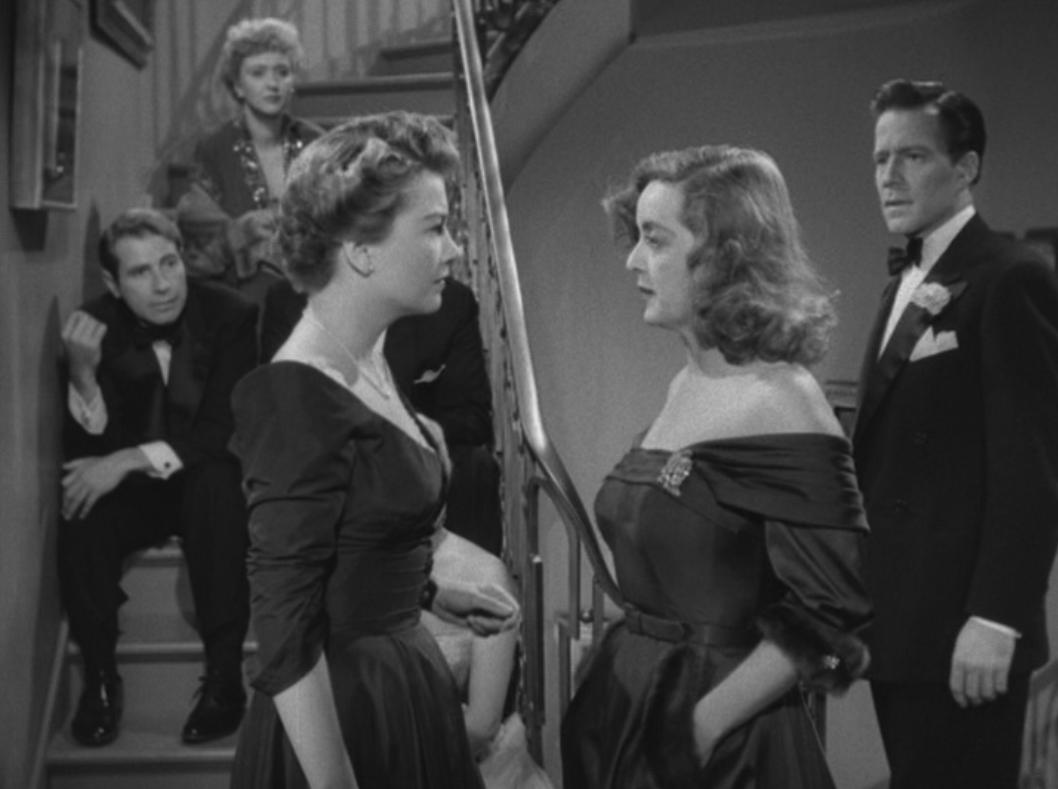
If you’re a lover of classic films or even if you’re just someone who occasionally watches TCM, chances are that you already know All About Eve.  It’s one of those films that is endlessly quoted and it features at least two performances — Bette Davis’s turn as aging Broadway diva Margo Channing and George Sanders’ acidic theater critic Addison DeWitt — that serve as frequent inspiration for professional impersonators.  It’s the film that was named best picture of 1950 and it continues to hold the record for both the most Oscar nominations overall and it’s the only film in Oscar history to receive four female acting nominations.

Even more importantly, it’s a film that everyone already knows it great.

So, that brings up the question that every film blogger dreads: how do you review a classic film that everyone already knows about?  I’ve often said that it’s easier to review a bad film than a great one.  It’s easy to pinpoint why a film fails but when it comes time to explain why a film is great, it’s often difficult to put to words the intangible qualities that elevate it.

Eve and Margo

For instance, I could tell you that the film has a fascinating plot but that barely only begins to scratch the surface of everything that’s going on underneath the glossy and melodramatic surface of All About Eve.  The movie tells the story of how scheming young actress Eve Harrington (Anne Baxter) becomes a star with the help of Addison DeWitt and at the expense of the talented but aging Margo Channing.  In telling Eve and Margo’s stories, All About Eve explores issues of female friendship and competition, sexuality, and why older men are celebrated while older women are constantly at risk of being pushed to the side for a newer model.  The complexity and power of All About Eve’s storyline can be summed up by the fact that right now, when I watch the film, I relate to Eve but I imagine that  twenty years from now, I’ll rewatch and I’ll relate to Margo.

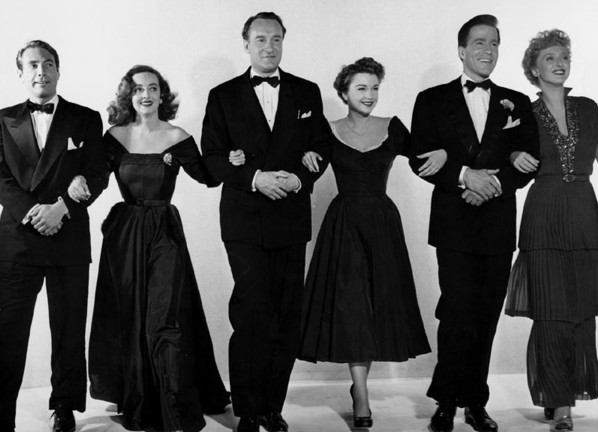
I could tell you that this is a film that is full of bigger-than-life characters and iconic performances but that doesn’t even begin to scratch at the surface of how well-acted and perfectly cast this film is.  Even boring old Hugh Marlowe is a perfect choice for playing boring old playwright Lloyd Richards.  (His wife is played by Celeste Holm.  Reportedly Bette Davis hated working with Celeste Holm but onscreen, their friendship feels very real and poignant and leads to some of the best scenes in the entire film.)  Gary Merrill, who later married Bette Davis, is likable as Margo’s boyfriend and Thelma Ritter is great as Margo’s outspoken assistant, largely because she’s Thelma Ritter and she was always great.  Marilyn Monroe famously makes the most of her minor role in All About Eve, playing an aspiring actress who has a very good reason for calling the butler a waiter.  And then there’s Bette Davis and George Sanders, both of whom are simply brilliant.

My favorite scene from All About Eve

My favorite scene from All About Eve

But to me, the best performance in All About Eve comes from Anne Baxter.  Baxter plays Eve as a perpetually smiling schemer and one of the great pleasures of the film is watching as Eve wrecks passive-aggressive havoc through Margo’s circle of friends.  Just watch the scenes where she deftly manipulates Celeste Holm.  All About Eve is usually referred to as being a vehicle for Bette Davis but if you actually watch the film, you see that the title is absolutely appropriate.  The film really is all about Eve.

And I could always tell you about how wonderfully sardonic the dialogue is but you already know that.  There’s a reason why even people who have never seen the film still quote Margo’s suggestion that everyone fasten their seat belts!

Bette Davis 2

So, in the end, what can I tell you about All About Eve?  Well, all I can really tell you is that it’s a great film and, if you haven’t seen it, you need to make time to learn all about Eve.

AllAboutEvecastpromo

Embracing The Melodrama #8: Dark Victory (dir by Edmund Goulding)


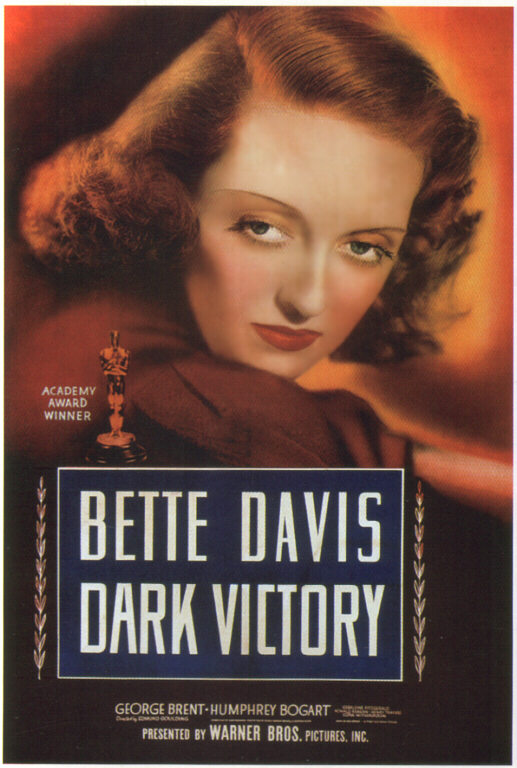
Dark-Victory

For our next melodrama, we take a look at the 1939 best picture nominee, Dark Victory.

Well, with a name like Dark Victory, you can probably guess that the story told be this film isn’t going to be a cheerful one.  Bette Davis plays Judith Taherne, a spoiled and self-centered socialite whose life revolves around hanging out with her constantly inebriated friends (one of whom is played by future President Ronald Reagan) and riding horses.  When Judith starts to suffer from double vision and headaches, she initially ignores the problem but, as her condition worsens, she finally agrees to see a doctor.

Well, as you can probably guess, the news is not good.  Dr. Parsons (Henry Travers, who is best known to us classic film lovers as Clarence Oddbody, the angel from It’s A Wonderful Life) refers her to Dr. Steele (George Brent), a brilliant neurosurgeon.  At first, Steele is reluctant to treat Judith.  He, after all, had been planning on giving up his New York medical practice so he can move to Vermont and spend his time doing research.  Judith, for her part, resents having to see him and treats him rudely.  However, when Dr. Steele discovers that Judith has a malignant brain tumor, he decides to put off moving to Vermont so that he can treat her (and, needless to say, fall in love with her as well).

After getting Judith to agree to surgery to remove the tumor, Steele discovers that the entire tumor cannot be removed and that Judith has only a few months to live.  Though Judith won’t feel any pain, she will die shortly after experiencing total blindness.  Hoping to make Judith’s last few days pleasant, Dr. Steele tells her that the surgery was a complete success and he also conspires with Judith’s loyal secretary, Ann (Geraldine Fitzgerald), to not allow Judith to find out about her terminal condition.

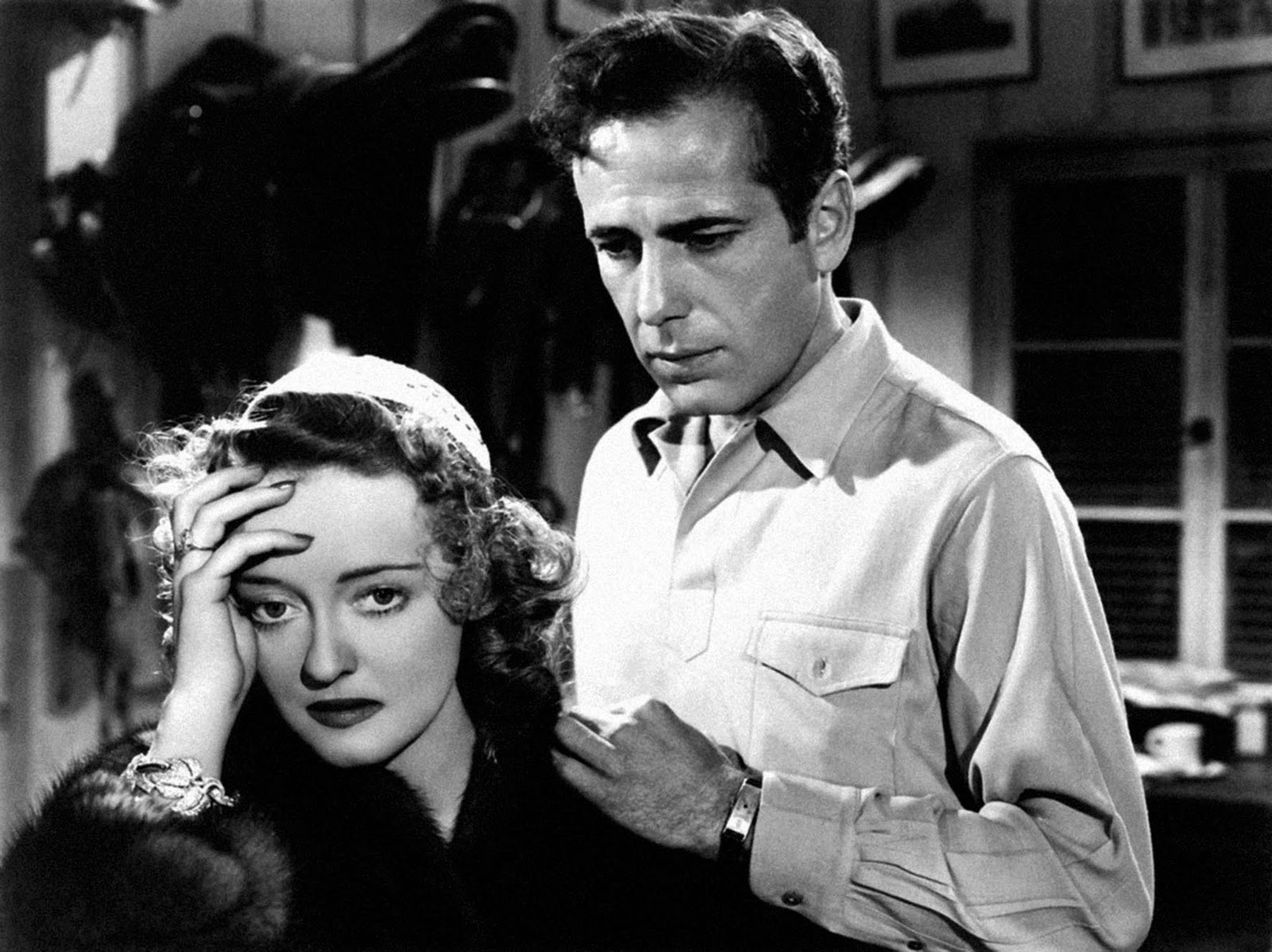
Steele also asks Judith to marry him and move to Vermont with him.  Judith agrees but, when she discovers Steele and Ann’s deception, she breaks off the engagement and returns to her decadent and wild ways.  Can her Irish stablehand (played by Humphrey Bogart) talk some sense into Judith before it’s too late?

If you want to nitpick, you certainly could do that with a film like Dark Victory.  Yes, the film is predictable and yes, Humphrey Bogart is a bit miscast and yes, this film probably did set a precedent for movies about independent women being both punished and redeemed by terminal illness.  Nitpick away but none of it really matters because Dark Victory works almost despite itself.

Whatever flaws the film may have, it also has Bette Davis delivering one of her best performances and making even the most overdramatic of events feel plausible and real.  Bette Davis gives a performance that runs the gamut from A to Z and then keeps running until it discovers letters that you didn’t even know existed.  (Okay, I didn’t come up with that description on my own.  A reviewer named DJ Kent said it on the IMDB but it was such a perfect description for what Bette Davis does here that I simply had to repeat it.)  Dark Victory is often described as being a “tear jerker” and, by the end of the film, I was in tears.  If even as lively and strong a character as Judith Taherne can’t beat death, what hope do the rest of us have?

But, at the same time, the film is not just about the dark.  There’s also a victory to be found in the darkness and that victory comes from the fact that even if Judith can’t beat death, she can at least face it under her own terms.  By the end of the film, you’re sad because Judith is going to eventually die but you’re also happy because she lived.

Dark Victory 3