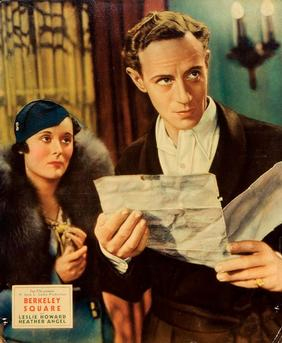
 For today’s final entry in Embracing the Melodrama Part II, we take a look at the 1933 film, Berkeley Square.
Berkeley Square opens in 1784. An American named Peter Sandish (Leslie Howard) has come from New York to England. Stopping off at an inn, he explains that he’s on his way to London. He has distant relations who live in a mansion located in Berkeley Square and it’s been arranged that Peter is going to marry his cousin, Kate Pettigrew (Valerie Taylor). As Standish talks, he’s interrupted by another man who excitedly announces that a Frenchman has flown across the English Channel in something called a “balloon.”
“It’s beginning,” Peter says, “A new age of speed and innovation…”
Suddenly, the film jumps forward over a hundred years. In 1933, Standish’s descendant — also named Peter and also played by Leslie Howard — has inherited the family’s old house at Berkeley Square. He’s spent several days locked away in the mansion, obsessively reading the first Peter’s diary and refusing to see his fiancée, Marjorie (Betty Lawford).
It turns out that Peter — much like Owen Wilson in Midnight in Paris — is frustrated with the modern world and desperately wants to live in the past. He believes that if he continues to stay in the house, he will eventually be transported back to 1784. When a friend points out that, even if time travel was possible, Peter would end up changing the past, Peter explains that he’s memorized the first Peter’s diary and, therefore, he knows everything that he needs to say and do.
And then, one night, Peter suddenly does find himself in 1784. Having taken his ancestor’s place, he meets the Pettigrews, makes plans to marry Kate, and attempts to adapt to 18th century London society.
Unfortunately, this turns out to be not as easy as he thought. Despite his best efforts, Peter keeps using 1930s slang and alluding to events that will happen in the future. At first, he explains away his habit of using modern phrases by saying that he’s using common New York expressions. However, the increasingly suspicious Kate takes a list of Peter’s phrases to the U.S. Ambassador (who is none other than future President John Adams) and is informed that nobody in New York speaks that way. As well, Peter’s insistence on regular bathing is viewed as odd by the members of upper class London society. (“I heard he used three buckets of water,” someone accusingly whispers.) Soon, Kate is convinced that Peter has been possessed by a demon.
An even bigger problem for Peter is that he’s not in love with Kate. Instead, he’s fallen in love with Kate’s headstrong younger sister, Helen (Heather Angel). When Helen discovers that Peter is from the future, Peter is forced to decide whether to continue to stay among the “living ghosts” or whether to return to his own time.
Berkeley Square shows on up on TCM fairly frequently and I absolutely love it. To a certain extent, of course, this is because I’m a secret history nerd and there’s a part of me that will always wish that I could travel in time and experience the past firsthand. (That said, after watching Berkeley Square, I don’t think I could handle 18th century hygiene. Agck!) But the main reason that I love Berkeley Square is because I love a good romance. And this is such a romantic film! Heather Angel and Leslie Howard have a really sweet and likable chemistry and, with his performance here, Howard shows why he would be the perfect choice to play the earnest, well-meaning, and ultimately tragic Ashley Wilkes in Gone With The Wind.
Keep an eye out for Berkeley Square. You won’t be sorry.
 Through the Shattered Lens