Catching Up With The Films Of 2025: Ella McCay (dir by James L. Brooks)


The Winter Olympics have begun and, waking up this morning, I did what any American celebrating the 250th birthday of her country would do.  I watched curling.  I watched as Team USA defeated Team Switzerland.  I enjoyed not only watching America notch up a victory but I also enjoyed the contrast between the super-intense, super-shriekey Swiss team and the relatively mellow American team.  Watching the Americans laugh and joke while the Swiss couple yelled at each other left me feeling very patriotic and hopeful.

In fact, it left me in such a good mood that I decided it was finally time to watch Ella McCay.

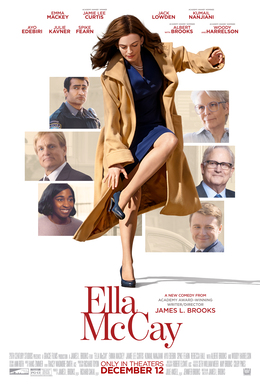
It’s easy to forget now what a big deal it was when the trailer for Ella McCay was first released in August of 2025.  It was the trailer for James L. Brooks’s first film in 15 years, a political comedy for adults.  It was full of familiar faces and it looked absolutely awful.  Seriously, the trailer was so unappealing that I became rather fascinated by it.  Even the worst films can usually scrounge together enough good material to at least come up with a passable trailer.  Watching the trailer for Ella McCay, I could only wonder who was responsible for putting it together.  Who thought it was a good idea to lead off with that lengthy Woody Harrelson scene?  Who thought the wedding scene didn’t look weird?  Who didn’t take the time to do something about Spike Fearn’s hair?

There were some who said that Ella McCay shouldn’t be judged based solely on its trailer.  They pointed out that director James L. Brooks directed three films that were nominated for Best Picture, two of which were actually good.  They pointed out that Ella, her brother, and her husband were all played by British actors who had appeared on niche television shows.  Soon, there was a mini-civil war being fought on twitter between those who dismissed Ella McCay based on the trailer and those who promised that they would love the film once it was released.

Then, on December 12, the film was released, the reviews were uniformly terrible, and it tanked at the box office.  It took the film a little less than two months to go from the theater to streaming online.

Having now watched Ella McCay, I can say that …. well, yeah, it’s pretty bad.

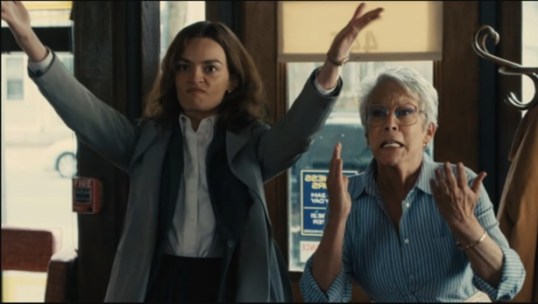
It’s not necessarily bad for the reasons that I thought it would be.  Watching the trailer, I thought the film’s downfall would be the performances of Woody Harrelson and Jamie Lee Curtis.  Both of them looked to be acting up a storm.  Having now seen the film, I can say that both of them actually do probably about as good a job as could be expected to do with the material that they were given.  Neither one is particularly memorable but they’re not terrible either.  For that matter, Albert Brooks is amusing as Ella’s boss and mentor, Governor Bill.

Instead, the main problem with the film is that Ella McCay is not a particularly interesting or even likable character, not matter how much the film’s narrator insists otherwise.  A policy wonk from a broken home who, at the age of 34, has become lieutenant governor of some nameless state up north, Ella is boring, humorless, and ultimately more than a little annoying.  She’s the girl in elementary school who always told on the kids who talked while the teacher was out of the room.  She’s your high school classmate who got all judgey if you wore a short skirt.  She’s your self-absorbed college roommate who always had to remind you that, no matter what you were going through, her father was a philanderer and her mom was dead.  She’s the colleague who voluntarily does all the work on your group project without being asked and then complains that no one helped her.  She’s the person who insists that she can change the world but who is still so emotionally stunted and immature that, at 34, she needs her aunt to teach her primal scream therapy.  Emma Mackey gives a disjointed performance as Ella, speaking with bland intensity whenever Ella is being serious and then overacting whenever Ella has to be flustered.

As bad as Mackey was, though, she was nowhere near as bad Spike Fearn, who plays Ella’s agoraphobic younger brother, Casey.  For some reason, Casey gets a huge subplot that doesn’t really seem to go anywhere.  We’re told that Casey hasn’t left his apartment in over a year and we repeatedly see that Casey struggles to communicate with people.  The film treats most of this as being a joke and Spike Fearn gives such a twitchy performance that Casey comes across as being far more creepy than he probably should.  We’re meant to cheer when Casey reconnects with his ex but I wasn’t silently yelling at her to run as far aways as possible.  We spend so much time with Casey that it’s hard not to wonder if maybe the filmmakers themselves realized that Ella wasn’t very interesting but Casey is hardly an appealing alternative.

There’s a lot about Ella McCay that doesn’t work.  Just the fact that the film features what appears to be hastily written narration from Ella’s secretary (Julie Kavner) would seem to reveal that someone understood that the film’s mix of tones and incidents really didn’t gel.  (Having Kavner actually say, “Hi, I’m the narrator,” is a touch that is more than a bit too cutesy.)  Ella’s husband (Jack Lowden) is such an obvious and odious villain that it was hard not to feel that Ella had to have been an idiot to marry him in the first place.  There’s a weird plotline involving Ella’s state troopers trying to get overtime.  Ella gets involved in one of the most jejune scandals of all time and the film ends with on a note that leaves you wondering how the 80-something Brooks can be so naive about politics.

But really, the main problem with the film is that it never convinces me that I should want Ella McCay to be governor.  To quote Karen Black in Nashville, she can’t even comb her hair.
 

Playing Catch-Up: The End of the Tour (dir by James Ponsoldt) and Love & Mercy (dir by Bill Pohland)


Two of the best films released last year dealt with troubled artists.

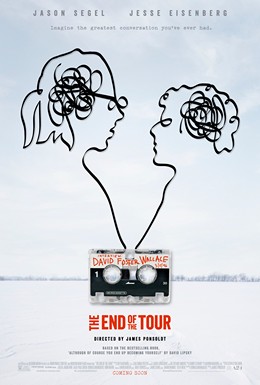
The_End_of_the_Tour

The End of the Tour opens in 2008, with a writer David Lipsky (Jesse Eisenberg) getting a call that the famous and acclaimed author, David Foster Wallace (Jason Segel), has committed suicide.  After learning of the tragedy, Lipsky remembers a few days that he spent interviewing Wallace 12 years earlier.  Wallace had just published his best known work, Infinite Jest.  At the time, Lipsky himself was a struggling writer and he approached Wallace with a combination of admiration and professional envy.  Lipsky hoped that, by interviewing Wallace, he could somehow discover the intangible quality that separates a great writer from a merely good one.

Almost the entire film is made up of Lipsky’s conversations with Wallace.  We watch as both the somewhat reclusive Wallace (who seems both bemused and, at times, annoyed with his sudden fame) warms up to Lipsky and as Lipsky forces himself to admit that Wallace might actually be a genius.  There are a few conflicts, mostly coming from the contrast between the withdrawn Wallace and the much more verbose Lipsky.  Lipsky’s editor (Ron Livingston) continually pressures him to ask Wallace about rumors that Wallace was once a drug addict.  But, for the most part, it’s a rather low-key film, one that’s more interested in exploring ideas than melodrama.  It’s also a perfect example of what can be accomplished by a great director and two actors who are totally committed to their roles.  Jason Segel, especially, gives the performance of his career so far.

The shadow of Wallace’s suicide hangs over the entire film.  Throughout their conversation, Wallace drops hints about his own history with depression.  Much as Lipsky must have done after Wallace’s suicide, we find ourselves looking for clues to explain his death.  But ultimately, Wallace remains a fascinating enigma in both life and death.

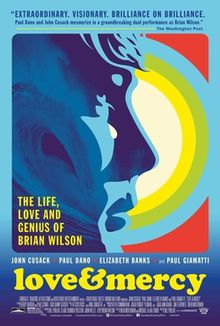
Love_&_Mercy_(poster)

Love & Mercy (dir by Bill Pohland)

Love & Mercy opens with Cadillac saleswoman Melinda Ledbetter (Elizabeth Banks) selling a car to a polite but nervous man (John Cusack).  The man sits in the car with her and rambles for a bit, mentioning that his brother has recently died.  Soon, the man’s doctor, Eugene Landy (Paul Giamatti), shows up and Melinda learns that the man is Brian Wilson, a musician and songwriter who is famous for co-founding The Beach Boys.  After having a nervous breakdown decades before, Brian is now a recluse.  He and Melinda start a tentative relationship and Melinda quickly discovers that Brian is literally being held prisoner by the manipulative Dr. Landy.

Throughout the film, we are presented with flashbacks to the 1960s and we watch as a young Brian (Paul Dano) deals with both the pressures of fame and his own relationship with his tyrannical father (who, in an interesting parallel to Brian’s later relationship with Landy, is also Brian’s manager).  As Brian struggles to maintain his grip on reality, he obsesses on creating “the greatest album ever.”

Love & Mercy is an enormously affecting story about both the isolation of genius and the redeeming power of love.  Whether he’s played by Cusack or Dano, Brian Wilson remains a fascinating and tragic figure.  It’s hard to say whether Cusack or Dano gives the better performance.  Indeed, they both seem to be so perfectly in sync with each other that you never doubt that the character played by Paul Dano will eventually grow up to become the character played by John Cusack.  Both of them do some of the best work of their careers in Love & Mercy.

Embracing the Melodrama Part II #96: A Simple Plan (dir by Sam Raimi)


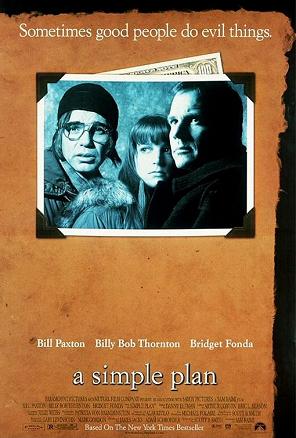
Simple_plan_poster

The 1998 film A Simple Plan reunites Bill Paxton and Billy Bob Thornton.  After previously playing adversaries in One False Move, they played brothers here.  However, it’s not just the cast that makes A Simple Plan feel like a spiritual descendant of One False Move.  Both One False Move and A Simple Plan deal with greed and violence.  Both One False Move and A Simple Plan take place in a small town where everyone thinks that they know all there is to know about each other.  Both One False Move and A Simple Plan feature Paxton as a man who turns out to be something more than what the viewer originally assumed.  Perhaps most importantly, both One False Move and A Simple Plan are meditations on guilt, greed, and community.

A Simple Plan takes place in Minnesota, in a world that seems to exist under a permanent layer of snow and ice.  While out hunting, Hank (Bill Paxton), his well-meaning but dim-witted brother Jacob (Billy Bob Thornton), and their redneck friend Lou (Brent Briscoe) stumble across an airplane that has crashed in the woods.  Inside the airplane, they find a dead pilot and a bag containing 4 million dollars.  At first, Hank says they should call the authorities and let them know what they’ve found but he rather easily allows Jacob and Lou to talk him out of it.  Instead, they agree that Hank will hide the money at his house until spring arrives.  They also agree to not tell anyone about the money but, as soon as he arrives home, Hank tells his pregnant wife Sarah (Bridget Fonda) everything that has happened.

Needless to say, this simple plan quickly get complicated.  Sarah is soon telling Hank that he should not trust Lou and Jacob.  The local sheriff (Chelcie Ross) saw Hank and Jacob leaving the woods after discovering the plane and may (or may not) be suspicious of what they found.  Alcoholic Lou starts to demand his share of the money early.  As things start to spiral, Hank finds himself doing things that he would have never thought he would ever do.  Or, as Sarah puts it, “Nobody’d ever believe that you’d be capable of doing what you’ve done.”

And then, one day, a mysterious FBI agent (Gary Cole) shows up and says that he’s looking for the plane.  Except that, according to Sarah, he’s not really with the FBI…

It’s appropriate that A Simple Plan takes place in a world that appears to be permanently covered in snow because it is a film that is both chilly and chilling.  Bill Paxton and Billy Bob Thornton are both perfectly cast.  (Thornton received an Oscar nomination for his performance.  Paxton undoubtedly deserved one.)  Bridget Fonda turns Sarah into a small town Lady MacBeth and Gary Cole, Brent Briscoe, and Chelcie Ross are all memorable in smaller roles.

(Brent Biscoe, in particular, is a redneck nightmare.)

The next time that you want to contemplate the evil that is done in the name of money, why not start off with a double feature of One False Move and A Simple Plan?