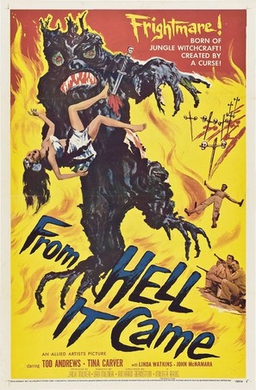
“And to Hell it can go!” — The Critics
Sometimes, you’ll come across something that simply defies easy description. It’s something that actually has to be seen to be believed. I could describe to you the monster at the center of 1957’s From Hell It Came but I don’t know that, even with my extensive vocabulary, I really have the capability to capture just how absurd and weird this thing is.
In this case, a picture says more than a thousand words ever could:
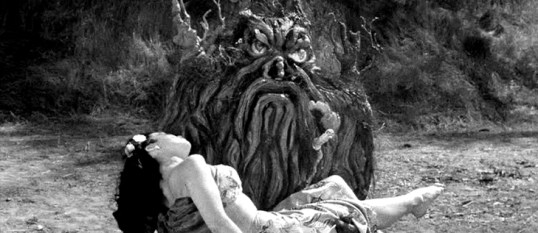
The monster in From Hell it Came is a walking tree that has a rather angry (not to mention immobile) face. After Prince Kimo is framed for the murder of his father, the chief of a tribe that lives on a South Sea island, he is sentenced to execution. He announces that he will seek revenge on everyone who framed him. He’s then stabbed in the heart and encased in the trunk of a hollow tree. (Apparently, the knife is left in his heart which seems kind of unnecessary but who am I to argue?) Later, Kimo comes back as a walking tree who tosses his enemies into quicksand. The knife is still sticking out of the tree, which would suggest that Kimo was physically transformed. However, the native insist that Kimo has actually become one of their legendary monsters, the fearsome Tabanga.
Along with the natives, there is also a group of American doctors on the island. They’ve been sent to conduct research and to also give the natives medicine to help them deal with an outbreak of the plague. The natives don’t trust the medicine. They trust the magic of their medicine men. Since this film came out in 1957, the doctors react to this by rolling their eyes and talking down to everyone. If there’s one thing that has remained consistent over the decades, it’s that the worst way to get people to do anything is to talk down to them.
The doctors are the first to discover the tree stump that will eventually become the Tobanga. They take the stump back to their laboratory, where they discover that the stump is radioactive due to some nearby atomic tests. The next day, the stump comes to life and leaves the laboratory. One of the most interesting things about this film is that the scientists are skeptical about the natives claim that the tree stump is one of their legendary monsters come to life but they are willing to accept that radiation created a walking stump. Radiation bringing a tree stump to walking life actually makes even less sense than magic doing it.
While the tree is killing its enemies, the American doctors deal with their own drama. For instance, Dr. Terry Mason (Tina Carver), is a woman and that greatly disturbs her male colleagues, all of whom can’t understand why she’s not currently married and raising a family. Meanwhile, Mrs. Mae Kilgore (Linda Watkins, an American actress who played the role with an amazingly bad British accent) owns the local trading post and is not happy about having a killer tree wandering around the island. Mrs. Kilgore is prone to saying things like, “I saw the bloomin’ thing!”
In the end, the Americans finally figure out how to deal with the murderous tree. “Your American magic is better,” the current chief of the natives says. “Hell yeah!” I shout in response, “AMERICA!” From Hell It Came is a thoroughly ludicrous movie but, once you watch it, you’ll never forget that tree.

 Through the Shattered Lens