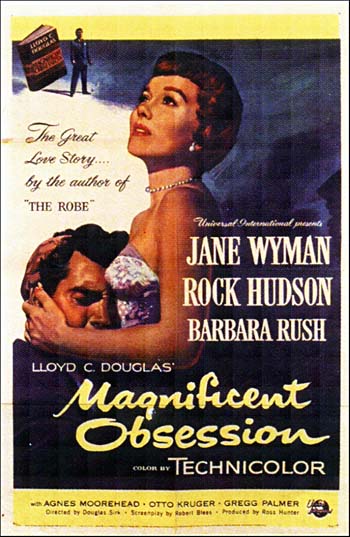
 There’s a scene early on in the 1954 melodrama Magnificent Obsession in which formerly carefree millionaire Bob Merrick (Rock Hudson) meets with an artist named Edward Randolph (Otto Kruger). We know that Randolph’s brilliant because he speaks in a deep voice, tends to be unnecessarily verbose, and often stares off in the distance after speaking. Bob wants to know about a dead doctor who was a friend of Randolph’s. Randolph explains the late doctor’s philosophy of doing anonymous good works. Bob’s mind is blown. (Hudson, who was never the most expressive of actors, conveys having his mind blown by grinning.)
“This is dangerous stuff,” Randolph warns him, “One of the first men who used it went to the cross at the age of 33…”
And a heavenly chorus is heard in the background…
And that one line pretty much tells you exactly what type of film Magnificent Obsession is. It’s a film that not only embraces the melodrama but which also holds on tight to make sure that the melodrama can never escape. There’s not a single minute in this film that is not hilarious overwritten. It’s not just Randolph who tends to be portentous in his pronouncements. No — everyone in the film speaks that way!
The dead doctor is dead specifically because of Bob. Apparently, the doctor had a heart attack but the local hospital’s only resuscitator was being used to save the life of Bob who, while the doctor was dying, was busy recklessly driving a boat.
Helen (Jane Wyman), the doctor’s widow is, at first, bitter towards Bob and when Bob offers to donate $250,000 to the hospital, Helen refuses to accept his check. This leads to Bob doing a lot of soul-searching and eventually having his life-changing conversation with Randolph. Excited at the prospect of doing anonymous good works for the rest of his life, Bob tracks down Helen and tries to tell her that he’s a changed man. Helen, however, wants nothing to do with Bob and ends up getting hit by a car while running away from him. Helen survives but now, she’s blind!
Now, at this point, you might think that Bob has done enough to ruin Helen’s life. At least, that’s the way that Helen’s family views it and when Bob attempts to visit her in the hospital, they order him to go away.
Eventually, Helen comes home from the hospital and starts to adjust to a life without eyesight. One day, she meets a man on the beach and they start up a tentative romance. What she doesn’t realize, at first, is that the man is Bob! By the time she does realize who the man is, Helen has fallen in love with him. However, she feels that it wouldn’t be fair to Bob to pursue a relationship with him and she leaves him.
So, of course, Bob’s response is to go to medical school and become a neurosurgeon. Many years later, Helen has a brain tumor and needs an operation to survive.
Can you guess who her surgeon turns out to be?
Magnificent Obsession is almost a prototypical 1950s melodrama. It’s big, it’s glossy, it’s self-important, and undeniably (and occasionally unintentionally) funny. Even the total lack of chemistry between Hudson and Wyman somehow adds to the film’s strange charm. It’s hard not to admire a film that starts out over-the-top and just grows more excessive from there.
Watching Magnificent Obsession is a bit like taking a trip into a parallel, technicolor dimension. It’s strange, fascinating, and far more watchable than it should be.


 Through the Shattered Lens