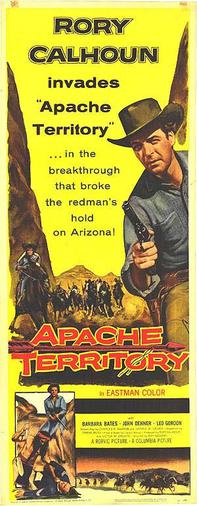
 In this B-western, Rory Calhoun plays Logan Cates, an old west drifter, while traveling through the desert, comes across a young woman named Junie Hatchett (Carolyn Craig). Junie’s parents were settlers who were captured and killed by a group of Apaches. Knowing that the Apaches will still be looking Junie, Logan takes her to a nearby canyon where there’s water and shelter. Soon, other victims of the Apaches start to show up at the canyon. With their supplies dwindling and the Apaches surrounding them, Logan has to keep everyone alive and lead them to safety.
Complicating matters is that one of the people who shows up at the canyon is Logan’s ex-girlfriend, Jennifer (Barbara Bates). Jennifer is traveling with her new husband, the wealthy (and therefore cowardly) Grant Kimbrough (John Dehner). Also seeking shelter at the canyon are a group of Calvary officers, a Pima Indian named Lugo (Frank DeKova), and a naive teenage cowboy named Lonnie (Tom Pittman).
Based on a novel by Louis L’Amour, Apache Territory is a pretty standard western. Some of the battle scenes are surprisingly brutal — particularly when one of the Calvary officers gets hit by a flaming arrow — but otherwise, this is a typical B-western, the type of movie that would have been the second part of a double bill at a Saturday matinee. Logan Cates is able to survive because, unlike Grant Kimbrough, he knows and respects the land and, unlike the Calvary officers, he respects his enemy. He’s a typical western hero, though well-played by Rory Calhoun.
The main problem with the film is that, for a film about a group of people trapped in one location, it never achieves any sense of claustrophobia. The size of the canyon seems to change from shot to shot. The film’s finale involves a well-realized dust storm but it still never reaches the type of action-packed conclusion that most western fans will be hoping for. It ends with a whimper instead of a bang. It feels more like an extended episode of Gunsmoke or The Virginian than a feature film.
This one will be best appreciated by undemanding fans of the genre.

 Through the Shattered Lens