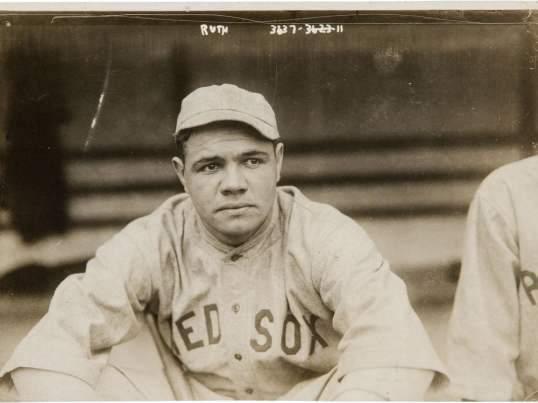
Searching For Babe Ruth


Because today is Babe Ruth’s birthday, I wanted to watch a movie about the player who is still considered to be one of the best to ever play the game of baseball.  Specifically. I wanted to watch a film that was made about him while he was still alive, The Babe Ruth Story (1948). in which the very presence of Babe Ruth on a baseball field causes a previously crippled child to walk again.

I couldn’t find that movie streaming anywhere online but I did watch two other Babe Ruth movies.  First, I watched Babe Ruth Story: That Ever Livin’ Babe (1962).  It’s available on Prime and it’s a documentary that was made about Babe Ruth.  Actor Pat O’Brien narrates the life of Babe Ruth, from his start at a school for wayward boys all the way through the end of his career.  It was a good good documentary and one thing that I found interesting is that the documentary didn’t try to sugarcoat any of Babe Ruth’s later problems with gambling or that he liked to live large.  (That was the reason why, despite his success on the field and his popularity off the field, Babe Ruth was one of the few former stars not be offered a management position after he retired from playing,)  The documentary even admits that, having grown up so poor that his own family sent him away, Babe Ruth was determined to enjoy his fame.  More importantly, the documentary also featured a lot of footage of Babe Ruth both on and off the field, including his first game at Yankee Stadium and also he and his wife selling liberty bonds during World War I.
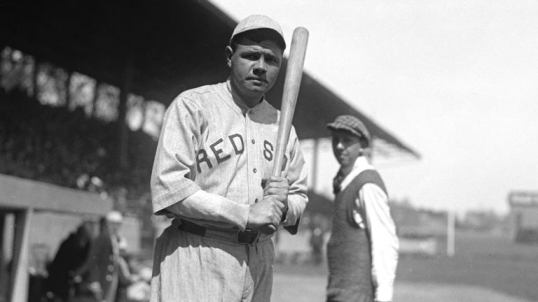
Then, on YouTube, I found Just Pals (1932), a nine-minute film starring the Babe himself.  Babe Ruth returns to the “orphanage” where he grew up and watches a group of boys play baseball.  When one of the boys strikes out and walks away dejected, Babe Ruth takes the time to teach the boy how to properly hold and swing a bat.  That’s not quite as good as magically curing a cripple but Babe Ruth still offers some good advice and an important lesson.  He teaches the kid how to hit a ball like Babe Ruth.  The team wins the next game and Babe Ruth is there to see it.  Then he drives away with one of the orphans stowing away in the trunk of his car.

What I’d really like to see is Babe Comes Home (1927), a silent movie starring Babe Ruth that supposedly featured a lot of footage from Babe Ruth’s games.  Unfortunately, it’s believed to be a lost film.
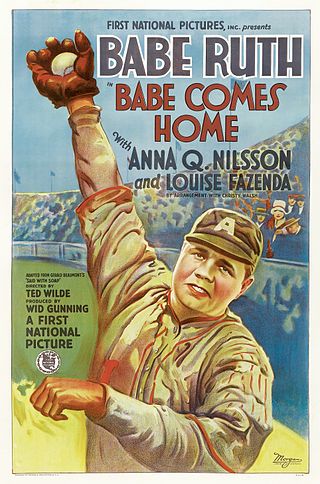
Artist Unknown

Babe Ruth was born 130 years ago and he played his last game 90 years ago.  He was the first baseball player and one of the first athletes to become a celebrity in America and he’s still considered to be one of the best to ever play the game.  I don’t know if he actually called his shot at the 1932 World Series but I like to think he did.

Happy birthday to Babe Ruth, the man who epitomized the the spirit of baseball!  As for the rest of us, Spring Training begins on February 20th, the Dodgers and the Club will play in Japan in March 18th and 19th, and then the Regular Season runs from March 27th to September 28th!  Go Rangers!
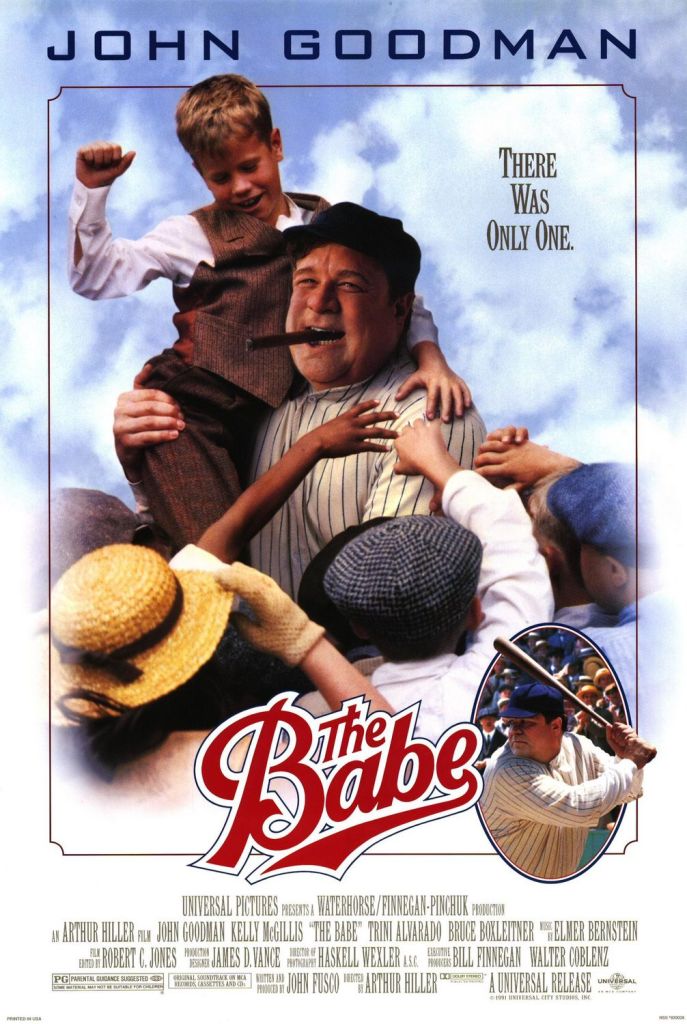


The Babe (1992, dir. by Arthur Hiller)


John Goodman. He’s a good actor but not a very convincing baseball player.

Last night, I watched The Babe, which starred John Goodman as Babe Ruth. Babe Ruth was one of the greatest baseball players of all time, the first of the great sluggers, and the holder of the career home run record from 1935 to 1974. He was the type of player that I wish The Rangers had right now because we’ve got a 22-27 records right now and the only bright spot is that we’re doing better than the Angels.

The Babe starts in 1902, with George Herman Ruth getting dropped off at reform school and learning how play baseball from Brother Matthias (James Cromwell) and then follows Ruth through his career, his first failed marriage, his attempts to become a manager, and his eventual retirement from the game. At first, everyone makes fun of the Babe because he’s not very sophisticated and all he wants to do is hit the ball. Then he shuts them all up by knocking ball after ball out of the park. Babe Ruth was a big man, like John Goodman. But he was also a great athlete. Goodman looked like he was in pain every time he had to swing the bat. Maybe that explains why Goodman plays the Babe as if he never actually enjoyed one minute of playing baseball.

The Babe is like a highlight reel of famous anecdotes. Babe Ruth hits his first home run in the Big Leagues. Babe Ruth promises a sick child that he’ll hit two home runs. Babe Ruth calls his shot. Babe Ruth hits three homers during his final game. In real life, Babe Ruth retired after he injured his knee. In the movie, he retires after he hears an owner talking about how having Babe on the team is only good for selling tickets to the rubes. All the famous Babe Ruth stories are here, along with all of the drinking and the womanizing. The movie never digs too deep into what made Babe tick or what it was like to be the most famous and popular athlete in America. It never even really explores how Babe Ruth changed the sport of baseball. Watching The Babe, you would never know that home runs weren’t even considered to be an important part of the game until Ruth established himself as someone who could hit one ball after another out of the park. The best baseball movies make you feel like you’re either out on the field with the player or you’re in the stands with the fans and they make you want to stand-up and cheer with every hit and every run across home plate. The Babe never does that. There’s no love of the game in The Babe.

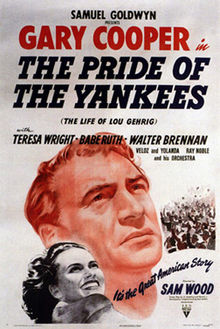
Lisa Reviews An Oscar Nominee: The Pride of the Yankees (dir by Sam Wood)


220px-The_Pride_Of_The_Yankees_1942

“People all say that I’ve had a bad break. But today … today, I consider myself the luckiest man on the face of the Earth.”

— Lou Gehrig (Gary Cooper) at the end of The Pride of the Yankees (1943)

After airing Foreign Correspondent earlier tonight, TCM followed up by showing the 1943 best picture nominee, The Pride of the Yankees.  Knowing that Pride of the Yankees was going to be a baseball film and that I know next to nothing about baseball, I recruited my sister, the Dazzling Erin, to watch the movie with me.  Erin loves baseball and I knew that she would be able to explain anything that went over my head.

Well, I absolutely loved watching this movie with my sister but it turns out that The Pride of the Yankees isn’t really much of a baseball movie.  True, it’s about a real life baseball player.  Several actual players appeared as themselves.  About 85% of the film’s dialogue deals with baseball and probably about 70% of the film features characters playing some form of the game.  But the film never goes into any great detail about baseball or how it’s played.  There’s no talk of strategy or rules or deeper meaning or anything else.  Going into the film, I knew that baseball was a game that involved throwing, swinging bats, and running.  And it turns out that was all that I needed to know.

The Pride of the Yankees is less about baseball and more about celebrity.  It’s a biopic of Lou Gehrig, who today is best known for his battle with ALS, a disease that is also known as Lou Gehrig’s disease.  Lou Gehrig died on June 2, 1941 and The Pride of the Yankees was released just a year later.  Watching the film, it’s obvious that Gehrig was a beloved figure, the type of celebrity who, if he were alive today, would probably be the center of stories like, “Lou Gehrig Did Something This Weekend And It Was Perfect.”  Watching the film, it easy to imagine how traumatic it must have been for the nation when a beloved athlete like Lou Gehrig died at the age of 37.

As a result, The Pride of the Yankees is less a biopic and more a case for canonization.  From the minute that the film’s Lou Gehrig appears on-screen, he is presented as being the type of saintly athlete who, by promising to hit two home runs in one game, inspires a crippled child to walk.  Lou is modest, kind, unpretentious, and never gets angry.  Over the course of the film, he takes care of his mother, displays a worthy work ethic, and marries Eleanor.  He and Eleanor have a perfect marriage without a single argument or a hint of trouble, except for the fact that Lou sometimes gets so busy playing baseball with the local children that he’s late coming home.  There’s not a hint of sadness in their life, until Lou suddenly gets sick.

And really, it should not work.  If ever there’s ever been a film that should be painfully out-of-place in our more cynical times, it would be The Pride of the Yankees.  However, the film still works because Lou is played by Gary Cooper and Eleanor is played by Teresa Wright.  These two excellent performers bring their considerable talents to making overly sentimental scenes feel credible.  Gary Cooper was 40 years old when he made The Pride of the Yankees and there’s a few scenes — especially the ones where Lou is supposed to be a student at Columbia University — where Cooper is clearly too old for the role.  But, for the most part, Gary Cooper did a great job as Lou Gehrig.  Cooper is especially memorable when Lou first starts to show signs of being ill.  Watching Lou struggle to swing a bat, I was reminded of a horse struggling to stand on an injured leg.  It was almost painfully poignant.

The Pride of the Yankees was nominated for 11 Academy Awards, including best picture.  However, it lost to another sentimental film that featured Teresa Wright, Mrs. Miniver.