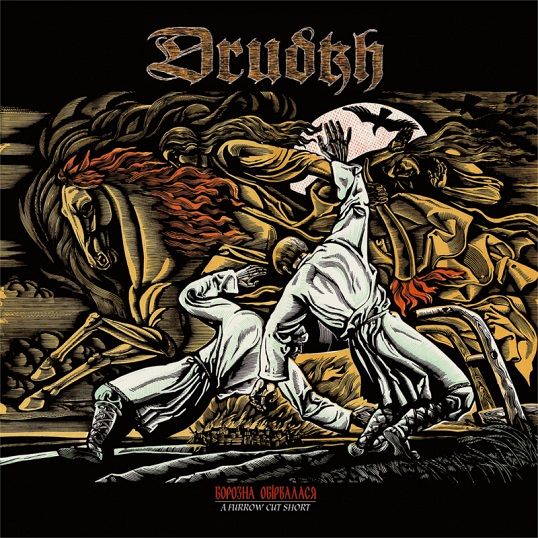
When I fired up Drudkh’s tenth studio album yesterday, A Furrow Cut Short, I was holding my breath in the dim hope that something awesome would slam into my brain from the get-go. After all, this is Drudkh. Not all of their releases have been met with equal acclaim, but they always seem to carry hype on their side.
The album began interestingly enough, with some bending tremolo guitar that kind of brought to mind Blut Aus Nord, and then I waited a bit and moved the play bar ahead. A pretty cool groove picked up around 1:50, and I rode it for a while. The song began to repeat an earlier passage with vocals tossed into the mix, and I moved the play bar ahead. There was that groove from 1:50 again. I rode it. I moved the bar ahead…
Greatness did not grace my ears in a neatly wrapped box, and that was fine. It was just a distant hope. At that point, my immediate instinct was to browse through the sixty minutes of content for all of the gripping moments that would surely rise out of the long black metal grind to knock my head around. A few came. Should I count them? Was that how best to measure this album’s worth? I started to feel a bit silly. This sort of fast-forward treasure hunt has been my subconscious approach to Drudkh for some time now. Here was a band that used to keep me wide-eyed through ten minute tracks as I waited for the peaks to overwhelm me, and over the course of ten albums the appeal had been reduced to skimming. What changed?
The production changed. That’s for certain. Since Microcosmos, Drudkh have been presenting a more deep and refined sound, and I don’t think it did them any favors. It was a technical improvement at the expense of the unique aesthetic appeal of their sound. They also largely left the world of folk music behind. On Songs of Grief and Solitude (2006), Drudkh reworked a variety of earlier melodies from their metal albums into a collection of instrumental folk tracks. It worked really well, and it’s something they would never be able to do with the tunes of Eternal Turn of the Wheel or A Furrow Cut Short.
Song: Cursed Sons I
<@Shad> One day
<@Shad> I will tell my children
<@Shad> That I started the Drudkh wikipedia page.
And there has been one other change. It’s something far beyond the band’s control, but it is significant: historical context. This first dawned on me when I was glancing over the reviews of A Furrow Cut Short already popping up on Encyclopaedia Metallum. One guy started off by writing “Ukraine is not a country where heavy metal thrives like in the UK or Scandinavia”. I stumbled over the words. I suppose fifteen years is a long time when you’re talking music. There are high school kids enjoying A Furrow Cut Short who weren’t born yet when Kharkiv was carving out its claim on the map of metal. That’s a little… weird for me, but it probably has a real impact on how I perceive this music too.
I will never really appreciate thrash metal, because I was never there. I encountered the genre as a prim and proper, cookie-cutter devolution of its original glory. I lacked the contextual sense that something new and monumental was overriding the standards of metal as I’d formerly known them. To me, thrash is just that sound Metallica pioneered, and I have no doubt that this perspective is woefully misguided. This same sort of historical misconception might be taking root on Ukrainian black metal. The reviewer I quoted… his statement would have been a reasonable introduction to Lunar Poetry or Goat Horns in the mid-90s, but by the time Drudkh started to gain attention, Kharkiv was no heavy metal backwater. It was a placename that you gobbled up. “Ukrainian” meant there was no need to sample an album first. You knew you wanted to hear it.
Nokturnal Mortum put Kharkiv on the map, and Knjaz Varggoth’s brainchild still stands leagues above anything else east of Prussia in my book. But Knjaz is also a racist piece of shit, and I can’t say I feel bad that the history books have been rewritten to regard Drudkh as the mother of all Ukrainian black metal. Still, we can’t forget the pre-existing spirit in which this band emerged. Standardized black metal was all about LaVeyan Satanism back then, its music a sort of declaration against society’s disposition to enforce religious values. “Satan” was a shallow facade, and once the point was made, the scene stagnated. Nokturnal Mortum ignited something novel by merging second-wave black metal’s counter-cultural rage with a sort of Bathory-esque true reverence for the old gods. Their music was as hateful as anything Mayhem or Emperor had produced, but it was also rabidly pagan. NeChrist slaughtered the tenets of modern society, smeared their blood across its chest, and danced naked on the pyre.
And that, to me at least, was the spirit of Ukrainian black metal entering the 21st century. It was not merely violent and destructive, but also highly contemplative. The means varied from band to band, but the idea was to bring a bygone spirituality to life. Musically, the tremolo and blast beats found themselves in the company of massive, sweeping auras of sound that might at any minute break into traditional melodies more savage and tribal than anything the co-emerging folk metal scene had to offer. Astrofaes and Hate Forest were two of the earliest bands to emerge from Kharkiv in this new tradition. Astrofaes, headed by Thurios, was the more melodic of the two, with forlorn chord progressions and folk allusions comparable to early Drudkh. Hate Forest, on the other hand, remains one of the most brutal bands I’ve ever heard. It was Thurios’ original collaboration with Roman Saenko, and it was so uncompromisingly violent and minimalistic that it made the most hellish Norwegian offerings feel tame. Yet it was entirely meditative. If Varg Vikernes popularized the notion of black metal as a trance-inducing journey, Hate Forest went leaps and bounds towards perfecting it.
When Thurios and Saenko went on to form Drudkh, the product was more tame than either of their parent projects. Thurios brought the folk and raw melody-crafting via Astrofaes, while Saenko added the trance state and fine touch for aesthetics. At least, that’s how I’ve interpreted it. I certainly can’t offer any informed view into their song-writing process. In any case, what they crafted, not so much on Forgotten Legends but definitely on Autumn Aurora, The Swan Road, and Blood in Our Wells, was totally unique and beautiful. But it did not feel unique to perhaps the extent that it really was. It felt like a brilliant addition to a scene that entailed so much more. (In more than one sense, and not all positive. I am sure the reviewer I mentioned must find it bizarre that almost every summary of Drudkh begins with a preface that they disavow all ties to racism/extremist ideologies.)
Song: To the Epoch of Unbowed Poets
I take two things from this. One is that Drudkh’s earlier sounds float on a cloud of nostalgia. An album that sounded a hell of a lot like Autumn Aurora would really excite me even if it was not half as good, because it would transport me back to a special place and time. The other is that a once unprecedented sound has become pretty common fair. Atmospheric black metal was not invented in Ukraine, but its modern roots run deep there. A lot of bands around the world have since come along and done more with it. They’ve taken it other places–incorporated it into other, equally novel sounds. Saor is a good recent example. In heaping praise on Andy Marshall’s solo project last year, I passively mentioned that it accomplishes its goal “without ever really breaching any new territory beyond the tried and true boundaries of pagan metal”. Well, Drudkh and the Ukrainian scene in general established a lot of those boundaries. And other bands took it further still, to the point where I could speak of an album like Aura without ever thinking “wow, this is original”.
A Furrow Cut Short has some really stand-out tracks. The two I sampled here especially struck me. But it is also lost in time. Changes to production and an abandonment of folk render the modern Drudkh incapable of reaching to the same plain of aesthetics that they once knew. I don’t think it incorporates anything new, either, that might allow me to hear it as a great example of where metal stands today. This album must stand or fall exclusively on its in-born aesthetic value, while competing with the vibe that it is a watered down version of what the band used to be.
That value is, well, average. You can get into the album if you try, but it will not sweep you off your feet. I am not one of these people who cling to the past and expect a band or style to sound exactly like it used to. I am always willing to humor “where are they headed now”, and I have a good deal of respect for what Drudkh did on Handful of Stars even if it didn’t much move me (or seemingly anybody else). At least they were trying to do something. Even Eternal Turn of the Wheel showed motion. A shying away from change, but motion at least, and I modestly enjoyed it for that. A Furrow Cut Short goes nowhere, and that fact drives home the feeling that this band’s sound has grown really stale.
I am a bit torn about A Furrow Cut Short. A part of me thinks “why did they bother?”, but a wiser side enjoys tracks like “Cursed Sons I” and “To the Epoch of Unbowed Poets” way too much to pretend I’d be better off without them. Still, I’m probably never going to listen to this album again. Maybe a quick revisit at the end of the year. There are just too many other bands doing something more original. And too many classics I’d rather rehash, for that matter. It’s strange, because Thurios, Saenko, and the rest of the crew haven’t lost their touch at all. They are doing great things with Blood of Kingu, and Dark Star on the Right Horn of the Crescent Moon would have definitely made my top albums list for 2014 if I had caught it in time. But considering every single member of Drudkh is in that band, I don’t get why Drudkh continue to sound so… redundant.
The album’s available via Season of Mist.
 Through the Shattered Lens