Film Review: The Shoes of The Fisherman (dir by Michael Anderson)


The 1968 film, The Shoes of The Fisherman, opens in a snowy Siberian labor camp.  For the past twenty years, this camp has been the home of Kiril Pavlovich Lakota (Anthony Quinn), the Ukrainian archbishop of Liviv.  Kiril is unexpectedly released by Russia’s new leader, Piotr Ilyich Kamenev (a very British Laurence Olivier).  After explaining to Kiril that Russia and China are on the verge of nuclear war due to a famine that has been instigated by U.S. sanctions, Kamenev tells Kiril that he is being released on the condition that he tell no one about the conditions at the Russian labor camp.  Kiril starts to protest just for Father Telemond (Oskar Werner), the Vatican’s representative, to say that the conditions have already been agreed to.

In Rome, Kiril meets the Pope (John Gielgud), who makes the humble Kiril a cardinal, over Kiril’s objections that he just a “simple man.”  Later, when the aged Pope suddenly dies, Kiril is unexpectedly elected, as a compromise candidate, to succeed him.  Still humble and considering himself to be a simple man with a simple mission, Kiril suddenly finds himself as one of the most revered and powerful men on the planet.  With Father Telemond as his secretary, Kiril tries to make the Vatican responsive to the needs of the people and sets out to bring peace between the Russians and the Chinese. That turns out to be easier said than done, especially when Telemond himself is eventually accused of heresy for his progressive views.

(And yes, Telemond is a Jesuit….)

The Shoes of the Fisherman is a type of film that should be familiar to anyone who has any knowledge of the Hollywood studios in the 60s.  It’s the type of big and self-serious film that was meant to tell audiences, “You won’t find anything this opulent and important on television!”  The cast is designed to appeal to everyone.  Anthony Quinn and Laurence Olivier are there for the older viewers (especially the older viewers who made up the majority of the Oscar voters in 1968) while, for the younger voters, there’s handsome Oskar Werner as a Jesuit who interpretation of the Gospels is so radical that even Pope Francis would probably tell him to step back a little.  For the older, anti-communist viewers, there are scenes that portray the harsh conditions at a Siberian labor camp.  The commies put Kiril in prison so he must be one of the good guys.  And for the younger, more liberal viewers, there was the suggestion that the threat of World War III was largely due to the actions of the American government.  And, just in case there was still anyone who thought that television was preferable to a prestige picture, TV star David Janssen shows up as a cynical reporter whose wife (played by Barbara Jefford) is a doctor who Kiril helps to get some medicine for one of her dying patients.  Director Michael Anderson includes enough sudden zoom shots to let younger viewers know that he’s with them while still directing in a stately enough manner to appeal to the older viewers.

The end result is a film that is big and grand but also rather slow.  The film gets bogged down in subplots that don’t really add much to the overall story.  We spend way too much time with the reporter and his wife.  Anthony Quinn does a good enough job as Kiril, giving a rather subdued performance by Quinn standards.  (A scene where Kiril recites a Jewish prayer for a dying man is wonderfully acted by Quinn, who seems to truly be emotionally invested in the film’s message of togetherness.)  Laurence Olivier is not at all convincing as a Russian but still, he has the stately bearing of a man used to being in power.  Like many of the studio productions of the late 60s, The Shoes of The Fisherman tries a bit too hard to strike a balance between old school Hollywood and the counterculture and the film ultimately feels rather wishy-washy as a result.  It’s a noble film with good intentions but it’s not particularly memorable.
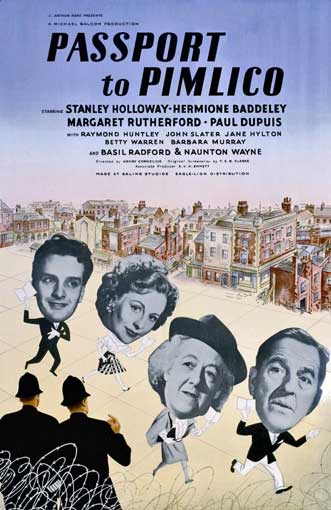
The Fabulous Forties #24: Passport to Pimlico (dir by Henry Cornelius)


Passport_to_Pimlico_film

The 24th film in Mill Creek’s Fabulous Forties box set was the 1949 British comedy, Passport to Pimlico!  Even though Passport to Pimlico is very much a British film (for instance, I had to use Wikipedia to discover the Pimlico is a neighborhood in London) and definitely a product of its time, it’s still a film that felt very relevant to some of the things that all of us in America are dealing with today.  If nothing else, Passport to Pimlico is definitely more memorable than Freckles Comes Home.

Passport to Pimlico opens in London.  World War II may be over but the city is still in the process of rebuilding.  War-time rationing is still in effect and all the residents of Pimlico regularly have to deal with the endless red tape of bureaucracy.  As well, there’s still unexploded German bombs littered around the neighborhood.  When a group of local children accidentally blow one of those bombs up, it leads to the discovery of a previously hidden cellar.  Inside the cellar is everything you could hope to find in a mysterious room: artwork, jewelry, and coins.  There’s also a parchment from the 15th Century, in which the king of England ceded the neighborhood to the final Duke of Burgundy.  Because no one knew that the charter existed, it has also never been revoked.  As a result, all of the citizens of Pimlico are actually citizens of dukedom of Burgundy.

That means two things: First off, the citizens are legally required to live under the laws of Burgundy, despite the fact that the dukedom no longer exists and those laws haven’t been changed since the 1400s.  Secondly, the neighborhood is no longer governed by the restrictive bureaucracy of postwar Britain.  In short, Pimlico — or Burgundy, as it is now called — is a free and independent state.

Soon, the nation of Burgundy is being overrun by greedy businessmen and enthusiastic shoppers.  The British respond by surrounding Burgundy with barbed wire and announcing that no one may cross the border.  The Burgundians react by demanding that anyone riding the underground through their country have a passport or run the risk being kicked off the train.

And things only escalate from there.  The British government is desperate to put Burgundy in its place while the citizens of Burgundy are determined to maintain their independence.  If Passport to Pimlico were made today, this is probably one of those situations that would either end in tragedy or with everyone learning not to question the whims of the government.  Fortunately, Passport to Pimlico was made in 1949 and, as a result, it is a genuinely warm-hearted comedy that celebrates both individual freedom and patriotism.

And really, it’s an enjoyable little film.  The cast is full of British character actors, all of whom deliver their dialogue with just the right amount of snark.  I enjoyed it and I have to admit that I related to it a bit.  As I look at America today and I think about what it’s going to be like in 2017 (regardless of who wins the presidential election because, let’s be honest, they all suck), there’s a part of me that would love a chance to get out of this country and be a Burgundian.

Seriously, come 2017, I’m seceding!

Until then, I guess I can just watch Passport to Pimlico.

Horror on the Lens: Full Circle (dir by Richard Loncraine)


For today’s horror on the lens,we have a film from 1977.  I recently watched this film very late at night and — OH MY GOD!  Seriously, I had nightmares for two nights straight!

Full Circle opens with the horrifying death of Kate (Sophie Ward), the daughter of Julia (Mia Farrow) and Magnus (Keir Dullea).  After Kate’s death, Julia and Magnus divorce and Julia moves into a new house.  However, she is haunted by visions of a little girl who looks just like Kate.  As well, the house is full of odd noises, creepy toys, and appliances that turn on by themselves.  Is Julia seeing the ghost of her daughter or something far more dangerous?

Full Circle is a truly haunting and disturbing haunted house film.  Mia Farrow gives a great performance as Julia and the entire film is dominated by a palpable atmosphere of dread.  And that final scene — AGCK!

http://www.youtube.com/watch?v=WQVrglbsjfQ