(With the Oscars scheduled to be awarded on March 4th, I have decided to review at least one Oscar-nominated film a day. These films could be nominees or they could be winners. They could be from this year’s Oscars or or they could be a previous year’s nominee! We’ll see how things play out. Today, I take a look at the 1938 best picture nominee, Test Pilot!)
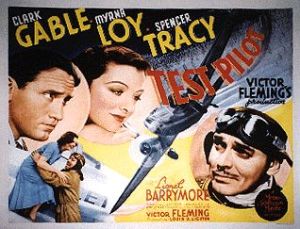
Test Pilot is all about charisma.
It tells a fairly simple story. I imagine that the plot seemed just as familiar in 1938 as it does in 2018. Jim Lane (Clark Gable) is a test pilot. In the early days of aviation, long before people took the idea of flight for granted, Jim Lane is a hero and celebrity. Whenever a new aviation technique is developed, Jim is the one who tests it. He’s the one who makes sure that it’s safe. Every day, when Jim goes to work for Mr. Drake (Lionel Barrymore), there’s a chance that he might not make it home. Not surprisingly, he’s cocky, reckless, and not prone to commitment. He’s also handsome, charming, manly, and quick with a quip. In short, he’s Clark Gable.
When the movie starts, Jim has only one real friend. Gunner (Spencer Tracy) is his mechanic. Gunner is a by-the-book, no-nonsense professional. He might enjoy a drink every now and then but Gunner knows his job and he knows his planes and, even more importantly, he knows Jim. Gunner’s a man of unimpeachable integrity, the type who will always call things as he sees them. In short, he’s Spencer Tracy.
One day, while on a test flight, Jim is forced to make an emergency landing on a farm in Kansas. That’s where he meets Ann Barton (Myrna Loy). Ann is beautiful and outspoken. She quickly proves that she can keep up with Jim, quip-for-quip. In short, she’s Myrna Loy and, before you know it, she and Jim are in love. Just as quickly, Jim and Ann are married.
The movie starts out as a bit of domestic comedy. Jim may know how to fly a plane but it quickly becomes obvious that he doesn’t know much about commitment or being a husband. When Jim attempts to buy his wife a nightgown, he doesn’t even know how to pronounce the word lingerie. (He asks a store clerk for help in finding the “lonjur department.”) However, Jim soon starts to find that married life agrees with him.
Of course, that’s a problem when your job requires you to defy death on a daily basis. Ann worries that Jim is going to go to work and never come home, fears that are intensified after a race with another airplane ends in a terrible and (for the other pilot) fatal crash. Gunner, meanwhile, starts to fear that there’s only so many times that Jim can cheat fate. Both Ann and Gunner promise that they will never leave Jim’s side.
Well, you can probably already guess everything that’s going to happen. Test Pilot is not exactly the most narratively adventurous movie ever made but, when you’ve got Gable, Tracy, Loy, and Barrymore all in the same film, you don’t really need to break any new ground, storywise. Test Pilot is an example of the power of pure movie star charisma. It’s watchable because the performances are just as entertaining today as they were in 1938. The film features Gable doing what he did best and Tracy doing what he did best and Loy and Barrymore all doing what they did best. In this case, that’s more than enough.
When it comes to the film’s numerous flight sequences, it’s perhaps best to try to put yourself in the shoes of someone seeing the film in 1938. Today, of course, we’ve been spoiled by CGI. We tend to assume that literally anything can happen in a movie. In the 30s, however, people couldn’t take special effects for granted. When they watched the flight footage in Test Pilot, they did it with the knowledge that it was filmed by people who actually were putting their lives at risk to get it. At a time when commercial aviation was considered to be a luxury, Test Pilot provided audiences with a view of the world in the sky and of the world below, a view that they probably wouldn’t have gotten a chance to see otherwise.
A huge box office success, Test Pilot was nominated for best picture but lost to another film featuring Lionel Barrymore, Frank Capra’s You Can’t Take It With You.
 Through the Shattered Lens