Retro Television Reviews: Fantasy Island 2.1 “Homecoming/The Sheikh”


Welcome to Retro Television Reviews, a feature where we review some of our favorite and least favorite shows of the past!  On Tuesdays, I will be reviewing the original Fantasy Island, which ran on ABC from 1977 to 1986.  The entire show is currently streaming on Tubi!
This week, we begin season two of Fantasy Island!

Episode 2.1 “Homecoming/The Sheikh”

(Dir by Earl Bellamy, originally aired on September 16th, 1978)

The second season of Fantasy Island begins with a bizarre mishmash of tones.

As usual, there are two fantasies.  The first fantasy features David Birney as Alan Boardman.  As Mr. Roarke explains it, Alan served in Viet Nam.  He was horribly burned in battle and captured by the Viet Cong.  He spent years, as an amnesiac, in a POW camp.  In the United States, he was reported to have been killed in action.  Finally, he was released from the POW camp and he underwent extensive plastic surgery.  He now looks completely different than he did in his past life.  It was only after the plastic surgery that Alan remembered who he was.  He also remembered that he had a wife (Lynda Day George) and a son (Ronnie Scribner).  Alan comes to Fantasy Island, hoping to be reunited with his family.  However, there’s a complication.  Alan’s wife has remarried and she still believes Alan to be dead.  Alan meets his wife and his son but he has to pretend to be a stranger.  Alan must decide whether to reveal his true identity or to accept that his wife has moved on and now has a new life.

Wow, that’s really dark!  It’s an extremely serious story, one that ends on a bittersweet note that will leave no one truly satisfied.  David Birney and Lynda Day George both give intense performances as they struggle to come to terms with the horror of the Vietnam War….

Meanwhile, the other fantasy features Arte Johnson as Edgar, a meek school teacher who wants to be a sheikh with a harem.  Seriously, that’s his entire fantasy.  Of course, once he becomes a sheikh, he discovers that his servant (played by Sid Haig) is a part of a conspiracy to murder him.  It also turns out that a member of the harem is actually one of Edgar’s fellow teachers, Yasmine (Georgia Engel).  Yasmine’s fantasy was for Edgar to finally notice her so Roarke’s solution was to force her to be a member of a harem!  (Really, Mr. Roarke?)  This fantasy is played for laughs and the comedy is extremely broad.  It’s somewhat jarring to go from David Birney obsessing on the war to Arte Johnson grinning at the members of his harem.  It’s such a tonal mismatch that it makes it difficult to get invested in either fantasy.

While all of this is going on, Tattoo is feeling depressed and suffering from ennui.  Mr. Roarke solves this problem by giving Tattoo a tiny car that he can drive around.  In this episode, Mr. Roarke doesn’t seem to openly dislike Tattoo as much as he did during the first season so I’ll be interested to see if that trend continues.  Reportedly, Ricardo Montalban and Herve Villechaize did not have the best working relationship but, in this episode, Roarke and Tattoo actually seem to have a vague respect of one another.  It’s a change of pace.

Anyway, this episode doesn’t work because the fantasies don’t really mesh well.  However …. SID HAIG!

The Fabulous Forties #3: The Black Book (dir by Anthony Mann)


The_Black_Book_Poster

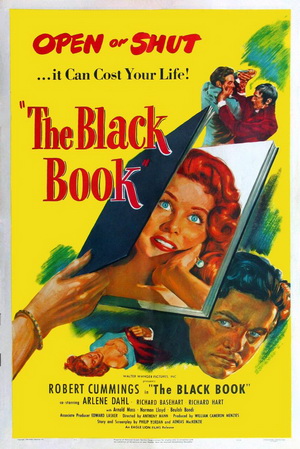
The third film in Mill Creek’s Fabulous Forties box set was 1949’s The Black Book, which was also released under the title Reign of Terror.

The Black Book takes place during the French Revolution.  It is, to quote Dickens, both the best of times and the worst of times.  Actually, mostly it’s just the worst of times.  The Black Book portrays revolutionary France as being a dark and shadowy country, one where the only things that hold the people together are paranoia and terror.  It’s a country where anyone can be executed at any moment and where power mad tyrants excuse their excesses by saying that they are only doing the people’s will.  Considering that the The Black Book was made in 1949, its vision of revolutionary France can easily been seen as a metaphor for Nazi Germany or Communist Russia.  Or perhaps even America at the start of the Red Scare.

(It’s probably not a coincidence that the Nazis also had a document known as the Black Book, one that listed everyone who was to be arrested and executed if Hitler succeeded in conquering Great Britain.)

Maximilien Robespierre (Richard Basehart, giving a disturbingly plausible performance that will make you think of more than a few contemporary political figures) is on the verge of having himself declared dictator of France.  Unfortunately, his little black book has disappeared.  Inside that black book is the name of everyone that he is planning to send to the guillotine.  If the book ever became public, then Robespierre would be the one losing his head.

Robespierre summons a notorious prosecutor named Duval (Robert Cummings) to Paris and gives him 24 hours to track down the book.  He gives Duval the authority to imprison and interrogate anyone in France.  He also informs Duval that, if the book is not found, Duval will be the next to lose his head.

However, what Robespierre does not know is that Duval is not Duval.  He is Charles D’Aubigny, a rebel against the Revolution.  Charles murdered Duval and took his place.  Now, Charles has to find the book without his own identity being discovered.  Not only do some of Robespierre’s allies suspect that Duval may not actually be Duval but some of Charles’s former allies also start to suspect that Charles may secretly be working for Robespierre, even as he claims that he’s trying to bring him down.  At times, even the viewer is unsure as to who is actually working for who.

Oh my God, this is such a good film!   In fact, it was so good that I was surprised that I hadn’t heard of it before watching it last night.  The chance to discover a hidden gem like The Black Book is the main reason why I continue to take chances on Mill Creek box sets.

The Black Book was definitely made on a very low-budget but director Anthony Mann (who is best known for directing several landmark westerns) uses that low-budget to his advantage.  There’s little spectacle to be found in this historical epic but then again, there was little spectacle to be found in the reign of terror.  This is a film that takes place in shadowy rooms and dark, almost claustrophobic streets.  It’s a historical film that looks and plays out like the most cynical of film noirs.  Despite the fact that all of these well-known French figures are being played by very American actors, the cast all does an excellent job of capturing the fear and desperation of people living under oppression.  The subtext of The Black Book was undoubtedly clear in 1949 and it’s just as clear today.  Fanaticism remains fanaticism, regardless of when it happened or what ideology is used to justify it.

There is a somewhat awkward moment towards the end of the film when a French army officer is asked for his name.

“Bonparte,” the officer replies, “Napoleon Bonaparte.”

“I’ll remember that name,” someone snarkily replies.

But, other than that one moment (which immediately made me think of Titanic‘s infamous “Something Picasso” line), The Black Book is an intelligent and effective thriller.  And because it’s in the public domain, you watch it below!