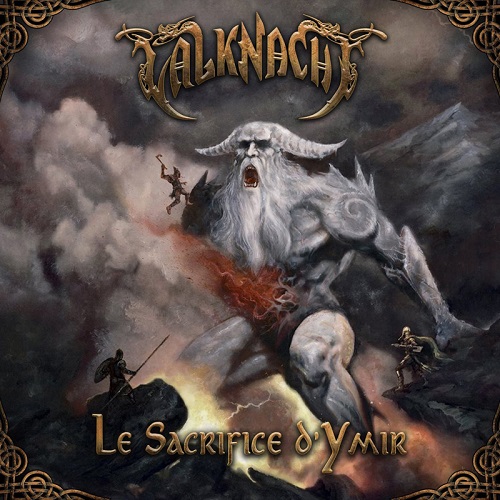
Review: Valknacht – Le Sacrifice d’Ymir


Valknacht is a five-piece paganish metal band from Quebec that have released three albums beginning in 2009–not to be confused with Walknut, the highly acclaimed side-project of Stringsskald from Темнозорь (Temnozor). I suppose I grabbed this album for an obvious reason: it presented a pagan tag from a relatively new act I had never heard of. With the folk and pagan metal scene now fifteen years in the making, a lot of the old stalwarts are simply running low on material. I am always hoping to stumble upon a new collaboration willing to pick up the slack and carry one of my favorite genres onward into a new era. Valknacht could be that band, but it’s going to take some work.

Valknacht – Bataille de Maldon, from Le Sacrifice d’Ymir

The album begins with a 3 minute intro track that I’ll not bother sampling here. You already know what it sounds like. Oars splash through the sea in time with viking voices oooing and OOOing and sometimes aaahhing. Break and repeat with some overbearing choral and brass synth, throw in a gong for good measure, and you will find yourself in the opening moments of “Bataille de Maldon”. Add a dash of synth woodwind, queue the crunch crunch crunch monotone guitar, and remind your drummer to make it metal in a few more measures. The black metal at 2:05 gives us a well-needed boost, and from there the song transitions to something that ought to be really, really cool. 2:40 made me think of Nokturnal Mortum’s “The New Era of Swords” from Weltanschauung, and for about one minute “Bataille de Maldon” is a song I really want to listen to. But the segment soon gives way to something fairly indistinguishable from what came before.

For the vast, vast majority of this 9:30 song, what you hear is an endless rain of double bass, rhythm guitar that only knows two patterns and three chords, a cheap synth whistle that’s totally unconvincing as the real deal, an admittedly interesting lead guitar, and total synth overkill plugging in every gap, sometimes doubled up with layers of “OOOOOOOOO”.

Yet, this could have all worked out really well. This band surely listened to a lot of Moonsorrow, and the string portion of the synth gets playfully close to Nokturnal Mortum at times. But the rest of the synth is just bad. It feels so fake. They use bold brass like they’re Equilibrium or Turisas, but the music isn’t nearly bombastic enough to merit it. The woodwinds have no depth, no air, no punctuation… Аркона (Arkona) is about the only band I can think of that pulls off fake woodwinds effectively (unless others are doing it so well I take them for studio musicians), and they must have much higher-end equipment than Valknacht at their disposal to do it with. It would have been nothing for one of the band members to pick up a whistle and record it proper. The vocals get really annoying really quickly for lack of dynamics or anything interesting to encase them. And the song goes on and on and on without ever adding much of anything. By 3:10 we’ve pretty much heard everything, and there’s next to nothing in the form of build-up or break until we hit a sudden transition at 8 minutes into an admittedly solid finale.

So, am I going to say anything good about this album? Surprisingly, yes. Quite a lot actually.

Valknacht – Le carmin des anges, from Le Sacrifice d’Ymir

The tragedy of Le Sacrifice d’Ymir is that just about anyone listening to this album will get the same impression that I did for its first 13 minutes. How many will keep listening? Few, I suspect, and it’s a shame because by the end this album is sounding pretty damn solid. “Le carmin des anges” is the closing track. It should have been the opening. Here is a song that cuts out all of the bullshit and condenses everything I did like about “Bataille de Maldon” into a much more manageable 5 minute package. The term “trying” drops back down my throat, and I hear some really badass Windir licks connected by groovy breaks and synth again reminiscent of Noktrunal Mortum. Thorleïf’s vocals do a total 360, and his previously dull deeper bellows sound epic when juxtaposed and then overlaid with higher-pitched rabid black metal screams.

The collective sound really works here, too. The Moonsorrow vibe they were going for in “Bataille de Maldon” flopped for a far-too-excessive attempt to be epic. That sort of music is meant to sound earthy, and the synth swarm just made it seem cheap and fake. On “Le carmin des anges”, a lot of the frivolous choral and brass sounds are gone, and what remains works far better with the Windir vibe they’re getting at.

Valknacht – Le sacrifice d’Ymir, from Le Sacrifice d’Ymir

You didn’t have to wait until the last track to find this though. The third, “Chants de guerre”, carries an infinitely more successful Moonsorrow vibe than the song before it. The woodwind’s fakeness is barely significant because the loop it plays is more of an unnatural Falkenbach chant than a harmony. Thorleïf’s full vocal range finally comes into play, and there is way more Windir-esque black metal–a sound they do right. Track 4, “Sur les ruines de Rome”, throws in some seemingly female screams and spoken lines that feel kind of reminiscent of Masha from Arkona, and could be a guest musician or further testament to Thorleïf’s range. (Liner notes for this album have been hard to come by.) As if Masha had been on their minds, track 5, “Le sacrifice d’Ymir”, feels pretty “slava!”, with some frantic whistle and guitar tapping. I had good cause to doubt another 10 minute track, but there is so much more going on here than in “Bataille de Maldon”. Thorleïf’s vocal dynamics alone are enough to make the overdrawn passages–and there are certainly a few–way less dull, the lead guitarist keeps up that Windir kick he’s proven pretty good at, that obnoxious rhythm guitar from the opener is all but missing, mixed down from a nuisance to its proper role and a background accessory.

“De murmures et de givre” starts nice but regrettably returns to a lot of the mistakes of “Bataille de Maldon”–a 7 minute track that could have probably made its point in three and a half. “Que le sang constelle mes mains” gives us our first and last taste of some accordion. Though its synthetic generation is painfully obvious, it does kick off with a melody pleasantly reminiscent of Finsterforst. Again though, the song drones on way too long with boring “I’m going to growl, you chugga-chug, and you hit a whole bunch of notes at once on your keyboard” moments.

So what’s the verdict? I think that this band either ran out of material and had to generate a few filler tracks, or else the minds behind it have some differences of opinion on how they ought to sound and they tried to accommodate everyone. Over all, fans of Windir will find plenty of moments to swoon over, and Moonsorrow die-hards will be modestly entertained. I got a Nokturnal Mortum vibe in some of the synth string utilization and rhythm guitar breakdowns, but not nearly enough to satisfy, and it has to take second stage to a lot of derivative crap. These guys have enormous potential, and they’re relatively young by band standards. I think the inclusion of “Bataille de Maldon” in its present state–at all let alone as the not-so-grand opener–is a little suspect. It would be nice to hear some session musicians for the folk instrumentation, or at least a better keyboard. And they really need to do something about song lengths relative to content. I will have long forgotten Le Sacrifice d’Ymir this time next year, but I won’t forget to check out their future releases. Turisas rose from a totally generic sound to release one of the best albums in folk metal. So did Finsterforst. Valknacht are certainly capable of becoming a band I could fall in love with.
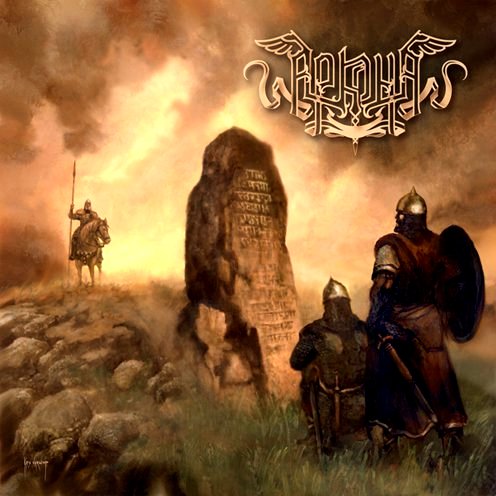
Ten Years #33: Аркона


Decade of last.fm scrobbling countdown:
33. Аркона (909 plays)
Top track (49 plays): Покровы небесного старца, from От сердца к небу (2007)
Featured track: Гой, Купала!!!, from От сердца к небу

It’s no coincidence that a lot of folk-oriented Slavic metal bands have more of an edge than their western counterparts. There is a spirit of primitivism and barbarism that seems to permeate these acts; while Alestorm and Korpiklaani are reveling in booze, bands like Arkona are delighting in something more savage. Grittier distortion, harsher vocals, lower quality production, and a tendency to incorporate black metal all play a role. While this has allowed a lot of Slavic folk metal bands to capture a slightly deeper, more introspective connection to their cultural roots, it has also reduced their accessibility. Arkona are impervious to this consequence; they manage to invoke that essence of savage Slavic glory while still constructing songs I wouldn’t hesitate to recommend to people unconditioned to extreme metal. This is due in part to their above-average production quality (obviously lacking in a youtube rip), but more so to Masha’s wildly diverse range of sung and screamed vocals, often accompanied by a glorious operatic Russian chorus.

As with the last entry in my last.fm series, there is not much I care to say about Arkona that I did not already cover in a previous post. Their position as my 33rd most listened to band of the past decade is no accident. Hell, they’re the initial reason I learned how to transliterate Cyrillic.

Review: Аркона – Слово (Arkona – Slovo)


I would like to believe that Аркона, or Arkona for you non-purists, is a band requiring little introduction. They did not create the Slavic brand of folk metal, nor are they necessarily the best of their kind, but I would argue that they are the most accessible. Eschewing the common pagan metal dependence on raw production, Arkona deliver directly, presenting a full sound pervaded with folk and ferocious intensity.

At least, that is how I think of them. My ability to relate to the band is a bit narrow. I have somehow only ever listened to Возрождение (Vozrozhdeniye) and От Сердца к Небу (Ot Serdtsa K Nebu), but I’ve listened to both countless times. I am in no position to describe what precisely has changed here since Гой, Роде, Гой! (Goi, Rode, Goi!), but 2007 isn’t that far removed.


Азъ/Аркаим (Az’/Arkaim)

Following their best introduction track to date, Slovo kicks off in standard Arkona form, exploding briefly and then opening up to Masha’s breathtaking vocals. The instrumentation employed differs little from the past–bagpipe and woodwinds driving over epic synths and intense pagan aggression, with slow, tense interludes setting each stage. In the details though, much has changed.

The first difference that caught my eye was the introduction of a violin to accentuate the tension. This application (not its use in general), as it turns out, is more a feature of the opening track than the album as a whole, but the mood it aims for is a recurring theme: expect softer, subtler means to distinguish Slovo’s dynamics shifts.

The other thing I immediately noticed was a diminishing in the intensity of Masha’s metal vocals, and this, unfortunately, is consistent throughout the album. Oh, she can still belt them out better than just about any female metal vocalist out there, but that Slavic shrillness behind the gutturals seems to be gone, degrading into something a bit deeper and a bit more typical to metal in general.


Никогда (Nikogda)

When I returned to a few Ot Serdtsa K Nebu tracks to confirm this latter observation, a lot of other disappointments surfaced. Masha’s mellowing out from a violent she-wolf to a standard death metal growler is only the tip of the iceberg, though her clean singing might be as good as ever. The entire album is really a step down in ferocity. Primitive folk transitions have been replaced by a more consistent reliance on synth and whispered interludes to create a sound that is perhaps fuller but not nearly as inspiring. The track at hand is a bit of a counterexample, but consider it among the heaviest Slovo has to offer, not par for the course.

Don’t get me wrong though. I consider Ot Serdtsa K Nebu one of the best albums of all time, and that’s a pretty high standard to maintain. On Slovo, Arkona continue to produce absolutely solid pagan/folk metal, they’re just complacently maintaining the genres rather than redefining them. The specifically Slavic sounds of pagan metal are here sharing the stage with a more universal approach to the genre.

The album still brings a lot of uniqueness to the table. The guitar on Nikogda manages to maintain a constant tension that never bores in spite of (or even perhaps specifically because of) its simplicity, and it pairs up with the vocals perfectly. The song Леший (Leshiy) delightfully converts a border-line cheesy, carnival accordion into convincing metal. And though no hammer dulcimer is mentioned in the album’s credits, a sound I can describe as nothing else (perhaps very convincing keyboards?) peppers many tracks like falling snow, giving them a decidedly wintery vibe. (I can’t resist pointing out, to the complete apathy of anyone potentially reading this, a peculiar reminiscence I perceive in this last feature to Midwinter Land, the Sindar Ruins theme of Suikoden III, by Michiru Yamane, Keiko Fukami, and Masahiko Kimura.)


Слово (Slovo)

As for my gripes about intensity, the title track does manage to rise to the level I’d come to expect from Ot Serdtsa K Nebu, and might bring to light the stylistic change I had in mind. What springs to life here around 3:30, THAT is what I was looking for on this album. If brief, it demonstrates the intensity hedging on insanity that Slavic folk can offer to metal. That the sort of impact I got from Ot Serdtsa K Nebu in its entirety can only be compared to a passing phrase in Slovo speaks against the album, but in all fairness, that’s a pretty high measuring stick. Slovo is a really enjoyable album throughout, and it’s taken no effort on my part to keep it on perpetual repeat these last few nights. It’s more mellow than what I’d come to expect, in its folk features even more so than in the metal, and the overuse of whispered/spoken introductions and filler tracks is a mild annoyance, but it’s still a cut above much of the competition. If you’re new to the band and these sample tracks left you unimpressed though, do acquire a copy of Ot Serdtsa K Nebu before you write them off altogether.

Song of the Day: Аркона – Покровы Небесного Старца


I have never been to Russia. I imagine they have cities and cars and year-end clearance sales and pizza delivery just like anyone else. But that’s just being boring and realistic. I would rather think of Russia as that savage, untamed land to the east, from whence road the Hun and the Mongol–a mysterious, Dionysian place in which primeval landscapes produce warriors with the spirits of beasts. Arkona seem to perfectly capture this. Their music dances care-free about you but is poisonous to the touch.

There’s something about Slavic languages that sounds ruthlessly vicious when screamed–a very different vibe from the power and command of Germanic tongues. At the same time, that typical deep Russian chorus sound is always so encompassing, embracing everything around it except, perhaps, the listener. Arkona employ ample quantities of both, and fuse it with brilliant folk. If someone described a sound as “one with nature” to me I’d probably roll my eyes, but the nature here presented is a pack of wolves delighting in the kill.

I don’t know, this particular song has just really struck me lately. Ot Serdtsa K Nebu is one of my most listened-to albums, but perhaps because of the lengthy intro I never took sufficient notice of the opening track before. “Shrouds of Celestial Sage”, or “Pokrovy Nebesnogo Startsa”, or “Покровы Небесного Старца”, however you want to write it, isn’t Arkona’s most beautiful song, but I think it might be their greatest success at melding such meledies with a characteristically eastern savagery.

The explosion at 5:03 is one of the most epic moments in metal, and the sound quality of a youtube video cannot do it justice. Also, Miss Masha Arhipova is the most awesome person ever. Yes, that’s her screaming.