Alex (Megan Ward) is a suburban teen still trying to come to terms with the suicide of her mother. She and her friend, Nick (Peter Billingsley), spend all of their time hanging out at the local video arcade, Dante’s Inferno. (Symbolic name alert!) Also hanging out at Dante’s Inferno is a man (John de Lancie) who is desperate to find people willing to play what he says is the next step in the evolution of gaming. The game, which is simply called “Arcade,” is a virtual reality simulator and soon, all the teens want to play it!
Unfortunately, there’s a problem with Arcade. It was partially programmed with the brain cells of a child who had been beaten to death by his mother. Don’t ask why anyone thought this was a good idea because this is a Charles Band production so you know no one would explain even if they could. The child wants either friends or revenge so, as a result, the game is stealing the souls of the people who play it and transporting them to the virtual reality world.
Realizing that all of her friends will soon be gone, Alex enters the virtual reality world to save them and thwart Arcade! She’ll have to defeat skulls, serpents, and every other CGI challenge that the game can throw at her.
If you remember this film, it’s probably because you’re like me and you saw it on HBO when you were kid. Though the film has an R-rating because of some awkwardly deployed bad language, the film really is a teen boy fantasy, one in which you can enter the world of your favorite video game and save the world with Megan Ward, a hot girl who loves video games just as much as you do. When it was released, Arcade’s special effects were pretty impressive. If you watch the movie today, it’s obvious that the actors have just been superimposed against a virtual background. Watching the film today, I had the same feeling that I had when I recently hooked up my old Xbox 360 and played a few games. It was more primitive than I remembered but that rush of nostalgia was enjoyable for a few hours.. Arcade features an energetic cast (including Seth Green and AJ Langer in supporting roles) and Dante’s Inferno was the coolest arcade I’ve ever seen. It was a hundred times better than the one from Joysicks.
One final note: If you needed any more evidence that Disney is evil, they actually sued Charles Band because they claimed Arcade was too similar to Tron! As a result, Band, working with Peter Billingsley, actually had to redesign a good deal of the CGI before the film could be released. Disney was right about Arcade being a goof on Tron but who cares? I doubt anyone has ever said, “I’ve seen Arcade, I don’t need to see Tron.” Chill out, Disney. There’s room for at everyone at the arcade.
VGM Entry 60: Splatterhouse
(Thanks to Tish at FFShrine for the banner)
Today is October 1st, and Shattered Lens readers probably have a good idea of what that means.
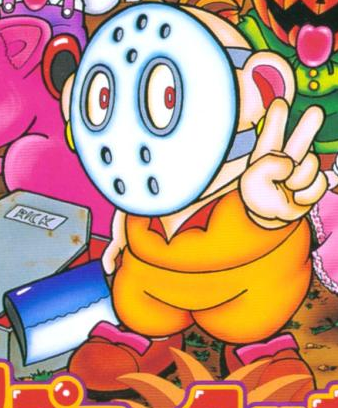
Namco’s Splatterhouse series first emerged in the arcades in 1988. As the advertisement poster used in this music video suggests, it was one of the first video games that really possessed the graphical capacity for some good old fashion gore. You play as Rick Taylor, a run of the mill college student who takes refuge from a thunderstorm in an old rickety mansion and inevitably finds himself demonically possessed, hacking and slashing his way through all sorts of hellspawn and ultimately butchering his girlfriend before defeating the mansion’s demon fetus-spawning womb and escaping. Quality stuff.
The game is accompanied by quite an impressive soundtrack.
When not taken to weird, incoherent noises such as on “Poltergeist”, the game has a knack for some rather pretty tunes that are only disturbing when placed in context. (The theme for Jennifer is one such instance; let’s not forget that the scene results in you chopping her head off.) I am not sure whether Yoshinori Kawamoto or Katsuro Tajima composed Splatterhouse. The former name crops up slightly more often on vgm websites, but trusting the majority consensus has lead me astray plenty of times before. Unfortunately, Namco have featured so seldom in my gaming music compilation that I am not really in a position to take an educated guess.
Splatterhouse is probably not thought of by most gamers as an arcade series. The original 1988 Splatterhouse only found obscure ports–to the PC Engine/TurboGrafx-16 in 1990 and the Fujitsu FM Towns in 1992. Its sequels made a bigger splash, becoming staples of the Sega Genesis/Mega Drive. Splatterhouse 2 and Splatterhouse 3 were released only seven months apart, in August 1992 and March 1993 respectively.
Both sequels were composed by Milky Eiko, and despite their wide acclaim, Milky’s rather outlandish pseudonym does not seem to have surfaced since. I could not find any other Eiko associated with Namco, and he must be regarded as both one of the last and one of the most famous game composers to be buried in complete anonymity, before composition credits became standard.
On an odd final note, there was actually another series game, Splatterhouse: Wanpaku Graffiti, released in 1989. It was an SD game, that is, super deformed, which generally refers in video games to over the top, excessively cute anime portrayals of familiar characters from earlier games. Released exclusively on the Famicom, Wanpaku Graffiti offered good clean serial murder for the whole family.
VGM Entry 59: Street Fighter II and SNES domination
(Thanks to Tish at FFShrine for the banner)
An enormous disparity had emerged between the Super Nintendo and competing platforms by the early to mid-90s. The Sega Genesis/Mega Drive, released two years sooner, still didn’t have much to offer, and the arcade was fading fast. The former simply couldn’t compete with the SNES’s ability to simulate real instrumentation, and the latter, I suspect, was no longer funded the way it used to be. This lends itself to a number of comparisons, but in consideration of the fact that my available time for writing these articles is rapidly coming to an end, let’s just jump straight to the point.
The Street Fighter II series is a massive and confusing string of titles through which Capcom managed to milk a great deal of money releasing minor updates and new characters over a short period of time. The original Street Fighter II came out for the arcade in 1991. This was followed (in the arcade) by Street Fighter II: Champion Edition (April 1992), Street Fighter II: Hyper Fighting (December 1992), Super Street Fighter II: The New Challengers (October 1993), and Super Street Fighter II Turbo (March 1994).
If that were all, it would be fairly easy to sort out, but each of these games was given a different title based on region and platform. Street Fighter II Turbo for the SNES, for instance, was a port of Street Fighter II: Hyper Fighting, not Super Street Fighter II Turbo. Street Fighter II: Special Champion Edition for the Sega Genesis/Mega Drive was not a port of Street Fighter II: Champion Edition, but rather of Hyper Fighting. The additions made in the original Champion Edition were carried over into most future versions of the game and ports, such that the original Sega Master System Street Fighter II (released in Brazil, where there was inexplicably still an SMS market, in 1997) was actually Street Fighter II: Champion Edition.
I would love to sort all this in a nice coherent list, but it would take me all day, and as I said, my time for writing these articles is starting to run short. So let’s just look at the version currently playing: Super Street Fighter II: The New Challengers. This one was released for the Super Nintendo in 1994 as simply Super Street Fighter II. Skip ahead to 5:12 and you’ll hear a delicious little oriental arrangement reminiscent of Miki Higashino’s Yie Ar Kung-Fu. (Again, time restricts me from actually finding the name of the song.)
Wikipedia credits Isao Abe and Syun Nishigaki with composing the Super Street Fighter II soundtrack. This is a little confusing as well, since Isao Abe and Yoko Shimomura get credited for the original Street Fighter II and a lot of the music is the same, but whoever wrote it, you’ve now heard the arcade version of the song, and I think we can all agree that at least in the 80s sound quality (not necessarily composition and arrangement) was substantially better in the arcade than on any home system.
The same song appears in the SNES Super Street Fighter II song compilation at 4:29, and I don’t think I need to point out how it’s better. Here’s a game released for a 1990 system, and the quality of sound is decisively better than Capcom’s 1993 arcade release. Forget about state of the art technology in the arcade; I think at this point companies were cutting costs, and high-end sound systems had to go.
Here’s another case in point. Shining Force (Sega, 1992) was a tactical RPG released for the Sega Genesis/Mega Drive. Composed by Masahiko Yoshimura, it is one of the most highly regarded soundtracks on the system. Aside from a ton of spin-off titles, Shining Force as a series only saw three installments, and each of these featured a different composer. Motoaki Takenouchi, for all his talents, didn’t do such a hot job with Shining Force II (Sega, 1993), and the third was released on the Saturn, so we’ll just focus on the original.
Masahiko Yoshimura did a really outstanding job here with the limited resources available to him, especially when the gameplay situation called for intensity. The tracks beginning at 1:47 and 2:34 especially impress me in this regard. Yoshimura’s militant snare carries the day, and there’s also something interesting going on in company with the bass. The deep piano tones on this second track play tricks on my ears, projecting a piano vibration onto the bass when I listen to the song as a whole which clearly isn’t there when I focus on the bass specifically. Both at the start of the 1:47 track and mid-way into the next, around 3:19, he musically employs a tone that sounds more like a jumping sound effect in order to simulate an instrument sample that probably wasn’t available on the system, and it works. You can catch some more of this in the track that kicks off at 7:23.
Packed with catchy songs creatively arranged to artificially simulate a higher degree of orchestration than the system allowed, Shining Force was a great success.
But what it took a lot of creativity to pull off on the Genesis the SNES made easy. Jun Ishikawa and Hirokazu Ando (both of Kirby series fame) composed Arcana (HAL Laboratory, 1992) the same year Shining Force came out, and the improvement in sound quality was staggering. RPGs to a large extent defined the SNES. I have no statistics to back this up, but I have to imagine more popular games outside of Japan fell into the RPG/adventure/tactics spectrum on the SNES than on any other system, to such an extent that NOA even incorporated an “Epic Center” column into Nintendo Power for two years (March 1995-November 1996).
An end date of late 1996 roughly coincides with the North American launch of the Nintendo 64, when Nintendo Power subscribers began to feel the effects of the cartridge gaming fallout. RPGs were big games, calling for big capacity, and the Playstation rapidly became developers’ new system of choice.
But this was 1992, and even little known, quickly forgotten titles like Arcana were blowing Sega and arcade gaming out of the water.
VGM Entry 46: Konami in ’91
(Thanks to Tish at FFShrine for the banner)
It was to be expected that Nobuo Uematsu and Koji Kondo would make magic on the Super Nintendo. Plenty of other composers did as well at an early stage. Konami in particular launched a number of impressive titles in 1991, and I think I’ll take a moment to showcase three of them.
Super Castlevania IV was composed by Masanori Adachi and Taro Kudo, both of whom remain rather obscure figures in the game music industry. There was actually a false rumor going around that Masanori Adachi died during the 1994 Sega Mega-CD port of Snatcher. In a sort of ‘meet the staff’ easter egg (in which Adachi also participated), Kudo jokingly wrote “Rest in peace, Mr. Adachi!” Credits to his name are so few that this has been taken literally by many, but it would make his future compositions quite a miraculous feat.
Super Castlevania IV marks a major reconception of the series’ sound, which will not be completely apparent in these opening tracks. Skip ahead a bit, to “The Chandeliers” (4:29) and “Secret Room” (6:35) for instance, and you will get a much better feel for the degree of diversity introduced in Adachi and Kudo’s new vision. At times the game embraces its classical roots to the fullest. They take full advantage of the SNES’s capacity for authentic piano, organ, and string sounds to cut out all the rock filler, when the situation calls for it. The album still has plenty of contemporary drumming, but it doesn’t feel quite as rock driven as the NES games, much to its benefit in my opinion. Rock would still infuse plenty of new compositions, but the SNES allowed a lot more room for diversity. I think Adachi and Kudo accomplish the most when they go for the straight classical sound, as on “The Chandeliers”, but they make a commendable effort to explore a large variety of styles appropriate for different elements of gameplay.
The first three tracks in this mix are of course the classic series staples “Vampire Killer” (1:05), “Bloody Tears” (0:00), and “Beginning” (1:50), from Castlevanias I, II, and III respectively. It’s certainly nice to hear the old familiar songs in an improved medium, and they did a fairly good job with them (though I do think this version of “Bloody Tears” could use some work–they play it too safe with the main melody and drum track for the addition of the flute and heavier percussion at the end to accomplish its desired effect), but what I think is more significant is that these three songs don’t stand out as anything really above and beyond the rest of the score. On the Nintendo they were exceptional, and familiarity is definitely a plus, but I honestly like a lot of Adachi and Kudo’s original compositions just as much.
If you’ve been keeping up with my posts, you should be thoroughly familiar with Ganbare Goemon by now. If you haven’t been, you probably don’t know what I’m talking about. Six years and six sequels after the launch of the series, a Ganbare Goemon game finally made it to North America. The port, retitled The Legend of the Mystical Ninja, didn’t launch until 1992, but the Japanese Ganbare Goemon: Yukihime Kyuushutsu Emaki from which it derives came out in 1991. Though well in keeping with the traditions of the series, The Legend of the Mystical Ninja was something of a musical novelty for western gamers.
Its composers were somewhat obscure. I could find very little on either Kazuhiko Uehara or Harumi Ueko, and though Ueko continues to appear in soundtrack credits up to the present day (mostly under the peculiar alias Jimmy Weckl), Uehara seems to all but vanish after a brief career in the early 1990s. It’s a shame, if the two in collaboration were capable of producing this kind of quality. But Uehara may also be a Yoshihiro Sakaguchi type–a sound programmer confusingly credited with a few other artists’ original compositions. I’ve seen him specified as the programmer in certain liner notes, and it would also explain the occasional credit he receives for what was I believe Mutsuhiko Izumi’s Turtles in Time score. But again, I don’t know just how extensively sound programmers were involved in composition. So this might be the work of Harumi Ueko, or he and Uehara might both have played fairly equal roles.
The Legend of the Mystical Ninja presents an oriental score, as you can tell, and I think it does a delightful job of it. If it is reasonable to expect more out of a SNES title than improvements on the same old NES sounds, then perhaps a little more situational diversity was in order. The light-hearted and adventurous style can only capture so many moods. But what it does well–create a sense of light-hearted adventure–it does exceptionally well. It’s the hoaky town and shop themes that prevent The Legend of the Mystical Ninja from being a consistently excellent soundtrack. The music written for the field of combat is all spectacular.
0:36. That is where you’ll want to skip to if you can’t handle some classic 90s cheese. A year before it became known to most of us as Teenage Mutant Ninja Turtles IV, Konami released this game to the arcade under its SNES port’s subtitle, Turtles in Time. I was pretty shocked to find this, actually. Konami’s original Teenage Mutant Ninja Turtles (that is, confusingly, Teenage Mutant Ninja Turtles II: The Arcade Game on the NES) and X-Men were by far my two favorite arcade games as a kid. I had no idea Turtles in Time even existed as such. Anyway, Mutsuhiko Izumi did the hard-rocking soundtrack. The music is largely the same in both games, and while nostalgia leads me to favor the SNES version, the arcade original is probably just a slight bit better–but only slightly, and this is debatable.
For instance, if you skip to 3:38 in the arcade mix and 2:43 in the SNES version–“Bury My Shell At Wounded Knee” if memory serves me–you’ll find a major disparity between the drum tracks. Turtles in Times‘s percussion is essentially indistinguishable from a real drum set. Turtles IV can’t compete there, but it does its best to compensate with some pretty wild sound effects and a really bizzare distorted bass. These features throughout the game grant the SNES port a unique and immediately identifiable sound all of its own. In some cases this paid off to such an extent that the port sounds slightly better than the original. Such is, I think, the case for the Super Shredder fight music.
I am lead to believe that Kazuhiko Uehara or Harumi Ueko, the same names associated with The Legend of the Mystical Ninja, were responsible for Turtles in Time‘s SNES port, and if so 1991-1992 was a pretty successful period for the both of them. Turtles IV is an outstanding and fairly faithful adaptation, recreating the original sound where technology allows and inventively maintaining the spirit of the original where it does not.
I can’t say I’ve heard too many instances, at a time when port soundtracks were necessarily different, of an original game soundtrack and a port both being equally exceptional. It worked out this time, compliments of Mutsuhiko Izumi, Kazuhiko Uehara, and Harumi Ueko.
….
Oh yeah, that brief nightmare at the start of the arcade version sampler? That was from the Turtles’ 1990 “Coming Out of Their Shells” tour. What
VGM Entry 32: Arcade and C64 in ’88
(Thanks to Tish at FFShrine for the banner)
Beyond the NES, a lot of great things were going on in 1988 that I am largely still unaware of. Late 80s arcade and computer gaming gets a lot less publicity today than the Nintendo counterpart, and even some of the best require a bit of digging to uncover, but here are a few I found worthy of mention.
Jeroen Tel is a Dutch composer born in 1972. I am not sure when he first got into the business, but his works really start to stand out for the first time in 1988. Cybernoid and Cybernoid II, both developed by Raffaele Cecco and published by Hewson Consultants, were also both released in 1988. The latter’s main theme is particularly catchy. The game was a sort of weird combination space shooter and action side scroller, hedging more towards the latter. It appeared on a number of platforms, but its C64 version is by far the most memorable, specifically because of Tel’s musical contributions. He would go on to be remembered alongside Rob Hubbard as one of the greatest Commodore 64 composers. His Cybernoid II music has even been performed by live orchestras, though the success of converting such an essentially chippy tune is dubious. Suffice to say this track is catchy in its original form, and clocking in at 6 minutes, it provides a pleasant motivation for extended gameplay.
The arcade had long established itself as the primary venue for optimal sound quality. The general lack of great arcade soundtracks in my experience makes me wonder if I’m not missing an enormous and important range of video game music. The works of Tamayo Kawamoto in Ghouls’n Ghosts (Capcom, 1988) certainly upholds the higher standard. The majority of the soundtrack is rather dark and ambient, and quite successful as such, but it’s the unique “Stage Two” theme which really stands out. For a relatively unknown video game composer, Tamayo Kawamoto has quite a history. She began her career on Capcom’s Alph Lyla house band, composing arcade music as early as 1984 to include the classic Commando. A few years after Ghouls’n Ghosts she would move on to join Zuntata, the Taito house band responsible for Darius and quite a number of other arcade classics.
The Ghouls’n Ghosts soundtrack, and “Stage Two” in particular, would ultimately be remembered in the form of Tim Follin’s Commodore 64 arrangement, not Tamayo Kawamoto’s original, and for good reason, but let’s give credit where credit’s due.
Even so, the world of the arcade was fading fast, and Zuntata were one of the few acts still putting their all into it. Some bad research on the part of youtube posters lead me to believe for a time that the music of the 1993 Sega-CD/Mega-CD port of The Ninja Warriors (Taito, 1988) was in fact the original, and it’s this latter version for which the game is probably most famous. But unlike with Ghouls’n Ghosts, the music to The Ninja Warriors didn’t conceptually change over time. It just improved in the light of better technology.
The soundtrack of The Ninja Warriors was headed by Hisayoshi Ogura, who also lead the composition of Darius. The track featured here, “Daddy Mulk”, is the most famous in the game. (I have no idea what the origin of this peculiar name is, and I wonder if it’s not an afterthought in consideration of the apparent sound of the electronic voice in the music.) Now that I am aware of the difference between the 1988 arcade soundtrack and its 1993 Sega-CD counterpart I’m a bit surprised that the arcade quality is quite this low. I mean, it’s outstanding compared to anything on competing platforms, but it doesn’t sound like any technological upgrades had been made since Darius two years prior. Another sign of the arcade’s fading significance? Perhaps. Zuntata certainly weren’t cutting corners, as their live renditions and later adaptations of the soundtrack would show. They were still kings of the arcade in 1988, even if this was a dying kingdom, and their legacy is well earned.
VGM Entry 17: A question of authorship (part 3)
(Thanks to Tish at FFShrine for the banner)
Kinuyo Yamashita and Kazunaka Yamane: two respected video game composers whose main melodies have appeared in both refined, noteworthy form (on the NES) and in rather half-hearted, trashy form (on the MSX and in the arcade respectively.) The lack of well-documented attribution leaves us clueless as to how much of a role either played in this disparity. But at least we can be fairly confident that they wrote the basic melodies of the songs.
In the case of some pretty famous works, even that much information can be difficult to come by.
Take Bionic Commando. Its main theme (calling it the “main theme” might be something of an afterthought; it first appears as the background music for level 2) is an iconic NES classic. But in the span of about a year between 1987 and 1988, Capcom released this game for the arcade, the Amiga, the Atari ST, the Commodore 64, the Amstrad CPC, the ZX Spectrum, DOS, and oh yes, the Nintendo. The Nintendo version did have its fair share of differences, both in gameplay and in song selection (perhaps as an undermining of Nintendo’s licensing laws akin to Vampire Killer), but the “Main Theme” faithfully appears in every version.
Here is a collection of some of the song’s variations over the years. You’ll notice that even the early takes were each quite different:
The first track in this mix is the arcade version. You’ll notice the central roll of the drums and the flutey trills, giving the song a distinctly martial feel quite appropriate for the game. It was clearly composed with an orchestra in mind, and could I imagine be preformed live with hardly any alterations.
The second track in the mix is from the Commodore 64 version. Tim Follin is credited with the arrangement, and if you’re at all familiar with his unique and lively approach to video game music, there can be hardly any doubt. The then about 17 year old Follin was determined to make a musical impact, and he certainly did, taking such spirited risks as mixing in the Star Wars theme song and converting an upbeat march into a grimy space groove. Completely inappropriate for the game, it’s certainly sub par to the arcade version, but Follin was fairly new to C64 sound programming at the time, having made his initial mark in the world of the ZX Spectrum. (Follin did use this same version of the song for the ZX Spectrum release, not featured in the compilation video, but considering its drastic departure from his previous Spectrum compositions I have to assume his arrangement was originally intended for the C64.)
The next track, confoundingly labeled “Nintendo Sequel”, “WRONG AMIGA VERSION”, and a bit later “Bionic Commando Rearmed” is in fact the Amiga 500 version. You might think of it as a toned down, slightly safer take on Follin’s C64 version.
The fourth take is the Nintendo version. Whether it should be regarded as a “sequel” or simply a heavily altered port is debatable. Its music in this instance is faithful to the arcade version, ignoring Follin’s spin, but it fails to incorporate a lot of the original’s frills or deliver with nearly the same impact. It is, I would say, by far the weakest of the five, while the original arcade take is the best. (The “Bionic Commando Rearmed” version which follows in this video is obviously a travesty, but it was released in 2008.)
Now tell me: who wrote this song? Do a quick google search, pull your best resources, see what you can come up with. Pretty much every result is going to direct you to either the 2008 remake Bionic Commando Rearmed or the 2009 sequel Bionic Commando (both by Capcom, same publisher as the originals), because their soundtracks were actually released and the latter uses the exact same name. You’ll find a lot of sites that simply list a composer for the 80s versions with no further information, but they can’t all seem to come to an agreement. Something official from the publishers would be nice. The original game manuals contain no credits (I checked), nor do the original games appear to have ending credits, save the NES version, which lists the composer under a pseudonym. So I pulled up the official liner notes of the 2008 and 2009 game soundtracks. Both acknowledge “Main Theme” to be based on the original by Junko Tamiya. A-ha. We have an answer.
But Wikipedia lists Harumi Fujita as the composer of Bionic Commando (arcade, 1987)–providing no source–and Junko Tamiya as the composer of Bionic Commando (NES, 1988)–providing precisely the 2009 liner notes I used as a source. And we know that “Main Theme” appears in the arcade version. You just heard it. The NES version wiki’s subsection on Music states that “The music for the game was created by female videogame music composer Junko Tamiya, who was credited under the pseudonym “Gondamin”. It is very highly praised for its militaristic compositional element. Two songs from the Arcade versions are used in some areas.” This last comment again has no source.
That makes a bit more sense. I picked up copies of both soundtracks, and sure enough, aside from “Main Theme” and “Power Plant”, all of the NES music is original. Junko Tamiya did likely compose sixteen out of its eighteen tracks. The problem is that one of the two she did not compose happens to be her most famous composition!
What to do when a few unsourced claims on Wikipedia get the credits right and Capcom, the people who actually made the game, don’t?
Bionic Commando‘s “Main Theme” is one of the most revered video game songs of the 1980s. If it wasn’t, I wouldn’t have been so concerned about figuring out who originally wrote it. It would certainly appear as though Harumi Fujita wrote it, Junko Tamiya rearranged it for the Nintendo shortly thereafter, and an oversite more then twenty years later lead the company who released it to get the two mixed up. But this is only a best guess. It just goes to reaffirm the dismal state of preservation of even some of the best early video game music.
VGM Entry 16: A question of authorship (part 2)
(Thanks to Tish at FFShrine for the banner)
Castlevania was released on the Nintendo first, but only by a period of one month. Vampire Killer was in development alongside it, and the two games are certainly not identical. It’s rather disappointing then that the soundtrack turned out to be a hasty port from the NES. Preserving Kinuyo Yamashita’s melodies was not the mistake here, but Konami should not have attempted to replicate the NES arrangements as closely as possible. Differences in technology meant an exact replica was not possible, and the result comes off as a dumbed down version of the NES music rather than a new spin of equal merit. Failure to consider a system’s unique limitations produced a soundtrack that just wasn’t that great.
This is just as much of an issue in reverse, with artists taking too much comfort in superior sound quality. Arcade games seem to have had it best in the pre-Genesis 1980s (and perhaps afterwards too.) My primary example thus far, Hisayoshi Ogura’s Darius, is probably unfair, because it is a reasonable contender for the title of greatest video game soundtrack of the 1980s. But having heard the miraculous feats it accomplished, let’s take a look at another arcade soundtrack: Double Dragon, composed by Kazunaka Yamane for Technos Japan (not to be confused with Tecmo) and released in 1987.
Now here is a soundtrack that shamelessly exploits the sound capabilities of an arcade machine if ever I’ve heard one. The bass is massive for its day, almost as a novelty. The tunes laid over top of it have a somewhat obnoxiously shrill quality made worse by one of the worst drum tones I have ever heard. The troubles just amplify in the next song, as you are forced to accept that the drum beats are truly an afterthought totally devoid of value. The song that kicks off at 7:10 sounds like elevator music. The only redeeming value is that groovy track at 2:40 that emulates every stereotype in the book and (that dreadful plague-ridden snare that just won’t die aside) just happens, almost as a fluke, to pull it off. My sincerest apologies to Kazunaka Yamane, especially in consideration of the possibility that this arrangement may have been completely out of his hands, but this whole soundtrack is just absolute garbage.
A lot of soundtracks are. Don’t take it too harshly.
Abysmal arrangements killed the arcade original, not Yamane’s compositions in the raw. But then the game was ported to the NES a year later. Whoever headed up the project–perhaps Kazunaka Yamane himself–decided it would be a good idea to retain all of the arcade version’s original tunes. The outcome couldn’t have been better.
Of course the contrast fluffs my opinions a little, but I think this really kicks ass. With the Nintendo’s monumental dearth of bass it was no longer possible to pretend that technology-exploitation could sell a game, so for starters the music compensates by blasting out at warp speed. The tones are all complimentary. The drumming, while still pretty dismally bland, is more of a non-entity than a nuisance, and it at least incorporates a little variation. And the shear ingenuity required to take that utter crap and make a solid go at it is commendable. I’d mentioned that the groove track at 2:40 was the arcade version’s only redeeming quality. But it was total bass exploitation–probably one of the hardest tracks in the game to convert. No? Skip up to 2:37 in the NES version (bless your attention to detail Garudoh). They pulled the style conversion off flawlessly.
The NES port of Double Dragon might deserve credit as one of the best CPR moves in the history of gaming music, if nothing else. It’s not my favorite soundtrack by any means, but I admire whoever accomplished it. It almost feels like a sort of proto-Mega Man.
But that’s the question these rampant port projects in the mid to late 80s have me stuck on. Who was responsible for them? Short of conducting personal interviews, how will I ever find out? Maybe Kazunaka Yamane redeemed himself in epic fashion, or maybe someone else arranged it, or, maybe having written the basic songs, Kazunaka Yamane had little further say in any of the game’s arrangements.
Did I mention Double Dragon was ported to the Sega Master System too? Yeah, that version retained all of the original melodies too, and reconstructed them in a third entirely different way. Ay yai yai….
VGM Entry 13: Darius
(Thanks to Tish at FFShrine for the banner)
Taito have kindly sent me a letter informing me of their intention to sue me for this post, and in particular for its visual and audio depictions of an out of print soundtrack for an out of print arcade machine, if I do not remove such content immediately. Taito being a subsidiary of Square Enix, I highly encourage you to boycott all Square Enix products in the future. Since their games are terrible these days anyway I am probably doing you a favor.
Unfortunately Hisayoshi Ogura is the one that suffers here, since Square Enix have simultaneously expressed no intention of legally distributing his work and barred all attempts by fans to share it.
It is very easy to get on a one-track mind and focus down home gaming in total disregard for the arcade. Arcade composers rarely had the lasting impact of Nintendo and computer game music, perhaps in part because arcade gaming as a business was pretty much dead by the end of the 80s. Where arcade music is still remembered today, it is usually in the form of NES and C64 port renditions. Yet in the mid-1980s, some producers still placed their finest resources into refining the arcade game first and foremost. Taito’s Zuntata sound team most significantly, and also Konami’s Kukeiha Club and Capcom’s Alph Lyla, were composing arcade music that far exceeded in sound quality anything ever heard on a home system. Taito did it best, and among their eccentric and innovative staff no one shines brighter than Hisayoshi Ogura. When Taito released its arcade shooter Darius in 1986, it achieved a level of sound quality that would not be surpassed until at least the late 1990s.
***Video removed due to Square Enix’s corporate bullying.*** Chaos and Boss 4
A collection of experimental oddities both catchy and disturbing, it could not have been better suited for the game it represents. Darius was experimental and innovative in many ways, featuring a triple-screen ultra-wide display and a non-linear level progression which would mix up the seven stages between (I believe) twenty-six possible maps, creating a slightly different experience on every play through. It even featured multiple endings–something you might not expect from a shooter game.
You probably wouldn’t expect to be fighting giant evil space fish, either. Darius receives pretty mixed reviews from a lot of shooter junkies these days, but if I was going to spend my quarters on anything in 1986 I know it’s the first game I’d have tried. It attempts to awe and bewilder, and it succeeds.
***Video removed due to Square Enix’s corporate bullying.***
You can really tell that Ogura designed his score to exploit every technological possibility available to him. The depth and fullness of the sound is overwhelming. It reminds me of the sort of audio experience I got from Square’s Einhänder–a game I bought specifically for the music. But Einhänder was released in 1997! Darius was 11 years old by then.
If it doesn’t sound that special to you, try plugging in headphones. Much like Kenneth W. Arnold’s Ultima soundtracks, my lousy laptop speakers can’t do it justice. I also recommend you try to get your hands on a copy of the soundtrack; Taito released a version as early as 1987, fully aware of its significance. I included a gameplay video of “Chaos” to showcase the music in action, but a playlist of the ost is also available. (Youtube link removed due to threats by Square Enix.) You can find full gameplay videos of each level with music on youtube thanks to *censored*.
***Video removed due to Square Enix’s corporate bullying.***
“The Sea” might be the most eclectic song in the mix. It’s certainly my favorite. You quickly discover that it does not intend to be a typical aquatic theme when the demented chime tones come into play. The next transition back to relative normalcy is quickly derailed by an erratic explosion of mechanized blast beats, and Hisayoshi Ogura wraps it all up in fittingly weird form with what feels like some sort of proto-dubstep.
Taito knew they were kings of the arcade. Their house band, Zuntata, even went so far as to perform some of the Darius soundtrack live.
***Video removed due to Square Enix’s corporate bullying.*** Chaos, performed live by Zuntata
A lot of game developers had “house bands” in the early days. This is part of why it is difficult to attribute authorship to a lot of game soundtracks of the era. Taking a closer look at these bands could prove pretty interesting–perhaps another task for another summer. Hisayoshi Ogura was not the first video game composer to perform his material live. I believe that credit goes to Koichi Sugiyama. But this concert, dated to 1990, has to be among the first.
Darius–a 1986 video game music masterpiece. Considering how easily it might have slipped by me unnoticed, I have to wonder how much more I am leaving behind.
VGM Entry 08: Ports complicate the picture
(Thanks to Tish at FFShrine for the banner)
While I have noted that composers remained within regional spheres, games certainly did not. Ports reigned supreme, and it was not uncommon for a game to appear around the world in a half dozen different formats. Each of these required a group of programmers familiar with the given system, and it was certainly not always the case that the original arcade version remained the best at the end of the day.
Take Commando (Capcom, 1985) for instance. The original main theme was composed by Tamayo Kawamoto, an obscure name which will persistently resurface throughout this series of articles. It’s certainly a commanding little march (utilizing the YM2203, if my previous article has peaked anyone’s interest in this regard), and I’d have fed in my quarter in the hopes of hearing more. But quite a number of Kawamoto’s soundtracks are better known for what other artists made of them in the port process than in their original form, and Commando is no exception.
Put it in the hands of Rob Hubbard and, well, did you expect anything less? This wild ride might be his most famous 1985 work after Monty on the Run, and it’s all the more enhanced when you realize how distinct it was from the original. Again Hubbard shines best when he is expanding and improvising upon the music of others. The potentially performable original work is completely lost here, transformed into a uniquely SID sound and style, and with all due respect to Tamayo Kawamoto, its certainly not worse off in consequence. The problem, which would go on to haunt countless composers down the line, is that most fans of Commando have no idea Kawamoto had any part in writing it.
The composition was actually a single day project, and the entire port was pushed through by Elite Systems in a mere two months. Hubbard briefly discussed it in an interview by Jason ‘Kenz’ Mackenzie’s Commodore Zone magazine. (Issue 10 as best I can tell, probably released in 1997): “There is an interesting story behind Commando. I went down to their office and started working on it late at night, and worked on it through the night. I took one listen to the original arcade version and started working on the c64 version. I think they wanted some resemblance to the arcade version, but I just did what I wanted to do. By the time everyone arrived at 8.00am in the morning, I had loaded the main tune on every C64 in the building! I got my cheque and was on a train home by 10.00 am…”
Yie Ar Kung-Fu (Konami, 1985) is an especially odd game to consider, because its ports varied so drastically. I couldn’t find a stand-alone sound sample of the original arcade version, but you can hear it well enough beneath the sound effects of this gameplay video. The upbeat, distinctly Asian sound is a refreshing change of pace from the usual video game song styles, and in consideration of what Rob Hubbard did with Commando, you can imagine the potential for new arrangements this presents. Arguably the most famous version of the game’s music, however, is a completely bizarre departure.
The only rational explanation I can think of for Martin Galway having replaced the traditional Asian music theme with a completely irrelevant cover of “Magnetic Fields” by Jean Michel Jarre is that the title screen music is, in fact, completely irrelevant. I think perhaps Galway, either by request or on his own initiative, submitted the song as an all-purpose Commodore 64 option for Imagine Software, who produced the European computer ports of the game, and that it found its way into Yie Ar Kung-Fu simply because it happened to be available at the time. It is not one of Galway’s finer works, but I suppose you can do what you want to the loader screen. It was the combat music that really defined the game.
Even so, the actual gameplay music to the Commodore 64 port of Yie Ar Kung-Fu is as unexpectedly similar to the arcade as the title screen is unexpectedly divergent. The arrangement makes no effort whatsoever to expand upon or even properly convert the original arcade gameplay music to suit the SID sound. Instead we’re met by an unimaginative attempt to emulate the original as closely as possible, marred by SID distortion which could have so easily emphasized the music’s finest features but instead just drowned them out. I mean, this is far more appropriate than Galway’s load screen, but so much for a middle ground between total disregard for the original and a carbon copy.
And then you have the Famicom/NES version, released in April 1985. (That’s five months before Super Mario Bros., to put things in context.) Without altering the style of the arcade version in the slightest, it offers an almost entirely original song. It’s really the best version of Yie Ar Kung-Fu out there–you’d be hard-pressed to argue otherwise–and its existence is a bit puzzling. Who composed it?
The notes I’ve found on Yie Ar Kung-Fu credit Miki Higashino, but they fail to distinguish between the arcade and NES versions, as if these weren’t completely different songs. Now, I am inclined to think Higashino wrote both, which is quite remarkable considering she was only 17 years old at the time. (The only other really famous game musician I can think of to get this early of a career start is Tim Follin.) The other titles credited to Higashino in the mid-80s don’t exhibit this kind of quality, but in consideration of the fact that ten years later she would compose one of the greatest game soundtracks of all time (Suikoden), I know she had it in her. The Suikoden soundtrack is predominantly folk and traditional music (like Yie Ar), and the consistency of style between the arcade and Famicom songs favors a single composer.
The other thing Higashino-authorship has going for it is that she worked for Konami, who made both the arcade and Famicom versions. She would have been involved in the sound team of both, so it’s reasonable to believe she would have had the liberty to create an entirely new song when it came time to program the port. Her hands would have been tied for the European versions, which were produced by Imagine Software. On a final interesting note, the MSX version ports the Famicom soundtrack, not the original arcade music.
It’s all just speculation though. Anyone at Konami could have potentially been responsible for the changes. I’ll leave you with one final version that was most certainly not arranged by Miki Higashino. … Ok, I’m really going to try to avoid video game covers where they aren’t historically relevant, but you have to admit this Markdoom Shehand cover is one of the most awesome things ever.
VGM Entry 07: Other chip options
(Thanks to Tish at FFShrine for the banner)
I am at the unfortunate disadvantage of having no clue what key terms such as “FM Synthesis” and “Programmable Sound Generator” really mean, and no amount of reading technical explanations or listening to arbitrary examples of audio employing one or the other is really going to fill me in. I feel like it is the very sort of thing this series of articles is intended to explain, but it’s not currently within my grasp.
One thing I’d like to know is what makes arcade games like Tube Panic (Nichibutsu/Fujitek, 1984) sound so much better than their arcade predecessors of only a year or two prior. (Unfortunately this composer’s name has eluded me, perhaps lost in translation.) This game uses a General Instrument AY-3-8910 chip, or so I am told, which is a PSG. So did Jungle Hunt, and the two are worlds apart. Jungle Hunt‘s three very basic tones could barely hold themselves together, constantly breaking out of rhythm and sounding quite primitive even when they all synced up. Of course the glitchiness was part of the charm, but Tube Panic is an entirely different animal. There is definitely no sense that the system is struggling to contain the music, and the tones are much fuller. What changed? And if it’s the case that later arcade games stacked multiple audio chips where early ones did not, how exactly does this effect the end product?
There is one thing I’ve noticed, and it’s probably both an amateur observation for those who know what they’re talking about and a pointless one for those who don’t. But it seems to me like audio employing FM-synthesis is much cleaner.
Thexder (Game Arts, 1985) for instance was composed by Hibiki Godai and released for the NEC PC-8801 the same year that this system began to incorporate a Yamaha YM2203 sound chip, which, as best I understand it, used FM synthesis. Whatever that actually entails, what I seem to be hearing here is a lack of distortion never attained with the AY-3-8910, or with the Commodore 64 SID for that matter (another PSG). That’s not necessarily a good or bad thing–distortion was the perfecting touch to the early Ultima soundtracks (the Mockingboard also employed multiple AY-3-8910 chips) and it would be the focal point for some of the best ZX Spectrum titles. But there is a noticeable difference in clarity, and if I had to guess I’d say it’s the dominant difference between FM synthesis chips and PSGs.
The most impressive early consequence of this cleaner sound is Marble Madness (Atari, 1984), which used the YM2151, an FM synthesis chip similar to the YM2203. The music Brad Fuller and Hal Cannon manage to create here is gorgeous and completely unbecoming of an otherwise conceptually mundane video game. The music of Marble Madness can essentially function as a stand alone semi-ambient synth album. With a few exceptions and a little longer content it could have been commercially released independent of any game to reasonable acclaim, and it is not all that particularly different from the sort of works you might expect on the Yamaha keyboards employed by 1980s synth musicians. Tasking Brad Fuller and Hal Cannon with the job and providing them with the sound chip to get it done might have been one of the only things Atari did right in the 1980s.
The last thing to note here is that Earl Vickers is credited as the Marble Madness sound programmer. This is one of the earliest games for which I’ve noticed different names associated with ‘composition’ and ‘sound programming’, and it’s a confusing distinction which will impact plenty of future discussions.
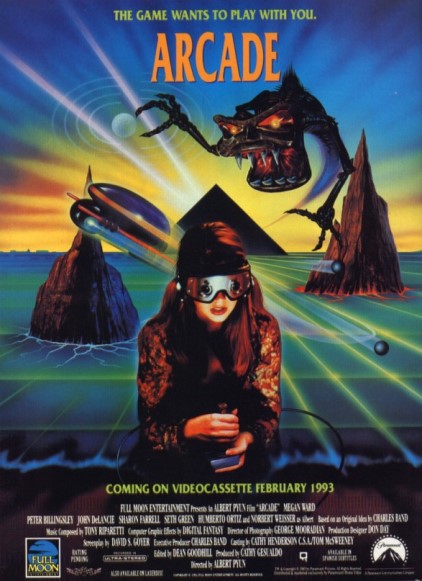 Alex (Megan Ward) is a suburban teen still trying to come to terms with the suicide of her mother. She and her friend, Nick (Peter Billingsley), spend all of their time hanging out at the local video arcade, Dante’s Inferno. (Symbolic name alert!) Also hanging out at Dante’s Inferno is a man (John de Lancie) who is desperate to find people willing to play what he says is the next step in the evolution of gaming. The game, which is simply called “Arcade,” is a virtual reality simulator and soon, all the teens want to play it!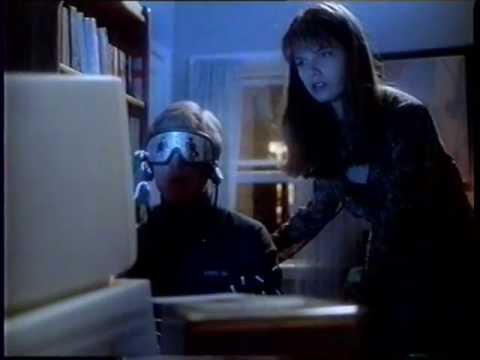

 Through the Shattered Lens