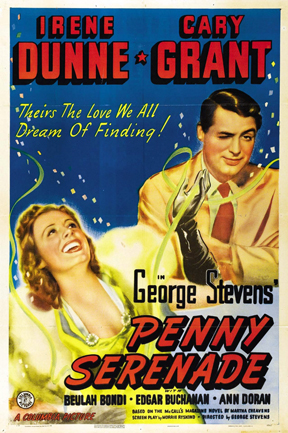
The Fabulous Forties #37: Penny Serenade (dir by George Stevens)


Penny_Serenade_1941_Poster

How many tears can be jerked by one tear jerker?

How melodramatic can one melodrama get?

These are the type of questions that I found myself considering as I watched the 36th film in Mill Creek’s Fabulous Forties box set, 1941’s Penny Serenade.

Penny Serenade opens with Julie (Irene Dunne) announcing that she’s planning on leaving her husband, Roger (Cary Grant).  Fortunately, before Julie goes through with her plan, she listens to a song called You Were Meant For Me.  Perhaps not coincidentally, the song is included on an album called The Story Of A Happy Marriage.  As she stares at the spinning vinyl, Julie starts to have flashbacks!

No, not flashbacks of the LSD kind.  (Though, interestingly enough, Cary Grant was reportedly a big fan of LSD…)  Instead, she has flashbacks of her marriage to Roger.  We see how she first met Roger while she was working in a music store.  Roger stopped by the store to tell her that a record was skipping and it was love at first sight.  However, Roger had no interest in getting married.  Or, at the least, he didn’t until Julie opened up a fortune cookie and read the fortune: “You get your wish — a baby!”

Julie continues to stare at the spinning record and we discover that eventually, she and Roger did get married.  Julie did get pregnant but, as the result of an earthquake, she lost the baby.  (Curse you, fortune cookie!  CURSE YOU!)  Meanwhile, Roger took over a small town newspaper and revealed himself to have absolutely no idea how to handle money.

Because of the earthquake, Julie will never be able to have a child.  (DAMN YOU, FORTUNE COOKIE!  DAMN YOU FOR YOUR LIES!)  However, they can still adopt!  She writes to Miss Oliver (Beulah Bondi), the head of the local orphanage.  Julie demands to be given a baby with “blue eyes and curly hair.”  Fortunately, Miss Oliver apparently has a surplus of curly-haired, blue-eyed babies but she’s still reluctant to approve the adoption.  After all, Julie is such a terrible housekeeper!  However, she is impressed by how much both Julie and Roger want a baby so Miss Oliver puts aside her concerns and allows them to have a baby for two years.

At the end of the two years, Roger and Julie have to go to an adoption hearing.  Unfortunately, the paper has gone out of business, the family has absolutely no money, and the fortune cookie has stopped giving advice.  Fortunately, Roger is Cary Grant and who can say no to Cary Grant?  Roger promises the judge that he’ll always love and take care of the baby…

But that’s not all!  The movie is not over yet.  And even as Roger makes his plea, we can’t help but think about the fact that this movie is being told in flashback and that present day Julie is still planning on leaving Roger.  Now, I’m not going to spoil the movie by going into why or revealing what happens in the end.  I’ll just say that it involves more tragedy and more melodrama.  In fact, it includes so much tragedy and so much melodrama, that it starts to get a little exhausting.  How much bad stuff can happen to Cary Grant!?

And the record just keeps spinning…because what goes up must come down, spinning wheel got to go round…

Over the course of his long career, Cary Grant only received two Oscar nominations.  Penny Serenade was his first nomination and, as a fan of Cary Grant’s comedies, it saddens me to say that Cary’s nominated performance really wasn’t that good.  Watching this film, you can tell that Cary felt that this was his chance to prove himself as a dramatic actor and, as a result, he acts the Hell out of every scene.  Of course, Cary’s undying popularity comes from the fact that he rarely seemed to be acting.  His charm was in how natural he was.  In Penny Serenade, he never seems natural.  He’s trying too hard and it’s just odd to see Cary Grant trying too hard.

If you want to see Cary Grant at his best, check out The Awful Truth.  Or maybe The Philadelphia Story.  Those are two great films that prove that Cary Grant was a great actor.  Even a rare misfire of a performance can’t change that fact.

Until next time…

Ride a painted pony, let the spinnin’ wheel spin. … Ride a painted pony, let the spinnin’ wheel turn.

Back to School #4: Rebel Without A Cause (dir by Nicholas Ray)


You may have heard of this one.

Traditionally, films about teenagers tend to age terribly.  The language, the clothes, the attitudes, and even the humor; it’s all usually out-of-date within five years or so.  One need only watch something like A Summer Place to both see how dated a film can become and to see how one generation’s idol can appear rather ludicrous to future generations.  (And yes, I am talking about Troy Donahue…)  What makes Rebel Without A Cause unique is that it’s a movie about teenagers that was released way back in 1955 and yet, nearly 60 years later, it still feels fresh and relatable.

Of course, it helps that the title character is played by James Dean who, to put it lightly, was no Troy Donahue.

Rebel Without A Cause tells the story of three alienated teenagers trying to survive in the suburbs of Los Angeles.  (“…and they all came from good homes!” the film’s poster informs us.)  Plato (Sal Mineo) is a painfully sensitive 15 year-old who has been abandoned by his parents and is being raised by the family’s maid.  (Since this movie was made in 1955, the fact that Plato is gay is obvious but never explicitly stated.)  Judy (Natalie Wood) is the girlfriend of Buzz (Corey Allen) and is acting out because she feels that’s the only way she can can get her father to pay attention to her.  And then there’s Jim Stark (James Dean), whose family has just moved to Los Angeles and who is constantly in the middle of the fights between his overbearing mother (Ann Doran) and his weak-willed father (Jim Backus).

Rebel Without A Cause 2

During Jim’s first day at high school, he not only manages to make an enemy when Buzz spots him attempting to flirt with Judy but he also gets to go on a field trip to the Griffith Observatory, where the students are told that the entire universe is going to end eventually.  After the field trip, Buzz challenges Jim to a knife fight.  Jim agrees only after the rest of Buzz’s gang (including a young Dennis Hopper) accuse him of being “chicken.”  However, after a security guard breaks up the fight, Buzz challenges Jim to a “chicken run.”

(People in the 50s were obsessed with chickens.)

That night, Jim and Buzz both drive stolen cars towards the edge of a cliff.  The first driver to jump out of his car loses.  Before they start their engines, Buzz smiles and tells Jim, “I like you.”  Yay!  Jim’s finally made a friend!  Uh-oh, Buzz just drove over the cliff and his car exploded!  Well, so much for that friendship.  Now, with Buzz’s gang swearing revenge and their parents incapable of understand what happened, Jim, Judy, and Plato are on the run.  They end up hiding out in an abandoned house and find a brief moment of happiness before the gang and the police show up to ruin everything.

NW-nataliewood-rebel-love

The challenge of reviewing Rebel Without A Cause is trying to find a new way to say what everybody already knows.  Rebel Without A Cause is a great film that’s distinguished by Nicholas Ray’s sensitive direction and James Dean’s iconic performance in the lead role.  Whenever I see Rebel Without A Cause, I’m always struck by just how much unexpected nuance there is Dean’s interpretation of Jim Stark.  We always think of James Dean as being the epitome of cool and I think we tend to forget that, at least in the beginning of the film, Jim is anything but that.  Instead, he’s awkward and shy.  His attempts to flirt with Judy lead to her calling him “a real yo-yo.”  As much as he tried to fit in with the rest of his classmates, he’s a permanent outsider.  (Just consider what happens with his infamous “moooo” during the presentation at the observatory.)  He has a lot to say but he doesn’t know how to say it and every time that he tries to express what he’s feeling, he’s ignored by adults who don’t have the patience to listen.  Dean brings such a raw intensity to these scenes that I always find myself wanting to reach out and hug him and tell him that everything’s going to be okay, even though I know that it’s not.  Even today, it’s still easy to see why every teenager in the 50s either wanted to be or to be with Jim Stark.

Also, whenever I watch the film, I’m reminded of how much I relate to the character of Judy.  I think that’s because, when I was 16, I might as well have been Judy.  Natalie Wood’s performance might not be as showy as James Dean’s but it’s equally effective.

Of course, one reason why Rebel Without A Cause has become iconic is because James Dean died shortly after filming ended.  (In fact, some of his scenes had to be redubbed by Dennis Hopper, who reportedly could do an exact imitation of Dean’s voice.)  It’s interesting to wonder what would have become of James Dean if he had lived.  Would he have continued to be one of our best actors or would he have eventually been forgotten or forced to appear on television?  Personally, I like to think that James Dean would have remained a great actor but he would have been too much of an iconoclast to remain in Hollywood.  Eventually, in my alternative universe, James Dean moved to Europe and teamed up with Klaus Kinski to star in a series of spaghetti westerns.  And they were great.

As for Rebel Without A Cause, it remains a great movie nearly 60 years after it was first made.  And really, what more needs to be said?

Rebel