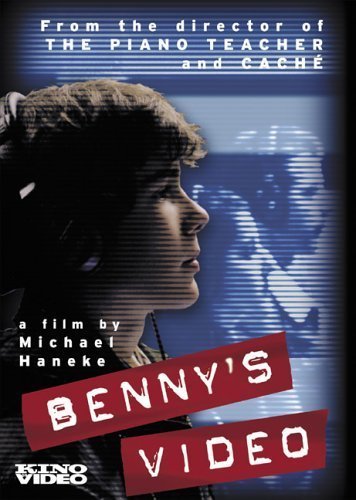
Back to School Part II #27: Benny’s Video (dir by Michael Haneke)


bennysvideo

For our next film in this Back to School series of reviews, let’s take a look at the 1992 Austrian film, Benny’s Video.  It’s a dark and disturbing film about murder and the death of morality.

“A disturbing Austrian film about murder and the death of morality?!” you’re saying, “What is this!?  A Michael Haneke film!?”

Well, as a matter of fact, it is.  Benny’s Video was Haneke’s second film and one of the interesting things about it is that it reveals that, even this early in his cinematic career, Haneke was already a master at telling stories about characters estranged from society.  Benny’s Video is remarkably assured film but it’s also one that is so disturbing that you may never want to watch it for a second time.

Benny is a an affluent teenager.  He’s obviously intelligent and he has friends but, from the minute we meet him, we can tell that there is something off about Benny.  Maybe it’s the flat monotone that he uses to express his thoughts.  Maybe it’s the cold and rather pitiless look of his eyes and the way that Benny always seems to be on the outside observing his family and friends.  Or maybe it’s the fact that, when we first meet Benny, he is obsessively watching and rewatching a video of pig being slaughtered with a bolt pistol.

When his parents go out of town for the weekend, Benny meets a girl (Ingrid Stassner) outside a video store.  He brings her back to his house and, while his own cameras record the action, Benny shows her the footage of the pig being slaughtered.  He tells her that he’s never actually seen a dead body but he knows “the tricks they use in action films” to make someone appear dead.  He then shows her that he has a bolt gun of his own.  As opposed to what happened to the pig, it takes three shots from the bolt gun to kill the girl.

Benny, who seems to be as confused by his actions as we are, puts the body in a closet and then goes out to a club.  He sees a movie.  He visits with friends.  He gets his head shaved.  And when his parents return home and snap at him for his new haircut, he shows them the video of him killing the girl.

Amazingly enough, the murder is not the most disturbing part of the film.  What’s far more disturbing is the way his parents react.  After sending Benny to his room, they sit at the kitchen table.  Benny’s father (Ulrich Muhe) starts to calmly discuss their options and points out that, if Benny’s crime is discovered, they could be held responsible.  Benny’s mother (Angela Winkler) is much more shaken by Benny’s crime.  When, in a state of shock, she starts to giggle at her husband’s dispassionate demeanor, he snaps at her to remain calm…

And, seriously, it is so disturbing to watch!  Haneke directs the film in an understated, almost documentary-like fashion and Arno Frisch gives a performance that somehow manages to be both compelling and soulless at the same time.  Benny remains a mystery to not only his parents and the audience but to himself as well.  Much like Gus Van Sant’s Elephant, Benny’s Video invites us to consider the enormity of a destructive act without offering any easy answers as to why the act happened in the first place.

Benny’s Video is a powerful film that will stick with you and one that shows that, even early in his career, Michael Haneke was a cinematic force to be reckoned with.

 

Playing Catch-Up: Clouds of Sils Maria (dir by Olivier Assayas)


Clouds_of_Sils_Maria_film_poster

It’s a little bit disheartening, to be honest, to see the lack of attention that has been given to Clouds of Sils Maria.  Kristen Stewart has picked up a lot of awards for her supporting performance and she might even get an Oscar nomination on Thursday but otherwise, the film has been ignored and that’s a shame.  Last year, it was one of the best films to be released here in the States.

Of course, it’s difficult to talk about Clouds of Sils Maria without also talking about Maps To The Stars.  After all, both films premiered at the 2014 Cannes Film Festival and both of them deal with an aging actress struggling to remain relevant in an industry that prizes youth above all else.  The main difference between the two is that Clouds of Sils Maria is a great movie while Maps To The Stars is a pretentious mess.  And yet, when initially released, Maps To The Stars was the more critically acclaimed of the two films.

Why was that?

I imagine it has something to do with the fact that Clouds of Sils Maria demands a certain amount of intelligence on the part of the audience.  Whereas there’s neither a subtle moment nor an unexpected detail to be found in Maps To The Stars, Clouds of Sils Maria rewards repeat viewing.  Clouds of Sils Maria invites the audience to ponder its mysteries and it does so without spelling anything out.  Clouds of Sils Maria is all about nuance and, as such, it’s not exactly the ideal film for critics who make their living off of clickbait.

As for what the film is about, it tells the story of Maria Enders (Juliette Binoche), a world-famous stage and screen actress.  20 years ago, Maria became a star when she appeared in both the theatrical and the film versions of Maloja Snake.  Maria played the role of Sigrid, a callous young woman who seduces a middle-aged, bourgeois woman named Helena.  When Sigrid eventually abandons Helena, the older woman is driven to suicide.  Though she is now closer in age to Helena, Maria continues to think of herself as being Sigrid.

When the writer of Maloja Snake dies, Maria is offered a chance to appear in a new stage production.  However, this time, she will be playing Helena and a young American actress named J0-Ann Ellis (Chloe Grace Moretz) will play Sigrid.  (Jo-Ann is better known for her scandalous private life than her acting.  Moretz appears to have a lot of fun playing the Lindsay Lohanesque Jo-Ann.)  At first, Maria does not want to play Helena.  She dismisses the role as being boring and says that she cannot see herself playing such a “normal” character.  (As well, Maria is haunted by the memory of the death of the actress who originally played Helena opposite Mara’s Sigrid.)  Even after Maria is finally convinced to take on the role, she continues to insist that she’s not right for it.  As quickly becomes apparent, it’s not so much the role that upsets Maria but what the role represents.  By playing Helena, Maria will be admitting that she is no longer the invulnerable Sigrid.

In order to rehearse, Maria retreats to a remote cabin in the Alps.  Accompanying her is Valentine (Kristen Stewart), her assistant.  At first, it seems that Val and Maria have an almost sisterly relationship but it quickly becomes obvious that the out-of-touch Maria is largely dependent on Val for any information about the outside world.  (Maria has to be constantly reminded that she can google any information she needs.)  Despite needing her, Maria occasionally talks down to Val (especially after learning that Val thinks Jo-Ann is a good actress and that Val likes a sci-fi film that Jo-Ann has appeared in) and Val occasionally seems to be annoyed with Maria’s neediness.

In the Alps, Maria continues to try to learn Helena’s role and, as the weeks pass, her line readings go from awkward to natural.  Reading opposite her, in the role of Sigrid, is Val and, often times, it’s difficult to distinguish between the play and reality.  How much of Val and Maria’s relationship is real and how much of it is just a rehearsal?

Clouds of Sils Maria is a visually stunning film, one of that is fully mystery and beautiful images.  Even more importantly, it’s a film that features three strong roles for three talented actresses, all of whom do some of their best work.  Clouds of Sils Maria did not get the attention that it deserved when it was first released but it’s never too late to discover a good movie.

http://www.youtube.com/watch?v=5L-9rcEhGm4