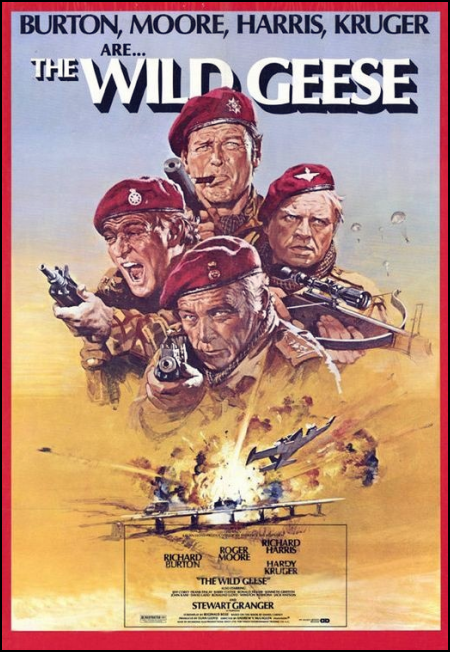
1978’s action war film The Wild Geese is an adaptation of Daniel Carney’s unpublished novel about a group of mercenaries on a mission during the turbulent revolutionary times that beset Central Africa during the 1960s and early 70s. The film features an all-star cast of British actors, a true who’s who of the era. Under the direction of Andrew V. McLaglen, The Wild Geese manages to be an action-packed and well-told film with memorable performances.
The character Colonel Allen Faulkner, played by Sir Richard Burton, is loosely based on the real-life mercenary legend Michael “Mad Mike” Hoare. Hoare not only inspired this central character but also served as the film’s military and technical advisor. Adding to the film’s authenticity, one of the actors portraying a mercenary, Ian Yule, had served with Hoare in his mercenary company. This infusion of real-life experience gives the film a vivid sense of art imitating life and lends credibility to its portrayal of mercenary warfare.
The story begins with a meeting between Faulkner and British banker Sir Edward Matheson about a rescue mission in the fictional Central African nation of Zembala. The first third follows Faulkner’s recruitment of a 50-man mercenary team, including his reluctant old friend Rafer Janders (Sir Richard Harris). The film portrays the mercenary company training and preparing for the mission before being inserted behind enemy lines. The second half details the rescue of their target: a deposed African leader about to be executed by the man who overthrew him.
During the second third of the film, the action intensifies. Though tame by today’s standards, the sequences were energetic and well-shot for their time. The mercenaries are shown not as idealized heroes but as pragmatic soldiers who use ruthless tactics—such as cyanide gas and poisoned crossbow bolts—that may shock modern audiences. This realism reflects Hoare’s influence and presents mercenaries as professionals doing a dangerous job for pay, blurring the moral lines of warfare. Betrayal during the mission tests their survival in enemy territory.
Burton and Harris deliver excellent performances as hardened war veterans, while a younger Sir Roger Moore adds roguish charm as the Irish pilot Shaun Fynn. Strong supporting roles include Hardy Kruger as Pieter Coetzee, an initially racist Afrikaner who gains new perspective on the continent’s upheaval, and Stewart Granger as the principled banker Matheson.
Though relatively small budgeted compared to other war epics of the era, The Wild Geese carries an epic feel and should have appealed more to American audiences. Unfortunately, financial difficulties with the production company affected its U.S. release. Over time, video and DVD releases built it a cult following among war and mercenary film fans, a subgenre often dominated by lesser films. McLaglen’s straightforward direction keeps the film’s pacing steady, and the story balances action with political and philosophical themes in its final act.
The Wild Geese stands as a rare gem in war cinema that delves into a little-known subgenre. With strong performances by knighted British actors, a former Hitler Youth, and real-life mercenaries as extras, the film distinguishes itself from the many flawed war movies flooding late-70s and early-80s cinema. Its roots in actual mercenary experiences, highlighted by Hoare’s real-life involvement and character inspiration, make it a compelling and underappreciated classic for aficionados of the genre.
 Through the Shattered Lens