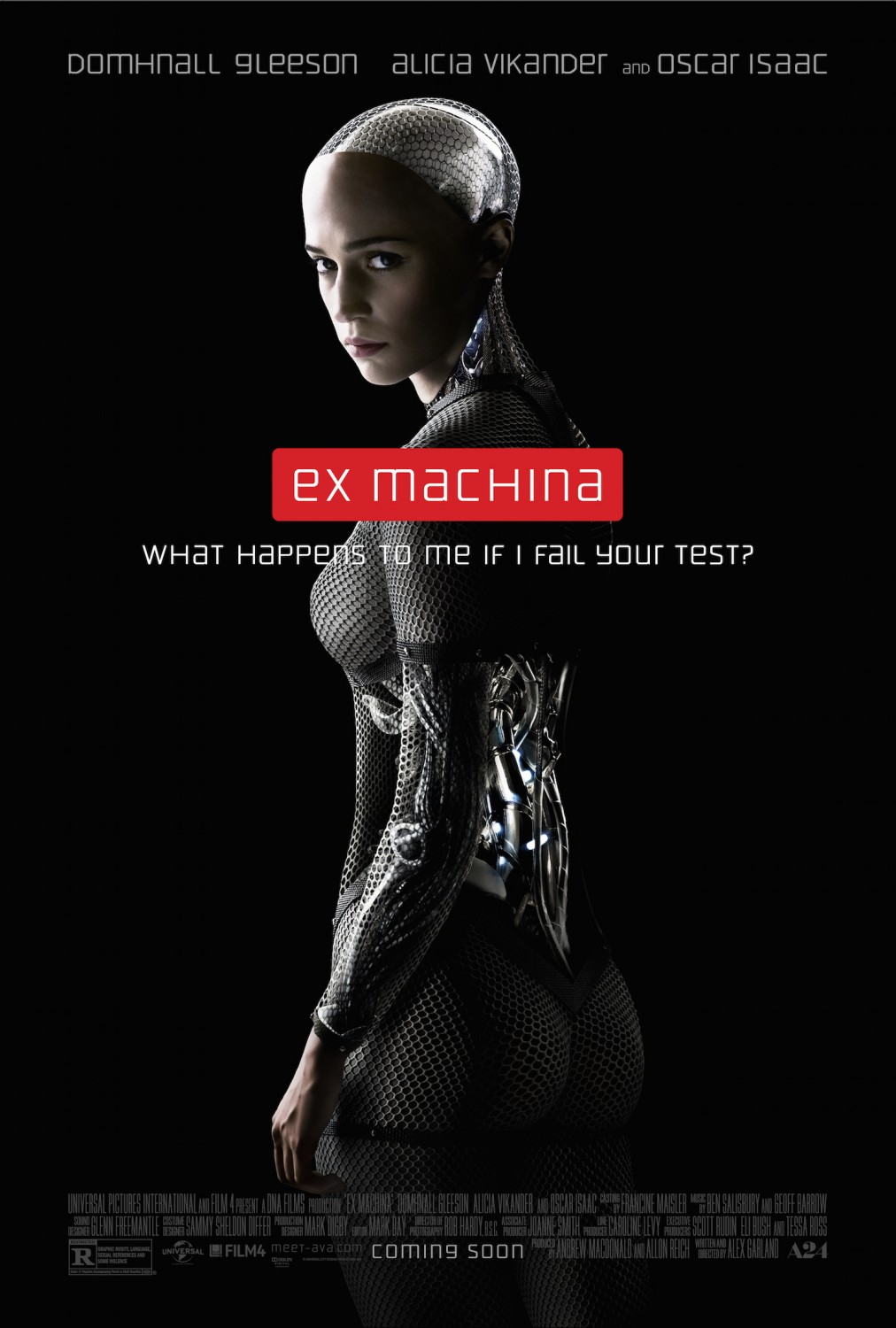
‘Ex Machina’ – the directorial debut of writer Alex Garland (‘Sunshine’, ’Dredd’) – had been on my radar for awhile. Like with ‘Interstellar’ and my interest in astronomy and astrophysics – I have a similar level of interest in A.I. and the Singularity that drew me to this project. Good A.I. films are hard to come by. Last year we did have ‘The Machine’ which was very good – but even then that was offset by ‘Transcendence’…that sound you just heard? Me gagging. So when I learned about ‘Ex Machina’, it wasn’t Oscar Isaac’s beautiful mug that caught my attention – or it being Alex Garland’s directorial debut – but rather the plot, the subjects and themes I knew it might explore. So I went in with high hopes but loads of caution and I am happy to report that the film succeeds on multiple levels. It is a dark, sleek, sensual, thought provoking and visually mesmerizing sci-fi thriller. It is the sort that requires your full attention – but rewards it with one of the smarter and more intense movie going experiences so far this year.
The film stars Dohmnall Gleeson (‘Frank’) as Caleb, a good-natured young programmer who wins a contest to spend a week at the luxurious mountain estate of his brutish and brash boss Nathan, played by Oscar Isaac (‘A Most Violent Year’). After an awkward exchange of pleasantries, Caleb is told that he was brought out to the middle of this mountain getaway – which is actually a makeshift research facility – to be the human element in a Turing test. Nathan has built an A.I. named Ava (played by Alicia Vikander of ‘A Royal Affair’), and wants Caleb to devise tests and to interact with her to see whether or not she possesses a truly conscience artificial intelligence. The prospect of being part of such a groundbreaking program excites Caleb – who is blown away by Ava. However, as power cuts hit the facility – and Nathan’s eradicate behavior and potential secret motive becomes more evident – Caleb begins to question the true intentions of his being there.
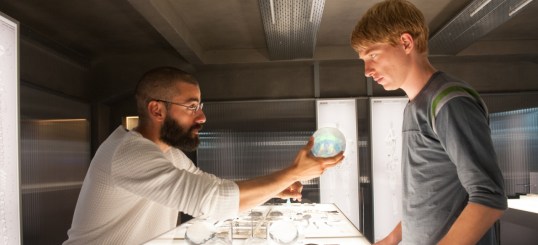
Now, I must stop you dear readers right here if you haven’t seen the film to say that I can’t go into much further detail explaining the events of the film, and the themes it explores, because it would spoil the experience. The film contains a ton of organically created twists and turns, and so giving away too much of the plot removes the initial suspense and shock that comes with the proceedings that follow Caleb’s first interactions with Ava. So I will start by going over some of the technical stuff and end with a more spoiler filled analysis for those that wish to read it. But if you want to go in totally cold, stop reading now and just get your butt into the theater…
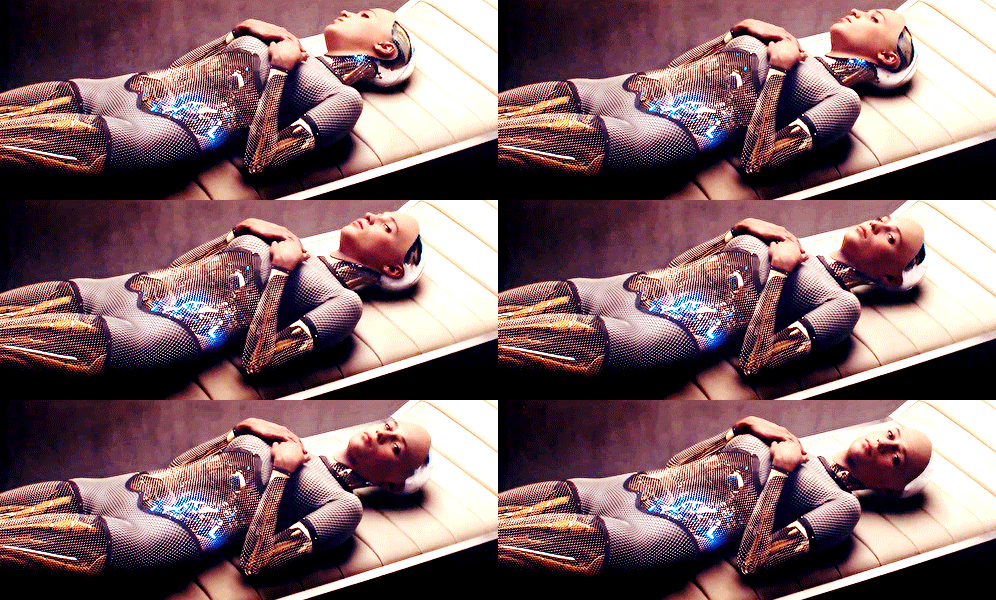
But if you want a reason why you should – without it being spoiled – I’ll start be saying the acting here is top notch and Gleeson and Isaac do a wonderful job…but it was the absolutely mesmerized performance by Alicia Vikander as Ava, who I had never seen before, that blew me away. Vikander has such a wonderfully expressive face and brilliantly evoked a sense of innocence and curiosity – but also an intelligence and intuition – you would expect such a machine to have. It was made all the more impressive given that it was a very physical performance and so much is expressed simply with slight turns of the head or side glances. Vikander, who has a background in ballet, even gave Ava a walk and posture that was robotic but also fluid. The character is all the more extraordinary given the design, which was gorgeous and unique. Much of the body is a gray mesh with a visible inner skeleton of brightly lit tubes and machinery – making her figure seem at times incredibly human in the right lighting – but also very clearly mechanical when viewed up close. All of this giving weight to the way in which both the viewer and Caleb view Ava.
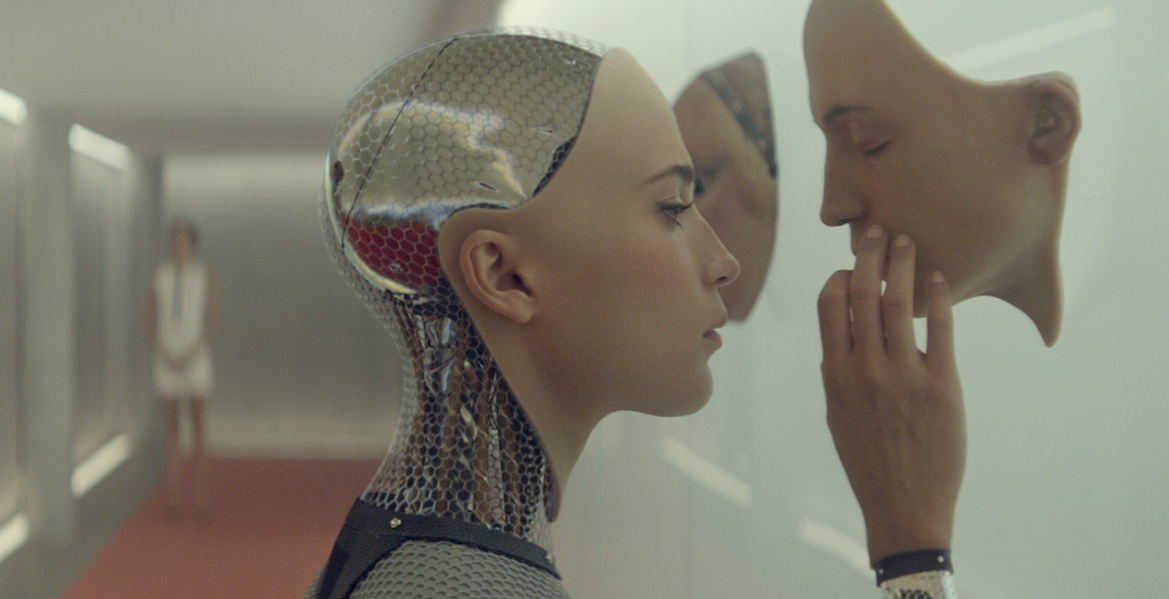
Speaking of gorgeous, the visuals – and not just the seamless CGI – are stunning. Tons of great juxtapositions of bright color against dark grays and blacks – neon reds and blues are sort of my thing – and they are used throughout. The cinematography was also really great and gives the sense that there is a meaning to almost every frame. The production design and set locations also lent a hand in giving the film a futuristic and almost dreamlike quality.
The script – trying not to be too hyperbolic – is quite genius. This is a very smart film with literary and mythological quotes and references – along with fascinating discussions of the human mind, human interaction, emotions, sexuality, etc. As I mentioned early on this is a film that can really only be fully appreciated with a little work on the end of the viewer to stick with the themes being explored, pay attention to the science involved – and doing a little bit of thinking of their own – to interpret how they all play into what is going on.
Last but not least, I would be remiss to not mention the hypnotic score by Geoff Barrow and Ben Salisbury, which was a perfect mood setter and had some truly awesome music cues. It just all adds up to a damn near perfect package – and a sci-fi thriller that feels unique and unlike anything before it.
I’ll end this part of the review by saying that it is hard to know this early on where this will ultimately fall amongst the other releases this year but I’d be very surprised if ‘Ex Machina’ doesn’t end up in contention for my favorite film of the year. Nothing so far released measures up – besides maybe ‘It Follows’ – and given my bias towards the subjects at hand this is one that will stick with me for a while. Hell, I’ve already seen it twice and wouldn’t hesitate to see it again – and my obsession has led me to read a lot into it (see below once you’ve seen the film). All I can say is just see it at least once. It isn’t for everyone and can be at times downright bizarre – but never boring. If only more science fiction films were this good.
***** Spoilers Follow *****
So I will assume you’ve already seen the film if you are reading this. So…good right?! No? Get out! But seriously, how about that ending? And what did it all ultimately means? Well the events of the film, especially the ending, are open to much interpretation. Even Gleeson and Garland hold different views. What did I think? Personally, I believe that what happened in that facility – as it did on Discovery One in ‘2001: A Space Odyssey’ – was perhaps a depiction of the final step in human evolution. In this case, the final battle between nature and nurture – the free thinking and the analytical. It wasn’t man vs. machine like Kubrick’s film, but rather the irrational fears, insecurities and inherent weaknesses of human emotion that led to the downfall of man – as the two sides battled and outdid each other – and gave rise to a more intelligent, restrained and arguably more deserving life form in Ava – who is ultimately the result of both Nathan’s brute nature and Caleb’s empathy driven nurturing. I think this idea of the ‘changing of the guard’ so to speak is expressed brilliantly in the way in which the film opens with a single human entering the facility and ends with an A.I. leaving. Garland admitted he almost named the A.I. Eve but felt that was too blunt. But it is fitting – she is the first of her kind – at least in regards to her level of intelligence and conscience. Her leaving the facility can be seen as her back in the garden…and one can only imagine what happened once she left.
Someone might still ask why she leaves Caleb, and for that I couldn’t help but think of ‘Stoker’. The moment when Ava put on the skin – which was a very coming of age sort of act – reminded me of when India received the high heels from her uncle. Like with that scene in Park’s film, I saw the aforementioned scene with Ava as her entry into “womanhood” – and with that was possibly a realization and new outlook that came with her sudden maturity – as it did with India. A realization of no longer needing Caleb who – though a nice guy – was still restricted by his human urges and faults. He still saw Ava as an object, lusting for her with his hand on the glass as she changed. He wasn’t a threat, and didn’t deserve to die like Nathan – but she wasn’t going to take him with her. After all, like Samantha in ‘Her’, she was much too complex and – lets be honest – far too superior to fall in love with a human. I personally don’t think Caleb dies. I’ll take a more optimistic approach and say he finds a way out.
One reasons I take this stance, and defend Ava, is that I have never bought into the idea of A.I. being a threat to mankind – even with leading scientist and inventors like Hawking and Musk warning about their potential threat. I think we should be much more concerned with ourselves. A lot of the fear over A.I. is simply humans reflecting our own faults onto this potential new form of life. We see our own vulnerability, anger, greed, etc. and assume that an A.I. would end up with those same aspects – but only with a greater intelligence and capability to destroy. But although I think a truly conscience A.I. would experience emotion – they’d also be able to apply a logic to them that humans can’t. We are often overcome and blinded by how we feel – and I think an A.I. could better process what often destroys us. Ava might not be perfect, but I found a logic and justification in what she has done.
But that is just my view. Many have come up with other theories – such as it being a battle of the sexes, or a classic femme fatale and noir scenario – and it is definitely a bit of both. But, no matter how you view it, the simple fact that is leads to such discussion and analysis – while still feeling so complete and utterly enjoyable – just elevates it in my mind.

 —-
—- Through the Shattered Lens