Che Guevara!
By most accounts, Che Guevara epitomized the excesses and the hypocrisies of the extreme Left. He spoke of the class struggle while remaining an elitist himself. He oversaw thousands of executions and advocated for authoritarian rule. In his writings, he frequently revealed himself to be a racist and a misogynist. By arguing that the Russians should be allowed to bring nuclear missiles to Cuba, he brought the world to the brink of destruction. However, he also died relatively young and he looked good on a t-shirt. Decades after he was executed by the Bolivian Army in 1967 (or was it the CIA?), he remains an icon for college students and champagne socialists everywhere.
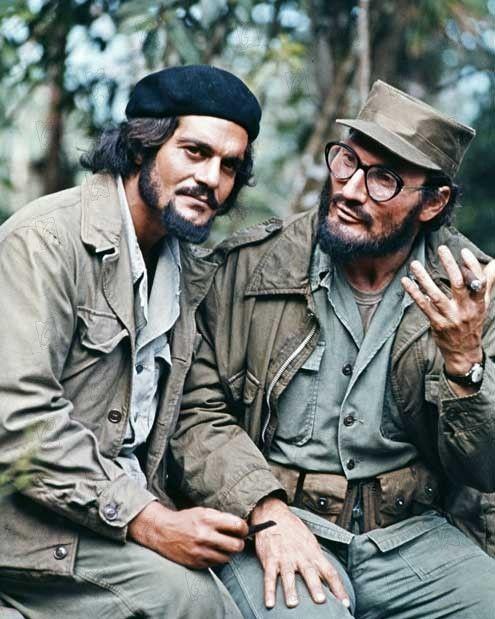
The film about Che! was released in 1969, two years after his death. Starring the Egyptian actor Omar Sharif as Che Guevara, Che! opens with Guevara already a martyr and then quickly gives way to flashbacks. Various actors pretending to be Cuban appear and speak directly to the audience, debating Che Guevara’s legacy. Some describe him as being a violent thug who killed anyone who displeased him. Others describe him as a visionary doctor who sacrificed his comfortable existence for the people. It’s a rather conventional opening and one that hints that Che! is going to try to have it both ways as far as Che’s legacy is concerned. But it’s still effective enough. A montage of soldiers and rebels creates the proper feeling of a society on the verge of collapse.
And then Jack Palance shows up.
Palance first appears creeping his way through the Cuban jungle with a group of soldiers behind him. Palance is chomping on a cigar and he wears the intense look of a man on a mission. My initial reaction was that Palance was playing one of the CIA agents who sent to Cuba to try to assassinate Fidel Castro or to set up the Bay of Pigs invasion. I kept waiting for him to look at the camera and launch into a monologue about why, for the safety of America, he had been dispatched the topple Cuba’s communist government. Imagine my shock when Omar Sharif called Palance, “Fidel.”
Yes, that’s right. Jack Palance plays Fidel Castro! As miscast as the suave Omar Sharif is as Che Guevara, nothing can prepare one for seeing Jack Palance playing Fidel Castro. Needless to say, there is nothing remotely Cuban or even Spanish about Jack Palance. He delivers his lines in his trademark terse Jack Palance voice, without even bothering to try any sort of accent. (And, needless to say, both he and Sharif speak English through the entire film.) Anyone who has ever seen a picture of a young Fidel Castro knows that, while he shared a family resemblance with Justin Trudeau, he looked nothing like Jack Palance. Eventually, Palance puts on a fake beard that makes him look even less like Castro. When one of our narrators mentions that Castro was a great speaker, the film cuts to a scene of Palance spitting out communist slogans with a noted lack of enthusiasm. When Castro takes control of Cuba, Palance looks slightly amused with himself. When Che accused Castro of selling out the revolution, Palance looks bored. It’s a remarkably bad piece of casting. Seeing Palance as Castro feels like seeing John Wayne as Genghis Khan. Thank goodness Hollywood never tried anything that silly, right? Anyway….
As for the rest of the film, it hits all the expected notes. The film was made in the very political year of 1969, a time when the New Left was ascendant and many considered Che Guevara to be a hero. However, since this was a studio production, Che! tries to appeal to both college radicals and their parents by taking a “both sides” approach to Che Guevara. Here’s Che teaching an illiterate farmer how to read. Here’s Che overseeing a bunch of dissidents being executed. Here’s Che getting angry at Castro for not being properly enthusiastic about housing Russian nuclear missiles. Here’s Che talking about a moral revolution. Here’s Che trying to start an unwanted war in Bolivia. Here’s Che talking to Sid Haig — hey, Sid Haig’s in this film!
Like so many mainstream political films of the 60s and today, Che! tries to be political without actually taking any firm positions. One is tempted to say that is the film’s downfall. Of course, the film’s real downfall is casting Jack Palance as Fidel Castro.
There’s no way to recover from that.

 Through the Shattered Lens