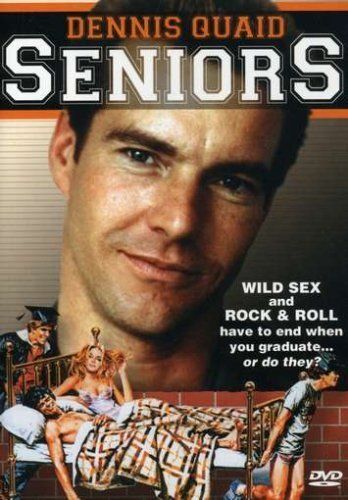
 Four college seniors (including one played by Dennis Quaid) are upset at the prospect of graduating, having to get real job, and losing Sylvia (Priscilla Barnes), the mute nymphomaniac who lives in their house with them and does all the cleaning and cooking. They decide that the best way to avoid getting a real job is by setting up a fake company called Phantom Research. They apply for and get a grant to study female sexuality, which essentially means that they pay the girls on campus to have sex with them. Before you can say Risky Business (which was actually released years after this film), they expand their operations, get involved with some crooked businessmen, and nearly lose their lives. It’s a comedy.
The Seniors is one of those films that used to come on television frequently when I was a kid. I remember watching it when I was 12 and enjoying it, mostly because I was a stupid kid and I was at that age where any film about sex seemed clever and hilarious. I recently rewatched it and discovered that there was only one funny bit and that was about a nerdy research assistant named Arnold (Rocky Flintermann) who helps out the seniors in return for them setting him up with Sylvia. Throughout the film, the formerly virginal Arnold gets laid so often that he loses the ability to walk and then he dies. Ha ha. The rest of the film is just dumb. The problem is that the film wants to be a raunchy, Animal House-style comedy but it was written by Stanley Shapiro (who previously wrote Doris Day comedies) and directed by Rod Amateau, who had previously directed several episodes of Gilligan’s Island. Their style is all wrong for the material.
The film’s opening credits announce that it stars, among others, Ryan O’Neal, Clint Eastwood, and Charles Bronson. A cartoon professor then walks out and announces that, “All of these big stars! None of them are in this film!” That’s too bad. I would have liked to have seen some of those stars in this movie. I think Eastwood would have told the seniors to get jobs and stop exploiting Sylvia. Bronson would have blown away the entire operation but Ryan O’Neal probably would have been cool with it all.
O’Neal, Eastwood, and Bronson are not in the film. Dennis Quaid is, though he probably doesn’t brag about. Edward Andrews and Ian Wolfe both have minor roles as corrupt businessmen who help fund Phantom Research. Alan Reed, the voice of Fred Flinstone, plays a professor. This was his last performance before his death.

 Through the Shattered Lens